Weed Barrier Calculator
Estimate landscape fabric area, roll length, staples, seam overlap, end anchoring, waste, and planting holes for bed or row layouts.
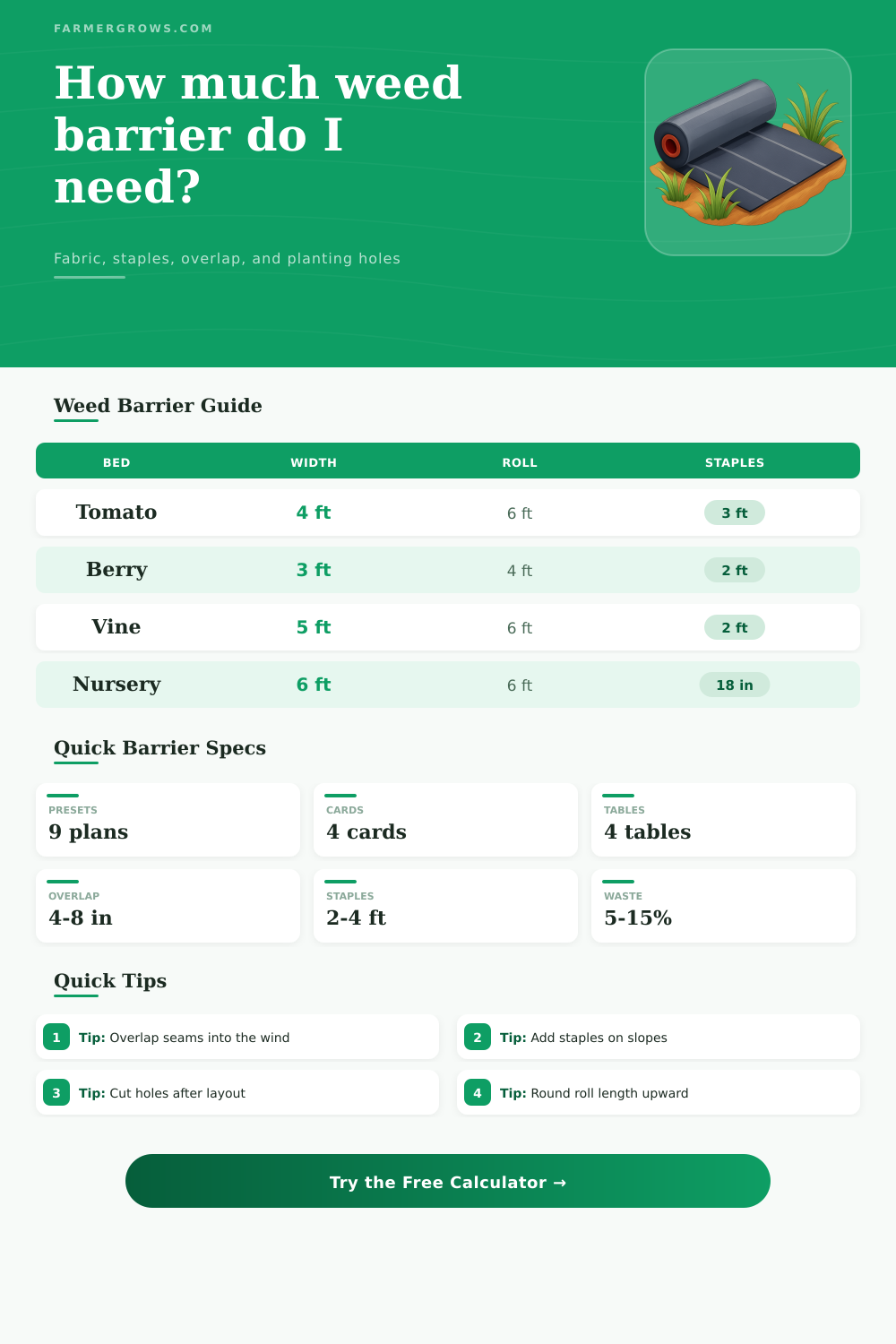
| Roll width | Best fit | Overlap note | Typical use |
|---|---|---|---|
| 3 ft | 30 in bed | Usually one pass | Herbs, berries, paths |
| 4 ft | 36-42 in bed | Leave edge tuck | Tomatoes, peppers |
| 6 ft | 48-60 in bed | One pass for wide beds | Squash, nursery rows |
| 12 ft | Large bays | Fewer seams | Greenhouse and nursery blocks |
| Site condition | Staple spacing | End anchoring | Waste buffer |
|---|---|---|---|
| Flat sheltered bed | 3-4 ft | 6-12 in | 5% |
| Open windy plot | 2-3 ft | 12-18 in | 10% |
| Sloped row | 18-24 in | 18-24 in | 15% |
| Nursery traffic | 12-18 in | 18 in | 10-15% |
| Crop pattern | Hole spacing | Lanes | Layout note |
|---|---|---|---|
| Tomato or pepper | 18-24 in | 1-2 | Cut X holes after drip line |
| Strawberry | 12-15 in | 2-4 | Offset lanes for canopy fill |
| Blueberry | 48-60 in | 1 | Use wider holes for mulch rings |
| Cut flowers | 6-12 in | 3-5 | Use a dibble board template |
| Formula | What it estimates | Calculator method | Why it matters |
|---|---|---|---|
| Passes | Fabric strips per row | ceil((bed width - roll width) / (roll width - overlap)) + 1 | Prevents underbuying wide beds |
| Roll length | Linear fabric to buy | passes x rows x (length + 2 end anchors) x waste | Matches how rolls are sold |
| Overlap area | Fabric buried in seams | (passes - 1) x overlap x cut length x rows | Shows hidden material use |
| Holes | Plant openings | rows x lanes x (floor(length / spacing) + 1) | Plans planting and burn holes |
Landscape fabric is a material that is used to cover the soil in your garden beds and to prevent weed from growing up through the soil. In order to determine the amount of landscape fabric that you will need to purchase, it is necessary to calculate how much landscape fabric you will need. If you dont calculate the amount of landscape fabric that you need, you may either find that you do not have enough landscape fabric to cover all of your garden bed, or that you will have too much landscape fabric that you will waste after you install the landscape fabric.
The weed barrier calculator will help you to determine the amount of landscape fabric that are required for your garden beds, based off the dimensions of your beds and the specifications for landscape fabric. Before beginning to install the landscape fabric into your garden beds, you must first determine the width of your planting bed. The width of your planting beds will determine the number of passes that you will have to make in laying down landscape fabric.
How to Measure Landscape Fabric for Your Garden
For example, if you are establishing a single row of blueberry plant, you can establish a narrow strip of landscape fabric. If, however, you are establishing double row of tomato plants, your landscape fabric strip will need to be wide enough to allow for the growth of those tomato plants. If the width of your garden bed is more greater than the width of the landscape fabric strip, multiple strips will have to be laid down.
When laying down multiple strips of landscape fabric, you will need to ensure that the strips are overlapped to prevent weeds from growing through the landscape fabric strips. The overlap that is created between strips of landscape fabric is critical in ensuring that the landscape fabric will remain secured in place. If the overlap is too narrow, weeds may grow through the overlap, as well as the wind may easily pull the landscape fabric away from the soil.
When using the landscape fabric calculator, you can enter the desired width of the overlap to determine how much extra landscape fabric will be buried under the overlap. This buried landscape fabric will help to secure the landscape fabric strips together, preventing the soil from being wash under the overlap during periods of rainfall. In addition to burying landscape fabric strips at the ends of the rows of plants to which the strips will be anchored, you must also ensure that the landscape fabric is anchored into the ground at each end of the rows.
You can tuck the landscape fabric into the soil along each end of the row to prevent the landscape fabric from being pulled from the ground. The landscape fabric calculator will calculate the length of landscape fabric necessary to provide for the amount of landscape fabric that will be buried at each end of each row. This anchoring of the landscape fabric strips is critical on slope in particular, as the landscape fabric may otherwise be pulled down the slope due to the gravitational pull of the earth.
To account for this, more staples will be required along the slope of the ground, as will an increased buffer for the landscape fabric strip. The location of the planting hole in the landscape fabric will also impact the way that you use the landscape fabric. The spacing of the planting holes will depend upon the type of crop that you are planning to grow in those planting beds, as well as your preferences in how you would like to work the ground in your garden.
For instance, strawberry plant will require more closely spaced planting holes than blueberry bushes, as the blueberry bushes require space to develop mulch rings around the bases of the bushes. Most garden growers will install the landscape fabric and drip irrigation line prior to creating the planting holes in the landscape fabric strips. Many individuals make mistake when installing landscape fabric in garden beds.
For instance, they may treat the installation of landscape fabric as if it is a flat rectangle of landscape fabric to be install into the garden bed. However, extra landscape fabric will be required to cover the seams of the landscape fabric strips. Additionally, individuals may not account for the width of the landscape fabric roll.
If the landscape fabric roll is narrow, more landscape fabric seam will have to be created than if the landscape fabric roll is wide. Each of these seams will require extra landscape fabric to be laid in place to secure the landscape fabric strips to one another. In addition to calculating the amount of landscape fabric that will be required for your garden beds, you should also provide for a waste allowance for the landscape fabric.
This waste allowance will be provided for any trimmings that may develop around the drip irrigation head, as well as for any tear in the landscape fabric that may occur during installation. Depending upon the type of garden bed that is to be established, the waste allowance may be five percent for flat and sheltered garden beds, but may be between ten and fifteen percent for open or sloped site. The percentage for the landscape waste will be applied to the total length of the landscape fabric strips to determine how much landscape fabric will be required for your garden.
The landscape fabric, the staples, the overlaps between strips of landscape fabric, and the planting holes will all work together to help to create a functional weed barrier within your garden bed. By entering dimensions of your garden bed and other specification for the landscape fabric into the landscape fabric calculator, you will be presented with a realistic list of the materials that will be required to establish a landscape fabric barrier within your garden. Such a list will include how much landscape fabric to buy, how many landscape staple to purchase, and how much extra landscape fabric to provide for waste.
By utilizing this calculator, you can make all of these decisions prior to beginning to install the landscape fabric strips into the ground.