Pressure Drop in Hose Calculator
Estimate water pressure loss through a hose run using inside diameter, length, flow rate, hose roughness, fittings, elevation, inlet pressure, nozzle target, and water temperature.
This field calculator is a planning estimate for clean water in flexible or semi-rigid hose. Final nozzle performance still depends on actual hose condition, pump curve, couplers, filters, and valves.
Hose Pressure Results
Pressure loss includes hose friction, fitting losses, and elevation change.
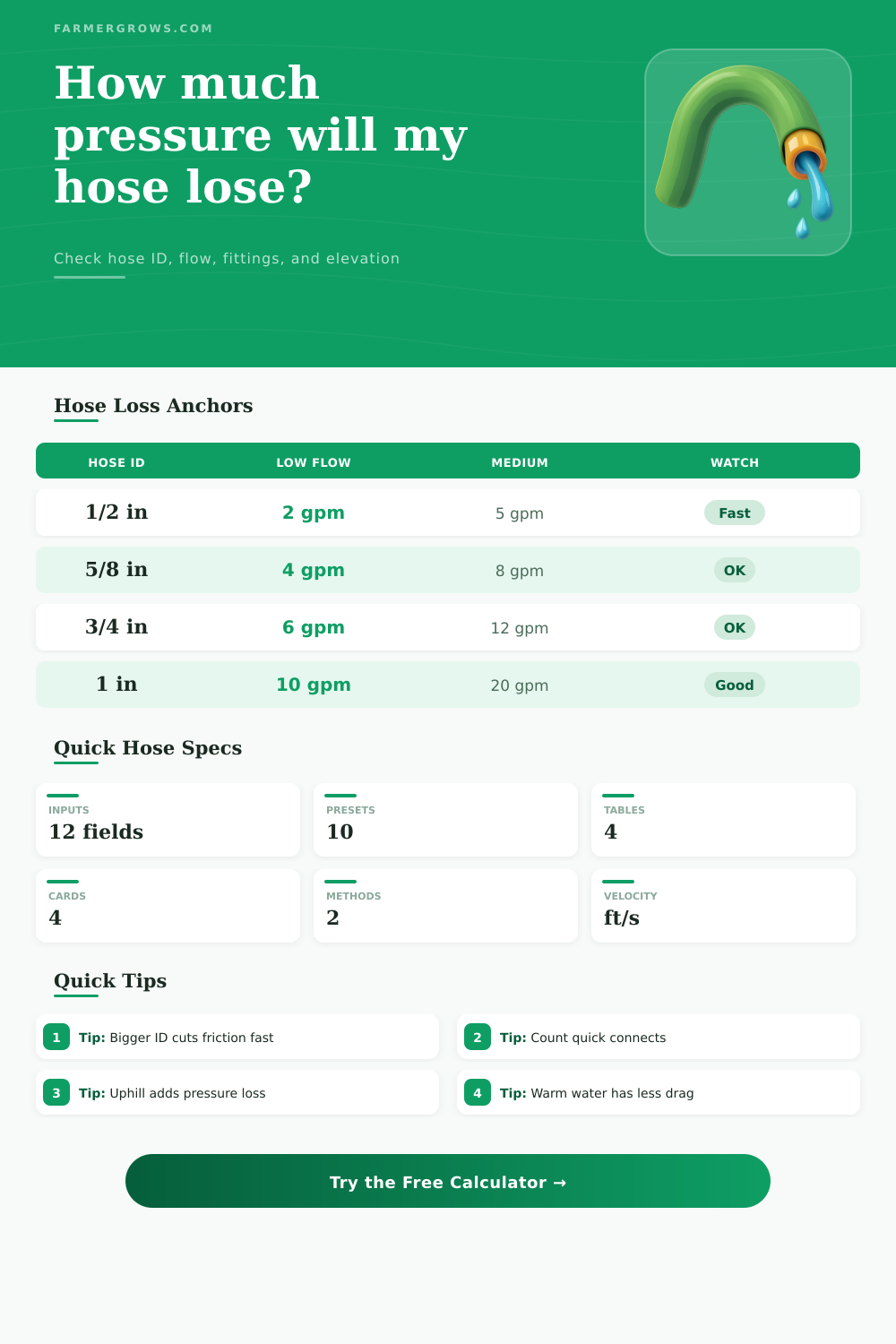
| Hose inside ID | Gentle flow | Typical flow | Velocity caution |
|---|---|---|---|
| 1/2 in | 2 to 4 gpm | 5 to 6 gpm | Small diameter builds loss quickly. |
| 5/8 in | 4 to 7 gpm | 8 to 10 gpm | Good general watering size. |
| 3/4 in | 6 to 10 gpm | 12 to 15 gpm | Better for long garden runs. |
| 1 in | 10 to 18 gpm | 20 to 28 gpm | Useful for filling tanks and transfer. |
| 1-1/2 in | 30 to 55 gpm | 60 to 90 gpm | Often used as layflat or transfer hose. |
| Fitting | K used | When to add it | Field note |
|---|---|---|---|
| 90° hose bend or elbow | 0.9 | Sharp bends, elbows, tight reel exits | Sweeping bends usually lose less. |
| Quick connect or coupler | 0.4 | Hose couplings, adapters, unions | Small-bore couplers can be worse. |
| Full-port ball valve | 0.2 | Open valves in the run | Partly open valves need extra K. |
| Nozzle or wand inlet | 1.5 | Wands, sprayers, reducers, strainers | Nozzle orifice loss is separate. |
| Water temp | Kinematic viscosity | Darcy impact | Use case |
|---|---|---|---|
| 40°F / 4°C | 1.57 cSt | Higher friction | Cold spring or winter water. |
| 60°F / 16°C | 1.12 cSt | Moderate friction | Cool well water. |
| 68°F / 20°C | 1.00 cSt | Common baseline | Standard reference condition. |
| 80°F / 27°C | 0.86 cSt | Slightly lower friction | Warm irrigation water. |
| Scenario | Hose setup | Flow | Planning check |
|---|---|---|---|
| Market garden watering | 100 ft of 5/8 in hose | 8 gpm | Often needs decent inlet pressure for a wand. |
| Tank filling | 200 ft of 1 in hose | 18 gpm | Large ID keeps fill time reasonable. |
| Drip header supply | 150 ft of 3/4 in hose | 6 gpm | Pressure margin matters at regulators. |
| Layflat transfer | 300 ft of 1-1/2 in hose | 70 gpm | Check pump curve and elevation lift. |
When the nozzle pressure is short, increasing hose inside diameter usually helps more than trimming a few feet of length.
Count reducers, filters, quick connects, and tight bends because small fittings can dominate an otherwise smooth hose run.
Pressure loss in a hose occurs when the water pressure decrease as the water travels from the source of the water to the nozzle of a hose. Factors such as friction, elevation change within the hose, the number of fittings included in the hose, and the diameter of the hose can decrease the pressure in the system. Each of these factors can contribute to weak water spray from the nozzle; in these situations, a person may try to increase the water pressure provide by the pump to compensate for the weakness in the spray.
However, increasing the water pressure from the pump does not address the cause of pressure loss in the hose; the causes of pressure loss are friction, elevation, the number of fittings in the hose, and hose diameter, all of which are factor other than the pump itself. One of the primary causes of pressure loss in a hose system is the diameter of the hose. The diameter of the hose affect the amount of friction that occurs within the hose system.
Why Water Pressure Drops in a Hose
If the diameter of the hose is smaller, there is an increased area of contact between the water and the hose. Because friction is created between the water and the walls of the hose, a smaller diameter of hose will experience more friction and, therefore, more pressure loss than a hose with a larger diameter. For instance, a three-quarter-inch diameter hose will experience less pressure loss than a half-inch hose.
A pressure loss calculator can be used to determine the effect of hose diameter and length on pressure loss within the hose; such calculators use formula to calculate the amount of pressure that the water will lose as it travels through the hose of a given length. Another of the factors that can contribute to pressure loss is the number of fittings within the hose system. Many people dont consider the number of hose fittings in their system when they set it up.
Each fitting within the hose has a resistance coefficient that contributes to the total pressure loss within the hose system. The more fittings that are included in the hose, the higher total loss of pressure within that hose. For these reasons, a person should consider all of the fittings within the hose system when calculating the total expected pressure loss that will occur within the hose system.
The third main factor that contribute to pressure loss is the elevation of the system. The elevation of the system is the vertical distance that the water must travel from its source to the nozzle. If the water travels from a low elevation point to a higher elevation point, the water will lose some of its pressure due to the effort of the water to overcome gravity.
Every foot of elevation loss results in a certain amount of pressure loss at the nozzle of the hose system. Thus, even if the slope of the hose system is very low, any increase in elevation will result in a loss of pressure at the nozzle. Fourth, the temperature of the water can impact the pressure loss within the hose system.
The effect of water temperature is due to the impact that temperature can have upon the viscosity of the water. Viscosity is a parameter that describes the thickness of a liquid. Cold water has a higher viscosity than warm water.
Thus, cold water will experience more friction between the water and the walls of the hose than warm water, leading to a loss of water pressure due to that increased friction within the hose. The pressure loss calculator display three different values. The calculator will calculate the amount of pressure that will be lost between the inlet of the hose system and the nozzle.
The calculator will display the actual water pressure that will reach the nozzle. Lastly, the calculator will indicate the inlet pressure that must be provided to the system to achieve the desired nozzle pressure. These three different value help to indicate whether or not any change to the hose system are required to minimize the loss of water pressure.
Velocity is another factor that can contribute to pressure loss within a hose system. The velocity of water within the hose system is the speed at which the water flow through the system. High velocities within the hose can cause additional friction within the hose system.
Additionally, high velocities can also create noise within the hose system. To avoid these problems, a person should aim for a moderate velocity within the system. A pressure loss calculator can help to determine if the velocity of the water within the hose system is too high for that system.
Beyond the factors that contribute to pressure loss within the system, a pressure loss calculator will also provide a planning number for the system based off the information that the person provides into the calculator. However, the information that the calculator calculates may not match the information within the actual system. For instance, scale can form within old hoses.
Kinks can form within hoses that are not provided for flexibility. Additionally, filters within the system may become clog over time. All of these factors will contribute to increased pressure loss within the system.
Therefore, while the pressure loss calculator is a helpful tool that can be used to plan a system, it is also important to actually test the system to determine whether or not it will function as intended. For instance, the calculation can be performed twice to compare different situation of the same system. For instance, the calculation can be performed to compare the loss of pressure with hoses of different diameter.
Through performing this type of calculation and comparing the results, a person can determine how each factor impact the loss of pressure within the hose system. Thus, by altering any of the factors within the system, diameter of the hose, length of the hose, number of hose fittings, elevation, and the temperature of the water, a person can make choice about how the system is to be set up to minimize the loss of water pressure.