Grow Light Wattage Calculator
Estimate fixture wattage from canopy area, PPFD, DLI target, LED efficacy, photoperiod, dimmer setting, optical losses, crop stage, and fixture count.
Choose a starting crop and stage, then adjust canopy area, fixture count, dimming, light loss, or photoperiod to match the actual grow space.
Grow Light Wattage Results
Results combine canopy photon demand, fixture efficacy, dimmer setting, light losses, photoperiod, fixture count, and the DLI target.
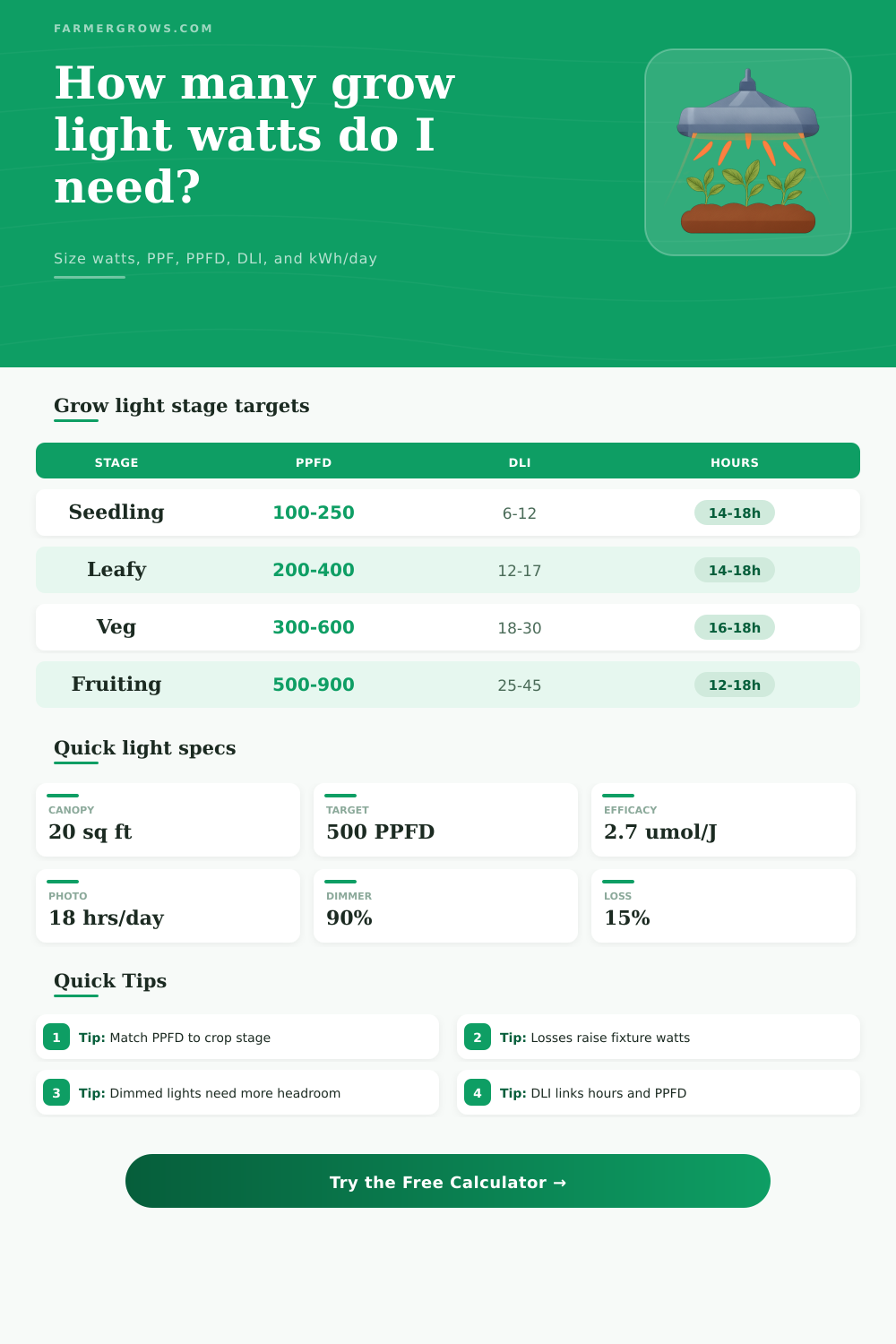
| Crop stage | Typical PPFD | Typical DLI | Photoperiod note |
|---|---|---|---|
| Seedlings and clones | 100 to 250 µmol/m²/s | 6 to 12 mol/m²/day | 14 to 18 hours is common |
| Microgreens | 150 to 350 µmol/m²/s | 8 to 16 mol/m²/day | 12 to 18 hours depending on crop |
| Leafy greens | 200 to 400 µmol/m²/s | 12 to 17 mol/m²/day | 14 to 18 hours balances intensity and duration |
| Culinary herbs | 250 to 500 µmol/m²/s | 14 to 24 mol/m²/day | Basil and mint usually like more light than parsley |
| Vegetative growth | 300 to 600 µmol/m²/s | 18 to 30 mol/m²/day | Often paired with longer day length |
| Flower and fruit set | 500 to 900 µmol/m²/s | 25 to 45 mol/m²/day | Photoperiod depends on crop response |
| Fixture class | Efficacy range | Planning value | What changes wattage |
|---|---|---|---|
| Older LED panel | 1.5 to 2.0 µmol/J | 1.8 µmol/J | Needs more watts for the same PPF |
| Mid-grade LED board | 2.1 to 2.5 µmol/J | 2.3 µmol/J | Good for small tents and shelves |
| Modern bar LED | 2.5 to 3.0 µmol/J | 2.7 µmol/J | Common efficient planning range |
| Premium horticulture LED | 3.0 to 3.5 µmol/J | 3.2 µmol/J | Lower watts for equal photon output |
| Fluorescent or compact lamp | 0.8 to 1.6 µmol/J | 1.2 µmol/J | Usually suitable only for low-light starts |
| Metric | Formula | Units | Use in this calculator |
|---|---|---|---|
| Canopy PPF | PPFD × canopy m² | µmol/s | Photons that must reach the plant canopy |
| DLI-derived PPFD | DLI × 1,000,000 / hours / 3,600 | µmol/m²/s | Converts daily target into average PPFD |
| Fixture PPF | Canopy PPF / dimmer / transmission | µmol/s | Compensates for dimming and light loss |
| Wall wattage | Fixture PPF / efficacy | watts | Turns photon output into electrical power |
| Daily energy | Watts × hours / 1,000 | kWh/day | Shows daily electrical energy use |
| Grow footprint | Canopy area | Loss planning | Fixture count note |
|---|---|---|---|
| 2 ft x 4 ft shelf | 8 sq ft / 0.74 m² | 10% to 20% | One bar or board often covers evenly |
| 3 ft x 3 ft tent | 9 sq ft / 0.84 m² | 15% to 25% | One centered fixture can work with good spread |
| 4 ft x 4 ft tent | 16 sq ft / 1.49 m² | 15% to 30% | One large fixture or four smaller fixtures |
| 4 ft x 8 ft bed | 32 sq ft / 2.97 m² | 20% to 35% | Multiple bars improve edge uniformity |
| 5 m² bench | 53.8 sq ft / 5 m² | 15% to 30% | Split fixtures by crop zones and aisle access |
When you are planning the lighting for your indoor plants, you need to understand the relationship between wattage and the light that your plants will recieve. Though lighting decisions may sound abstract, they become much more practical when you can observe the reactions of your plants to different intensities of light. If your plants receive too little light, they may exhibit thin leaves and wide spacings of there stems.
In contrast, if the intensity of the light is too great for the plants, they will struggle to grow. Wattage is one of the main factor to consider within lighting decisions for indoor grow operations. Wattage represents the electrical power that each lighting fixture will draw from the power source.
How Wattage Affects Light for Indoor Plants
Knowing what wattage represent will allow you to easily make lighting fixture plans regarding the amount of electricity that your indoor plants’ lighting fixture will use. Plants do not react to electricity, but they do respond to light. The intensity of the light that lands on the plants is measured in unit called Photosynthetic Photon Flux Density, or PPFD for short.
The total amount of light that falls on the plants each day is known as the Daily Light Integral, or the DLI. Growers can target these two metric based on the growth stage of the plants, as plants in one growth stage will require more light than another. Growers use wattage to determine the power of each lighting fixture necessary to achieve these targets.
The relationship between light and wattage is tied to the efficacy of each lighting fixture. The efficacy of lighting fixtures can be measured in micromoles per joule, or how many usable light unit the lighting fixture will release for every watt of electricity that it consumes. The higher the efficacy of the lighting fixture, the less wattage will be required to achieve the targeted PPFD or DLI value.
For instance, if one lighting fixture has an efficacy of 2.7 micromoles per joule and another lighting fixture has an efficacy of 1.8, the first lighting fixture will require less wattage to achieve the same level of PPFD or DLI as the second lighting fixture. Additionally, efficacy will play a key role in how much ventilation or air conditioning will be required to clear the heat that the lighting fixtures will release. The amount of light that reaches the plants will never be as high as the wattage of the lighting fixtures that is running.
Some of the factor that will reduce the amount of light that reaches the plants include the dimming of the lights and optical losses of light. For example, if the lights are run at 90% of the power of the lighting fixtures instead of 100%, then there will be less light that reaches the plants. Additionally, some optical losses may occur due to the height of the lights, dirty lenses, or reflectors that may be used to reflect some of the light towards the plants.
These losses can reduce the amount of light that reaches the plants by as much as 15%. Using a calculator for lighting fixtures will account for these losses in determining the wattage of each lighting fixture that must be used in the grow operation. The growth stage of the plants will impact the targeted values for both PPFD and DLI.
For instance, leafy green plants will require a PPFD between 200 and 400, but flowering plants will require a higher level of 500 to 900 PPFD. The photoperiod, or the number of hours that the lights are on, will also impact the DLI. The DLI is equal to the light intensity levels times the number of hours of light, so a lower photoperiod can be used with higher PPFD levels to provide the same DLI as a longer photoperiod with lower PPFD levels.
Using a lighting calculator will allow the grower to test out different photoperiods for their plants and to understand how the total wattage of the lighting fixtures will change with the changing photoperiod. Another factor to consider is the number of lighting fixtures that will be used within the grow operation. It is possible for growers to use many small lighting fixtures instead of just a few large lighting fixtures.
However, the wattage of each lighting fixture will change if many small lighting fixtures is used. The total wattage that is used will be the same regardless of whether one large lighting fixture is used or many small lighting fixtures. Other considerations for the number of lighting fixtures may include the height of the grow benches and the available number of aisles within the grow operation.
Regardless of the number of lighting fixtures that may be selected, the total wattage will have to be ensured to meet the lighting requirements for the indoor plants. The actual growing environment may differ slightly from what is calculated during the planning of the lighting for those indoor plants. Factors that may impact the actual light intensity that reaches the plants include the reflectivity of the walls of the grow operation, the density of the plants, and the hang height of the lighting fixtures.
Because of the potential difference between the calculated and actual light intensity, the wattage calculation is used only as a target for the lighting fixtures. After the grower hangs the lighting fixtures in the grow operation, a PAR map can be used to ensure that the light intensity is as calculated as possible. A PAR map can also be used to determine whether adjustments to the hang height or dimmer setting of the lighting fixtures is needed.
The daily kilowatt-hour (kWh) that the lighting fixtures use will determine the energy cost for the lighting fixtures. The photoperiod of the lighting fixtures will range between 12 and 18 hours, creating different costs for the lighting fixtures each month. For instance, if lighting fixtures are set at a lower percentage of full brightness during the early growth stages of the plants, and if the dimmer settings of the lighting fixtures are increased during the flowering stages of the plants, the total cost of electricity will be reduced.
Such adjustments can be programmed into the lighting fixtures using a lighting fixture planning calculator. Though spectrum and environmental factors will be separate from the wattage calculations, they will still impact the plants. For instance, if the spectrum of the lighting fixtures is not balanced properly, the plants may produce stretchy stems despite having the proper wattage for their needs.
Similarly, the effect that the temperature and CO2 has upon the plants will impact the amount of light that they use. Thus, two growers with the same wattage of lighting fixtures may experience different results due to differences in the temperatures or CO2 levels that is provided to their plants. Though the lighting fixture calculations can provide the grower with a starting point for light intensity, actual monitoring of the plants will be required to fine tune the lighting for those indoor plants.
Using a calculation tool for lighting fixtures will allow the grower to treat wattage as just one of many data points that will describe the lighting for the grow operation. In addition to wattage, other data points that can be programmed into the lighting fixture planning calculator may include the size of the plant canopies, the growth stage of the plants, the efficacy of the lighting fixtures, the dimmer settings of the lighting fixtures, and the losses of light that will occur within the grow operation. These data points will provide the grower with the total wattage of the lighting fixtures, the wattage of each lighting fixture if using many similar lighting fixtures, and the total daily energy use of the lighting fixtures.
Such information can be used to compare the wattage of the lighting fixtures to the available electrical circuits in the grow operation and to the budget of the grow operation. Should the wattage of the lighting fixtures be too high for the budget of the grow operation, the grower could of used the lighting fixture planning calculator to test the use of lighting fixtures with higher efficacies or an increased number of lighting fixtures to determine if that will bring the total wattage of the lighting fixtures into a range that the grow operation can cost effectively budget for.