Exhaust Fan Calculator
Size greenhouse and grow room ventilation from room volume, heat load, temperature rise, filters, duct length, static pressure, intake ratio, and climate mode.
The calculator compares room-volume CFM with heat-removal CFM, then corrects for static pressure, filter load, duct length, intake restriction, and climate mode.
Ventilation Result
Use the higher of the volume and heat formulas, then choose a fan that can still deliver this airflow at the estimated static pressure.
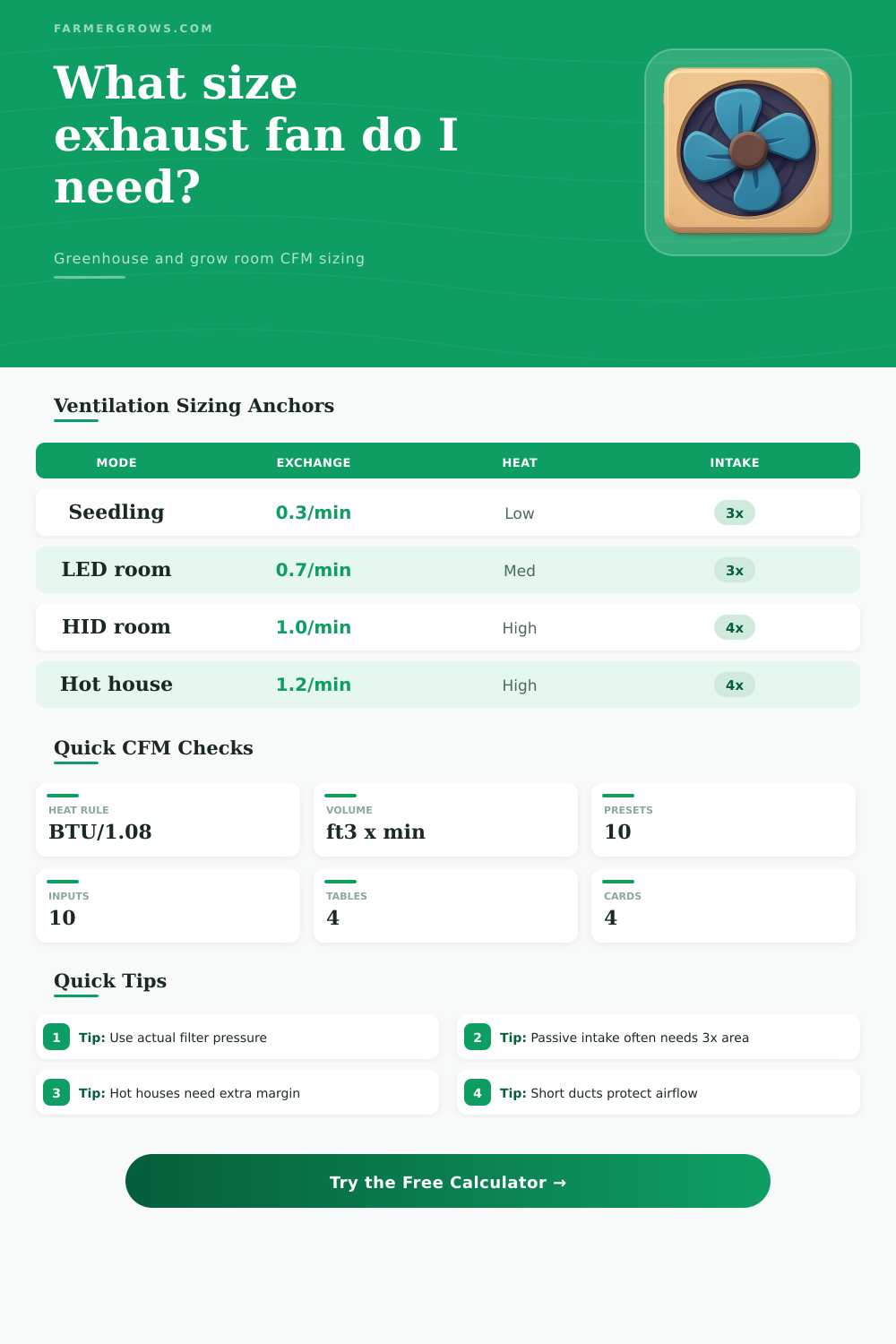
| Space type | Exchange target | Best use | Watch point |
|---|---|---|---|
| Seedling tent | 0.25-0.40 per minute | Gentle fresh air with lower heat load. | Avoid drafts across trays. |
| LED grow room | 0.50-0.85 per minute | Common range for rooms with moderate equipment heat. | Check humidity removal separately. |
| HID or dense canopy | 0.85-1.20 per minute | Useful when lighting heat or canopy moisture is high. | Filter pressure can control fan choice. |
| Sunny greenhouse | 1.00-1.50 per minute | High daytime exchange for solar gain. | Large intake and shade reduce fan burden. |
| Heat load | BTU/hr | CFM at 8°F rise | CFM at 12°F rise |
|---|---|---|---|
| 400 W | 1,365 | 158 CFM | 105 CFM |
| 800 W | 2,730 | 316 CFM | 211 CFM |
| 1,500 W | 5,118 | 592 CFM | 395 CFM |
| 3,000 W | 10,236 | 1,185 CFM | 790 CFM |
| Restriction | Typical allowance | Calculator input | Sizing note |
|---|---|---|---|
| Open wall shutter fan | 0.05-0.10 in. w.g. | No filter, short path | Airflow stays close to rated free-air CFM. |
| Insect screen or light prefilter | 1.08x to 1.15x | Filter factor | Clean screens often matter less than intake area. |
| Carbon filter grow room | 1.25x plus pressure | Filter factor and static | Use the fan curve at the filter pressure. |
| Long duct run | About 0.03 in. per 10 ft | Duct length | Bends, reducers, and dirty filters add more loss. |
| Design airflow | Approx duct at 800 fpm | 3x intake free area | 4x intake free area |
|---|---|---|---|
| 250 CFM | 7.6 in round | 135 sq in | 180 sq in |
| 500 CFM | 10.7 in round | 270 sq in | 360 sq in |
| 1,000 CFM | 15.1 in round | 540 sq in | 720 sq in |
| 2,000 CFM | 21.4 in round | 1,080 sq in | 1,440 sq in |
If a carbon filter is part of the system, choose from the fan curve at the estimated static pressure, not only the free-air CFM label.
Passive intake usually works best when the free area is at least three times the exhaust area, and hot greenhouses often benefit from four times.
Choosing the correct exhaust fan for an greenhouse or a grow room requires more than just reading the size of the greenhouse or grow room. The type of lights that is used in the greenhouse or grow room will affect the amount of heat that builds up within those spaces. Similarly, the various filters and ducts within the greenhouse or grow room will affect the amount of air that can actualy exit the greenhouse or grow room.
Each of these factors will influence the amount of air that should exit the greenhouse or grow room, and each incorrect consideration can lead to stress for the plants. To determine the amount of air movement that is required for the greenhouse or grow room, you must calculate the volume of the greenhouse or grow room. You can multiply the length, width, and height of the greenhouse or grow room to determine the number of cubic feet of the greenhouse or grow room.
How to Choose the Right Exhaust Fan for a Grow Room or Greenhouse
The number of cubic feet of that space can be multiplied by the number of air exchanges per minute that are desired within the greenhouse or grow room. For instance, areas that contain young seedlings may require only one-third air exchanges per minute, but areas that contain heavy plants under high-intensity lights may require one air exchange per minute. The air exchange rate is a factor that determines how quickly the air within the greenhouse or grow room should be replaced.
The second calculation that must be performed is the calculation of the heat load within the greenhouse or grow room. Factors that contribute to the heat load of the greenhouse or grow room include lights, ballasts, pumps, and the greenhouse or grow room structure itself. You can convert the wattage of these items into BTU per hour, and that value can be divided by a factor that represents the temperature to which the greenhouse or grow room should rise in order to determine the required CFM for that space.
Many growers find that heat load can contribute to a required exhaust fan that is larger than the one calculated from the volume calculations alone. Static pressure within the greenhouse or grow room can alter the calculations that were made for the required CFM of the exhaust fan. Any filters or ducts within the grow room will contribute to the static pressure within the greenhouse or grow room.
Factors that contribute to static pressure include exhaust fans pushing air through a carbon filter, twelve feet of duct, and any other restrictive areas within the exhaust fan system. The correction factors that are included in the calculator for the grow room will account for the decrease in CFM of the exhaust fan that is caused by these factors. Ignoring the static pressure calculations is a factor that is often responsible for growers purchasing exhaust fans that do not provide the amount of air movement that was calculated prior to purchase.
In addition to the exhaust fan capacity, the intake area of the greenhouse or grow room is another factor that contributes to the CFM calculations for exhaust fans. The intake area must be large enough to allow fresh air to enter the greenhouse or grow room at the same rate that the exhaust fan is removing air from the greenhouse or grow room. The intake area should be three to four times the size of the exhaust area of the grow room.
The size of the intake area may change throughout the year according to the plants that is within the greenhouse or grow room. A forced intake area can contribute to exhaust fans working harder than they should and can reduce the CFM of that exhaust fan. The climate in which the grow room or greenhouse is established is a factor that may alter the calculations of the CFM requirements for the exhaust fan.
For instance, a grow room that is shaded and located in a cooler region may be able to use a smaller exhaust fan than a sunny high tunnel greenhouse of the same square footage. The climate mode factor allows for these different growing regions and climates to be accounted for within the calculations for the exhaust fan. While choosing the incorrect climate mode for the location of the grow room will not immediately adversely affect the grow room and its plants, the wrong climate mode will impact the safety margin that is established for that grow room.
The reference tables that are provided on the page help to show the various exchange rates for different types of grow rooms and greenhouses. Tables within the article allow growers to calculate the CFM of exhaust fans based off the heat load of the grow room, the rise in temperature of the grow room, the effect that the various filters have upon static pressure within the exhaust fan system, and the diameter of the ducts that are established within the grow room. While the numbers in these tables do not have to be memorized, the table values can help to growers to determine whether their chosen exhaust fan is within the range of exhaust fans that can account for the calculated conditions of their grow room or greenhouse.
While the calculations within the exhaust fan calculator are made with ideal conditions for exhaust fans in mind, the actual conditions within the grow rooms may differ. Factors that reduce the performance of the exhaust fans include the amount of dust that is within the grow room that settles on the exhaust fan blades, the amount of pollen that is within the grow room that settles on the screens of the exhaust fan, and the introduction of bends within the ducts that contribute to the reduction of the CFM of the exhaust fan. Safety factors are established within the calculator to ensure that the exhaust fan will continue to perform at the level that is calculated when these factors are at play.
Growers make common mistakes when installing exhaust fans in grow rooms and greenhouses. One of these common mistakes is purchasing an exhaust fan whose CFMs are only calculated for the movement of air within the grow room when the grow room’s fan is required to move air through a filter and duct system. The other common mistake is purchasing exhaust fans that are of an oversize capacity in an attempt to ensure that the grow room is effectively vented; however, exhaust fans that are oversold will contribute to constant drafts within the grow room, and will adversely impact the humidity of that grow room.
These mistakes can be avoided by performing the calculations for the grow room volume, heat load, static pressure, intake area, and climate mode prior to purchasing the exhaust fan. The type of exhaust fan that is used within a grow room can impact the way that the exhaust fan and grow room system functions. Inline fans are able to handle more static pressure than exhaust fans that are shutter fans.
Exhaust fans that are shutter fans work best for greenhouses that are established in the greenhouse walls. Centrifugal fans are capable of moving air through heavy filters, but they are more expensive and use more power than the other types of exhaust fans. EC fans of the variable-speed type allow for the exhaust fans to be adjusted to the amount of air movement that is required of the grow room during different periods of the day.
In addition to the type of exhaust fan that is used within a grow room, the maintenance of that exhaust fan can contribute to the long-term performance of the exhaust fan. The filter that is associated with the exhaust fan should be cleaned and inspected a few times each grow season. The static pressure at the intake of the exhaust fan can be measured to determine whether the exhaust fan is experiencing resistance from the grow room; static pressure that is higher than the static pressure that was calculated for the exhaust fan indicates that the exhaust fan is moving less air through the grow room than it should.
You can correct the static pressure by adjusting the exhaust intake or by cleaning the exhaust fan filter. Cleaning the filter is a better approach to correcting high static pressure than purchasing an exhaust fan with a higher CFM. Some variables are more stable than others within a grow season.
For instance, the volume of the grow room does not change, but the heat load of the grow room does change based upon the plants that are within that grow room. Similarly, the intake area of the grow room can be adjusted, but the static pressure within the grow room will change with the addition of a filter or the introduction of a bend within the duct system. These variables can be tested within the exhaust fan calculator to ensure that the exhaust fan that is purchased will still be able to move the required amount of air within the grow room during the hottest part of the season.
After the exhaust fan has been installed in the greenhouse or grow room, the temperature and humidity of that grow room should be measured. If doors or vents need to be opened to release the air within the grow room, either the sizing of the exhaust fan or the intake area of the grow room may need to be adjusted. These problems can be corrected by adjusting the ratio of the intake area to the exhaust area, or by adjusting the target exchange rate of the exhaust fan.
By getting these numbers correct initially, the adjustments that are needed later will be more minimal.