Lux to PPFD Calculator
Convert a lux meter reading into estimated PPFD for plants, then compare it with crop targets, canopy adjustment, fixture height, and measurement grid coverage.
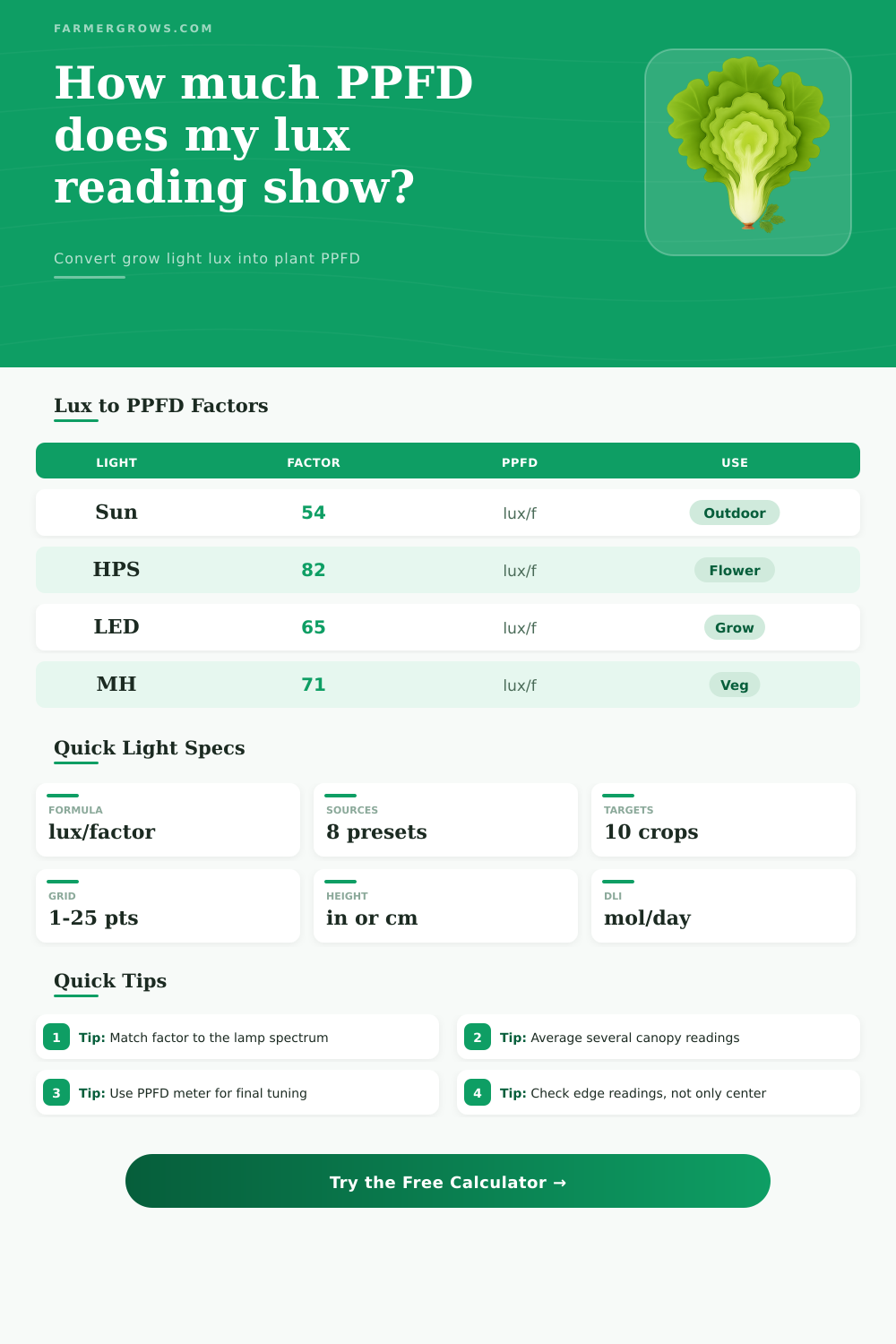
Lux meters weight light by human vision, so the conversion depends on spectrum. These factors are field approximations in lux per 1 umol/m²/s; use a PAR meter for final crop tuning.
Broad daylight is the common outdoor benchmark for lux-to-PPFD estimates.
Full-spectrum horticulture LEDs often sit near 60-70 lux per PPFD.
High-pressure sodium looks bright to lux meters, so PPFD per lux is lower.
Blue-heavy discharge lamps usually convert closer to cool fluorescent light.
Lux to PPFD Results
Estimated plant light appears here after calculation.
| Light source | Approx factor | Formula | Best use |
|---|---|---|---|
| Sunlight / daylight | 54 lux per umol/m²/s | PPFD = lux / 54 | Outdoor beds, greenhouse daylight, shade cloth checks. |
| Full-spectrum white LED | 65 lux per umol/m²/s | PPFD = lux / 65 | Most white horticulture fixtures and grow shelves. |
| Cool white LED | 63 lux per umol/m²/s | PPFD = lux / 63 | Leafy green racks, propagation, and blue-rich lamps. |
| Warm white LED | 67 lux per umol/m²/s | PPFD = lux / 67 | Redder white LED strips and warm indoor grow lamps. |
| High-pressure sodium | 82 lux per umol/m²/s | PPFD = lux / 82 | Flowering rooms and legacy greenhouse fixtures. |
| Fluorescent / T5 | 74 lux per umol/m²/s | PPFD = lux / 74 | Seedling flats, microgreens, and nursery benches. |
| Metal halide | 71 lux per umol/m²/s | PPFD = lux / 71 | Vegetative rooms and blue-heavy discharge lighting. |
| Red-blue horticulture LED | 45 lux per umol/m²/s | PPFD = lux / 45 | Use with caution because lux meters under-read deep red and blue. |
| Crop group | Common PPFD range | Calculator default | Practical note |
|---|---|---|---|
| Seedlings and clones | 100-200 umol/m²/s | 150 | Start gentle and raise intensity after roots develop. |
| Microgreens | 150-250 umol/m²/s | 180 | Short cycles usually need even coverage more than high peaks. |
| Leafy greens | 200-350 umol/m²/s | 250 | Lettuce and basil often grow well in this range indoors. |
| Herbs | 250-450 umol/m²/s | 300 | Higher light improves compact growth for many culinary herbs. |
| Fruiting vegetables | 500-800 umol/m²/s | 600 | Tomato, pepper, and cucumber crops need stronger light. |
| High-light houseplants | 75-200 umol/m²/s | 120 | Use longer photoperiods before pushing fragile leaves too hard. |
| Target PPFD | Sunlight factor 54 | White LED factor 65 | HPS factor 82 |
|---|---|---|---|
| 150 umol/m²/s | 8,100 lux | 9,750 lux | 12,300 lux |
| 250 umol/m²/s | 13,500 lux | 16,250 lux | 20,500 lux |
| 400 umol/m²/s | 21,600 lux | 26,000 lux | 32,800 lux |
| 600 umol/m²/s | 32,400 lux | 39,000 lux | 49,200 lux |
| Grow area | Suggested grid | How to average | What to watch |
|---|---|---|---|
| Single seedling tray | 5 points | Center plus four corners | Keep corners within about 25% of the center. |
| 2 x 4 ft shelf | 9 points | Three by three pattern | Measure at leaf height after the fixture warms up. |
| Greenhouse bench | 12-16 points | Even rows across the bench | Include both supplemental and daylight-only zones. |
| Indoor bed or room | 16-25 points | Map the whole canopy | Check edges, aisle spill, and hot spots under fixtures. |
Calibrate your expectation by lamp type. A red-blue grow light can show low lux while still delivering useful plant photons.
Take readings at canopy height after the fixture has warmed up, then average the grid before comparing to the crop target.
Lux meters is tools that measure the light intensity for the human eyes but dont measure the light intensity for plants. Lux meters will indicate a high light value for lights that the plant dont use but will indicate a low value for the lights that the plants require. Converting the lux reading to a usable plant reading is essential because the spectrum of the lamp will indicate the amount of lux reading that will become usable for the plants.
The spectrum of the light will affect the reading of the lux meter. The calculator will mathematically compute the value once you choose the correct spectrum factor for your lamp. Sunlight will show up in the middle of the spectrum factor range but will require a higher factor for high-pressure sodium lamps because they emit yellow-orange light that the lux meter will register as strong light.
How to Convert Lux Readings to Plant Light
Full spectrum lamps will read somewhere in the middle of the spectrum factor but red-blue lights will read toward the low end of the spectrum for the same reasons that lux meters undercount red-blue light. Choose the factor for your lamp to ensure that the reading estimate for light intensity is close to the reading that a proper PAR meter would register at the same location for the same plants. Choose the spectrum factor and determine where to take the light measurements.
Taking a reading at the brightest center of the lamp will overstate the light that the plants is receiving. Plants will receive less light at the edges of the grow shelf than they will in the center because the leaves will shade the plants lower leaves. The same concept applies to the edges of the shelf where the plants will receive less light than the center plants because grow lights will create hot spot for the plants directly below them.
Taking several light readings will allow you to average the light that the plants will receive. This information is included in the calculator to remind you to take several light readings and to average them. The height of the light fixtures above the plants is another critical piece of information.
The higher you raise the lights, the lower the intensity of the light but the more even the shelf will receive the light. Raising the height of the lights will even out the light from the center to the edges of the plants but will lower the light intensity for the plants. Conversely, lowering the height of the lights will increase the light intensity but may create hot spots for the plants that may suffer from heat stress.
Use the height field in the calculator to enter the height of your grow lights. Plants have different light intensity requirements. Plants that are seedlings or young cuttings will require lower light intensities because they are just establishing their roots.
Leafy crops such as herbs will do well with medium light intensities but fruiting plants such as tomatoes and peppers will require strong light intensities once the flowers begin to appear on the peppers and tomatoes. The target field allows for you to compare the light reading to the light that the plants require to grow properly. Another consideration is the daily light integral because the plants require more than just light intensity but also the total amount of light that falls on the plants each day.
The length of the photoperiod will multiply the corrected PPFD value to get the daily light integral the plants receive each day. Shorter days in winter and longer days in the summer will change the daily light integral values. This calculation is included in the calculator to allow you to determine the effect of different photoperiod lengths on the plants.
The real world in which the plants grow can complicate the lux meter reading because plants are a dynamic part of the room. As the leaves move, the plants grow in height, or other lights in the area begin to cast shadows on the plants the reading that the lux meter obtains will change. Reflective surfaces will reflect the light back into the plants as well.
The reading that is taken in an empty room may not be the same as the reading taken when the plants are filling the room. Use the lux meter reading as a starting point for lighting but monitor the plants response to the light. If the lower leaves of the plants begin to yellow or the stems of the plants become stretched the light levels may need to be adjusted.
The spectrum of the lights may drift over time as the plants age and the lamps wear out. LED grow lights of a certain spectrum factor may require a different spectrum factor after a few thousand hours of use. Check each grid point every few weeks to ensure that your estimate of the light that the plants are receiving remains accurate.
The conversion factor is an approximation of the light intensity that the plants will receive and is not a universal constant. The spectrum of LED lights from different manufacturers may have slight differences in their light output. However, the factors provided by the calculator will give you a starting point for the light that your plants will receive; you can fine-tune the reading if you use a PAR meter.
Using the calculation will allow you to remove the largest sources of error from your grow room lighting plan. It is useful to keep a record of the corrected PPFD, the target light levels for the plants, and the length of the photoperiod the plants are growing in. Additionally, take a note about the appearance of the plants.
By recording these values you will be able to learn the specific light requirements of each type of plant. You will be able to learn how much light is lost between the light that you calculate and the light that reaches the plants in your grow room. By performing the calculation from lux to PPFD you have changed a human-centric reading to a plant-centric reading.
The value will tell you if the light levels you have established for your plants are near the target for those plants. It will also provide you the signal to adjust the lighting plan for the plants if the light levels are either too low or too high. You will use these numbers to determine how to change the lighting for the plants.
By performing this exercise you have established the lux meter reading as a number that you will use to make decisions about your grow room lighting. This number will allow you to make adjustments to the lighting for the plants based on the numbers that describe the amount of light that the plants are receiving.