Two Stroke Fuel Mixture Calculator
Mix chainsaw, trimmer, blower, auger, outboard, and vintage two-stroke fuel from 16:1 through 100:1 with exact oil in milliliters, US fluid ounces, teaspoons, and bottle counts.
Enter the gasoline volume before oil is added. For a ratio such as 50:1, the calculator uses oil = fuel volume / 50, then adds your optional ethanol and measuring-loss allowances so the final pour amount is clear.
Older manuals may call for richer oil mixes, especially with plain bearing designs or break-in instructions.
Most modern chainsaws, trimmers, blowers, and augers sit in this range when using quality two-stroke oil.
Small portable outboards commonly list 50:1, but the motor label and owner manual should decide.
Use lean oil ratios only where the equipment or oil maker explicitly approves that mixture.
Your Two-Stroke Mix
Calculated oil amount appears here.
oil mL = fuel L × 1000 / ratio.
oil fl oz = fuel gal × 128 / ratio.
teaspoons = oil fl oz × 6.
total oil = per batch oil × batch count.
| Mix ratio | Oil for 1 US gallon | Oil for 5 liters | Approx oil percent | Common equipment note |
|---|---|---|---|---|
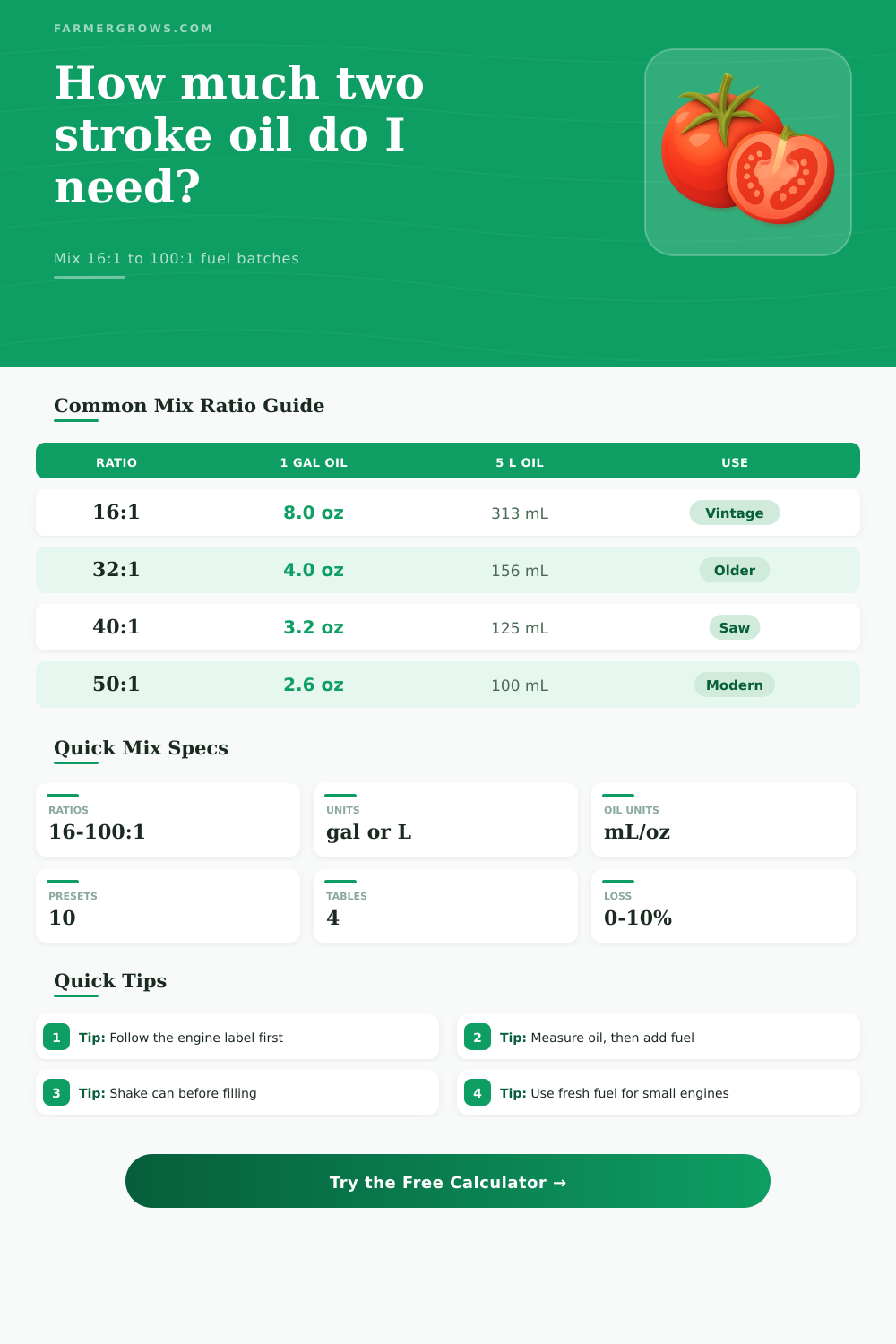
| 16:1 | 8.00 fl oz / 237 mL | 312.5 mL / 10.57 fl oz | 6.25% | Vintage engines and some break-in instructions. |
| 20:1 | 6.40 fl oz / 189 mL | 250.0 mL / 8.45 fl oz | 5.00% | Older saws, pumps, and small utility engines. |
| 24:1 | 5.33 fl oz / 158 mL | 208.3 mL / 7.04 fl oz | 4.17% | Legacy handheld tools and run-in mixes. |
| 25:1 | 5.12 fl oz / 151 mL | 200.0 mL / 6.76 fl oz | 4.00% | Older trimmers, brush cutters, and imports. |
| 32:1 | 4.00 fl oz / 118 mL | 156.3 mL / 5.28 fl oz | 3.13% | Common old mower, auger, and saw setting. |
| 40:1 | 3.20 fl oz / 95 mL | 125.0 mL / 4.23 fl oz | 2.50% | Many chainsaws, blowers, trimmers, and scooters. |
| 50:1 | 2.56 fl oz / 76 mL | 100.0 mL / 3.38 fl oz | 2.00% | Modern farm handhelds and small outboards. |
| 80:1 | 1.60 fl oz / 47 mL | 62.5 mL / 2.11 fl oz | 1.25% | Only where equipment and oil instructions allow. |
| 100:1 | 1.28 fl oz / 38 mL | 50.0 mL / 1.69 fl oz | 1.00% | Special oils and approved applications only. |
| Tool type | Typical ratio range | Good starting preset | Fuel batch style | Calculator caution |
|---|---|---|---|---|
| Chainsaw | 40:1 to 50:1 | 50:1 for many modern saws | 1 to 5 gal or 5 L can | Use the saw label when it differs from the oil bottle. |
| String trimmer | 40:1 to 50:1 | 50:1 small batch | Quart to 1 gal | Small tanks go stale fast; mix only what you use. |
| Leaf blower | 40:1 to 50:1 | 50:1 workday can | 1 to 2.5 gal | Backpack blowers often share the handheld mix can. |
| Earth auger | 25:1 to 50:1 | 32:1 for older augers | 1 gal or 5 L | Cold starts and heavy load make the manual important. |
| Portable outboard | 50:1 common | 50:1 tank fill | 3 to 6 gal tank | Never use E15 unless the motor specifically permits it. |
| Vintage engine | 16:1 to 32:1 | 16:1 or 24:1 | Small test batch | Old seals, bearings, and manuals may need richer oil. |
| Package size | Oil volume | 50:1 fuel it treats | 40:1 fuel it treats | Best field use |
|---|---|---|---|---|
| 50 mL mini bottle | 1.69 fl oz | 0.66 gal / 2.5 L | 0.53 gal / 2.0 L | Metric top-ups and small tanks. |
| 100 mL bottle | 3.38 fl oz | 1.32 gal / 5.0 L | 1.06 gal / 4.0 L | One 5 L can at 50:1. |
| 2.6 fl oz pouch | 76.9 mL | 1.02 gal / 3.8 L | 0.81 gal / 3.1 L | Common one-gallon 50:1 pouch. |
| 3.2 fl oz pouch | 94.6 mL | 1.25 gal / 4.7 L | 1.00 gal / 3.8 L | Common one-gallon 40:1 pouch. |
| 8 fl oz bottle | 237 mL | 3.13 gal / 11.8 L | 2.50 gal / 9.5 L | Farm can refill shelf stock. |
| 16 fl oz bottle | 473 mL | 6.25 gal / 23.7 L | 5.00 gal / 18.9 L | Multiple cans or seasonal work. |
| 1 quart bottle | 946 mL | 12.5 gal / 47.3 L | 10.0 gal / 37.9 L | Shop measuring with a dedicated cup. |
| Fuel amount | 32:1 oil | 40:1 oil | 50:1 oil | 100:1 oil |
|---|---|---|---|---|
| 1 quart / 0.95 L | 1.00 fl oz / 29.6 mL | 0.80 fl oz / 23.7 mL | 0.64 fl oz / 18.9 mL | 0.32 fl oz / 9.5 mL |
| 1 US gallon / 3.79 L | 4.00 fl oz / 118 mL | 3.20 fl oz / 95 mL | 2.56 fl oz / 76 mL | 1.28 fl oz / 38 mL |
| 2.5 US gal / 9.46 L | 10.0 fl oz / 296 mL | 8.0 fl oz / 237 mL | 6.4 fl oz / 189 mL | 3.2 fl oz / 95 mL |
| 5 US gal / 18.93 L | 20.0 fl oz / 591 mL | 16.0 fl oz / 473 mL | 12.8 fl oz / 379 mL | 6.4 fl oz / 189 mL |
| 5 liters / 1.32 gal | 5.28 fl oz / 156 mL | 4.23 fl oz / 125 mL | 3.38 fl oz / 100 mL | 1.69 fl oz / 50 mL |
Start with the engine manual. Oil bottle marketing cannot override the ratio stamped on the saw, auger, outboard, or trimmer. Use the calculator to measure that chosen ratio accurately.
Keep the batch fresh and labeled. Write the ratio, date, ethanol blend, and oil brand on the can. Shake the can before each fill because oil can cling to the container walls.
A two-stroke engine requires a specific balances of fuel and oil. The fuel-to-oil balance is necessary to determine how well the engine will run. If the fuel-to-oil balance is incorrect, the engine may run smooth or it may seize up during operation.
The fuel-to-oil ratio impact the amount of lubrication in the engine, as well as the combustion temperature, the life of the spark plug, and the usability of the fuel if stored for long periods of time. While many people will look at the ratio printed on the engine cap, other variable can impact the amount of oil that must be mixed with the fuel. In order to mix the fuel and oil for a two-stroke engine, you must first measure the fuel volume.
How to Mix Fuel and Oil for Two-Stroke Engines
This step come first because measuring the fuel volume first will make the math easier. Additionally, measuring the volume of fuel first will prevent add too much fuel to the fuel can. Once you have measured the amount of gasoline, the ratio will determine the amount of oil that should be mixed with the gasoline.
For instance, a 50:1 ratio requires adding one part oil to fifty parts of gasoline. The same ratio is true for a 32:1 or 16:1 ratio. Ratios that is rich in oil will allow more oil to be added to the combustion chamber.
Rich mixtures are used for older engines with loose tolerances. Lean mixtures allow for less oil in the combustion chamber which results in less carbon deposits, but there is less margin for error. The calculator will perform the math once you have entered the ratio of fuel to oil that you wish to use for your engine.
Additionally, the calculator will allow you to adjust for the amount of ethanol in the fuel. Adjusting for the ethanol is important because ethanol will attract water. Because ethanol will attract water, the water will separate from the gasoline over time.
In order to combat the effect of ethanol on the fuel, you can add an extra allowance of oil. Adding an extra oil allowance will allow you to compensate for the amount of ethanol in the fuel. Additionally, there is a field for loss in the calculator.
This loss in the fuel will allow you to account for any oil that remains on the walls of the measuring cup or funnel. When measuring fuel with a cup or funnel, it is common to lose two or three percent of the oil. The calculator will tell you the exact amount of oil and fuel that you should pour into the fuel can.
Additionally, the calculator will also provide information regarding the total volume of the fuel can after you have added the oil to it. Not all tools use the same ratios of fuel to oil. This is because the different tools have different requirements.
For example, moddern chainsaws require a 50:1 ratio of fuel to oil. The 50:1 ratio keeps the exhaust port of the chainsaw from getting clogged. For older tools, such as earth augers, the ratio is 32:1.
Most portable outboards use a 50:1 ratio, however, the manual for the outboard may require a different ratio for engines with oil injection system. In any case, you should always use the label on the engine as the final word on the ratio that should be used. The calculator is only a tool that will assist with translating the ratio on the engine to the amount of oil and fuel that should be mixed.
Some batches of fuel contain more oil than others. For instance, some individuals may need to mix fuel and oil for a single quart of fuel for a string trimmer. Other individuals, however, may have to mix fuel and oil for five gallon of fuel for a chainsaw.
The batch-count field on the calculator will allow you to calculate the total amount of oil that will be needed for each batch of fuel. This field will allow individuals to easily determine the total amount of oil needed for fuel. Additionally, this field will also allow individuals to pre-mix fuel cans and label them ahead of time.
The oil that is used to mix with the fuel comes in different sizes. For instance, one type of oil comes in pouches that are 50:1 for one gallon of fuel. While these pouches reduce errors in the fuel-to-oil ratio, there will always be some oil left inside the pouch.
Other oil comes in larger bottles. To measure this oil, a dedicated measuring cup is required. When measuring oil, ensure that the measuring cup is levelled to eye height so that the measurement is accurate.
The calculator will estimate the number of whole bottle or pouches of oil that will be needed to add to the fuel. The calculator will round the number to the next whole number in case fuel and oil are purchased for the day. Ethanol content is in the gasoline that is sold at the gas pump.
Because of the ethanol content in the fuel, some individuals may experience a problem with fuel storage. Specifically, the ethanol content will attract water to the fuel. As a result, the water will separate from the gasoline over time.
The amount of water that will separate from the fuel will reduce the amount of petroleum-based fuel. The reduction of the petroleum fuel will make the fuel leaner when mixed with oil. To combat the lean fuel, a one percent extra oil allowance will be made.
This allowance will ensure that lean fuel will not become a problem for the two stroke engine. However, it will not turn the fuel mix into a smoky mess. In cases where ethanol content is a problem for the fuel, you can set the oil allowance to zero.
In these cases, ethanol-free fuel can be used. Many engine owners choose to use ethanol-free fuel to store their engine over the winter. Loss in the fuel mix is another problem that will occur when fuel is measured.
This loss is visible when left in the measuring cup. Two percent is an allowance made for losses in the fuel when using a measuring cup. Additionally, you can make an extra allowance if the fuel is to be measured with a plastic funnel.
An even higher allowance can be made if the fuel to be measured is cold or if a long syringe will be used to measure the oil for the two stroke engine. This allowance will be added to the fuel amount after the ethanol allowance. Common mistakes when mixing fuel and oil for two stroke engines is when oil is added first to the fuel container.
By adding oil first, the ratio of oil to fuel will change. The ratio will no longer match the amount of fuel in the container. Additionally, another common mistake is to use the leftover fuel mixture from one season to the next without shaking the fuel container.
When the fuel container is not shaken, the oil will settle at the bottom of the container. This will create issues for the engine when fuel is burned. The reference tables on the calculator will show you the different ratios for different quantities of fuel.
Additionally, the tables will show you the categories of tools and the ratios to fuel that they use. These tables are not meant to replace the specification on the two stroke engines engine label. However, the tables will provide context for those using fuel and oil mixers to understand if the ratio is appropriate for the engine.
The goal with mixing fuel and oil for two stroke engines is to use the same mixture each time. The mixture should be prepared in a repeatable process. In order to ensure consistency in fuel and oil mixtures, the process should begin by measuring the fuel first.
Then, the ratio can be applied. Allowances can then be made for ethanol and measuring loss. Finally, you can properly label the fuel and oil mixture.
By using the calculator, you will eliminate the mental math for two stroke engines.