Battery Backup Calculator
Size a backup battery bank for grow lights, pumps, fans, controllers, heat mats, and other farm loads using watt-hour, amp-hour, inverter, depth-of-discharge, reserve, and solar recharge math.
Choose a starting point, then edit any field. Presets include steady running load, motor or ballast surge, chemistry, voltage, reserve, and solar recharge assumptions.
Backup Battery Results
Results account for AC load energy, inverter losses, reserve margin, battery depth of discharge, and optional solar recharge losses.
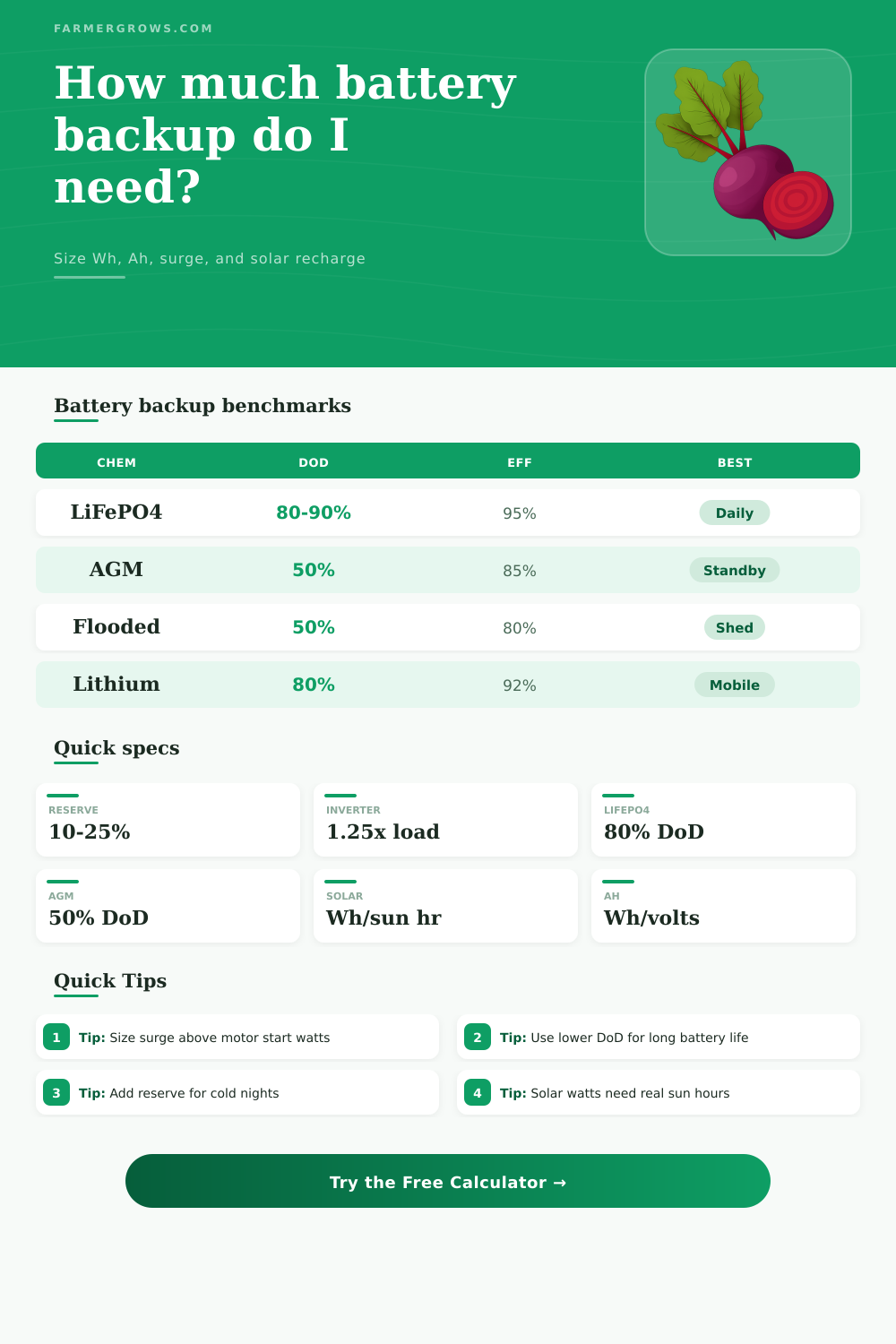
| Chemistry | Planning DoD | Round-trip efficiency | Best farm use |
|---|---|---|---|
| LiFePO4 | 80% to 90% | 92% to 96% | Daily cycling, grow rooms, solar sheds |
| AGM sealed lead acid | 50% | 80% to 88% | Standby loads and low-maintenance backup |
| Flooded lead acid | 50% | 75% to 85% | Ventilated utility rooms and serviceable banks |
| Gel lead acid | 50% to 60% | 80% to 86% | Low-current standby circuits |
| Lithium NMC | 80% | 90% to 94% | Compact mobile or trailer systems |
| Nickel iron or nickel cadmium | 70% to 80% | 60% to 80% | Rugged long-life sites with lower efficiency |
| Equipment | Typical watts | Startup surge | Backup sizing note |
|---|---|---|---|
| EC fan or vent fan | 80 to 350 W | 2x to 3x | Use measured watts for variable-speed fans |
| Submersible water pump | 120 to 800 W | 2x to 5x | Surge often sets inverter size |
| Air pump for hydroponics | 15 to 120 W | 1.2x to 2x | Long runtime can dominate battery Wh |
| LED grow light circuit | 100 to 1000 W | 1x to 1.5x | Battery gets large quickly for lighting |
| Controller, sensors, router | 10 to 80 W | 1x | Good candidate for long-duration backup |
| Heat mats or small heaters | 100 to 1500 W | 1x | Resistive heat needs very large banks |
| Peak sun hours | Planning condition | Array formula | Practical note |
|---|---|---|---|
| 2.0 to 3.0 | Winter, cloudy, shaded | Wh / sun / eff | Use this for critical backup in poor season |
| 3.5 to 4.5 | Mixed annual planning | Wh / sun / eff | Common conservative starting band |
| 5.0 to 6.0 | Good summer exposure | Wh / sun / eff | May undersize winter backup if used alone |
| Recharge in 1 day | Fast recovery | Bank Wh / sun | Requires larger array and controller |
| Recharge in 2 days | Moderate recovery | Bank Wh / 2 / sun | Useful for non-critical farm circuits |
| Step | Formula | What it means | Why it matters |
|---|---|---|---|
| AC load energy | Watts x hours | Watt-hours consumed by equipment | Base runtime requirement |
| DC battery draw | AC Wh / inverter eff | Energy pulled from battery side | Accounts for inverter heat loss |
| Reserve energy | DC Wh x reserve | Extra margin for aging and weather | Improves real outage performance |
| Bank size | Usable Wh / DoD | Total nominal battery capacity | Prevents over-discharging the bank |
| Amp-hours | Bank Wh / volts | Battery capacity at bank voltage | Matches battery labels and wiring plans |
| Solar watts | Recharge Wh / sun / eff | Panel watts for refill window | Sizes recharge option without pricing |
When the power go out during a grow cycle, you must determine how much usable energy is stored in the battery bank. The battery bank provides power to constant loads and sudden loads. You must calculate how long the battery bank can run the grow tent’s loads before it runs out of energy and causes a total loss of power to the grow tent.
To calculate battery bank runtime, you need to know the running load in watts, the startup surge in watts, and the desired runtime of the battery bank. The running load in watts is the amount of power the grow tent needs to operate. The startup surge in watts is the power required by the motors in the tent when they start up.
How Long Will a Battery Run Your Grow Tent
You also need to account for the inverter efficiency because inverters lose some of the watts from the battery bank to heat. If you do not account for the inverter efficiency, the battery bank will be undersize. The desired runtime is the amount of time the battery bank should provide power to the grow tent.
The runtime can change with the situation. For grow tents, an eight-hour runtime might be enough. For a remote monitoring system for grow tents, the runtime might have to be thirty-six hour.
The chemistry of the batteries used in the bank also affects the runtime. If you use a deep cycle lithium iron phosphate battery bank, you can use eighty percent of the usable capacity because these batteries can be deeply discharged without being damaged. If lead-acid batteries are used, such as AGM or flooded lead acid batteries, the batteries will lose the cycle life if the lead acid batteries are discharged below fifty percent of there capacity.
This means that the battery bank will have to be larger in size for lead acid batteries to provide the same runtime as a bank of deep cycle lithium iron phosphate batteries. A reserve buffer must be included in the battery bank calculations. A battery bank reserve buffer is used to provide extra energy for circumstances that arises.
In colder climates, batteries lose the capacity to hold a charge. The deeper you discharge a battery, the less capacity remains. This means that the battery bank will last for less time than if it were under ideal conditions.
The best way to accommodate for these issues is to include a twenty percent reserve buffer in the battery bank calculations. A twenty percent reserve buffer will prevent the battery bank from running out of energy sooner then expected. Another factor to consider is whether to include solar recharge to the battery bank.
The solar recharge will allow the battery bank to refill itself after using all of its energy. To determine the size of the solar array needed for the battery bank to refill itself, you need to consider the number of peak sun hours in your location. The efficiency losses in the charge controller will also impact the size of the solar array needed to recharge the battery bank.
For instance, if you want to allow the battery bank to refill itself in a one-day time window, you will need a larger solar array than if you wanted to allow the battery bank to refill itself in a two-day time window. Using a one-day refill time window for the battery bank will allow for the system to be ready for operation again in a short period of time. The reference tables show the differences between battery chemistries.
The tables also show the surge multiples for different types of equipment. According to the tables, the grow-room battery bank should use lithium batteries because the bank will cycle daily. On the other hand, an irrigation controller that will be used seldom can use sealed lead acid batteries.
Another benefit of the reference tables is that they show the surge multiples so that people dont make the mistake of only providing enough capacity in the battery bank for the running load of the equipment. For example, if you only account for the running load of a submersible pump in your calculation of the battery bank size, the inverter will shut down when the pump starts up. As the article states, real farms contain many different types of loads.
For example, there might be a vent fan, a submersible pump for the roots of the plants, and a controller for the tent’s lights and fans. All of these device have a different surge profile. The best way to find the actual draw of the equipment is to use a plug-in meter.
The draw that the plug-in meter records will be less than the nameplate wattage of the devices. Every watt that is reduced from the continuous load of the equipment will reduce the capacity of the battery bank that is required to run the grow tent. Another factor that can impact the battery bank is the choice of voltage for the battery bank and the distance that the electrical wiring will have to travel.
However, the battery bank calculator does not ask for the length of the electrical wiring. If you choose a lower voltage for the battery bank, the current that moves through the wiring will have to be higher. Higher currents require thicker electrical cable to reduce the loss of power in the wiring.
Using a lower voltage such as twelve volts will require a thicker electrical cable than using twenty-four or forty-eight volts. Using a higher voltage will reduce the current that is required in the system, thus making it cheaper and run cooler. The last two topics to discuss are the depth of discharge limits for the battery bank and why surge and runtime should not be treated as the same requirement.
Depth of discharge limits protect the battery bank from being deeply discharged in a way that will damage the battery bank. Additionally, depth of discharge limits protect the battery bank from experiencing a sudden sag in the voltage that gets delivered to the inverter. For example, if the battery bank is pulled to only ninety percent of its state of charge in the battery bank on a cold morning, the voltage may sag enough to cause the inverter to shut off the grow tents electrical equipment.
Depth of discharge limits must leave some headroom in the battery bank for unexpected circumstances to arise. This headroom will allow the system to function even when the actual conditions differ from the model that was created for the system to operate under. One way to test if the battery bank that was sized for the grow tent is adequate is to run the system using only the battery bank for the desired runtime.
However, while the system is running on the battery bank under the normal load, you should add the largest expected surge for the system to the system. If the inverter remains online and the voltage does not collapse, then the sizing of the battery bank is adequate. If the inverter turns off or the battery bank voltage collapses, then you should increase the reserve buffer for the battery bank or the surge headroom for the system.