Soil Bulk Density Calculator
Calculate dry bulk density from a field core, compare g/cm³ with lb/ft³, check gravimetric moisture, adjust for rock fragments, and interpret the result by texture and compaction class.
▣ Field Core Presets
Use a preset as a realistic starting point, then replace the measurements with your own ring dimensions and wet or oven-dry weights.
◎ Core Sample Inputs
Calculated Soil Core Results
▤ Measurement Breakdown
Rock-corrected density uses the oven-dry fine-earth mass divided by the core volume minus the rock fragment volume. If your dry weight includes stones, remove and weigh them separately before using this correction.
▦ Soil Texture Comparison Grid
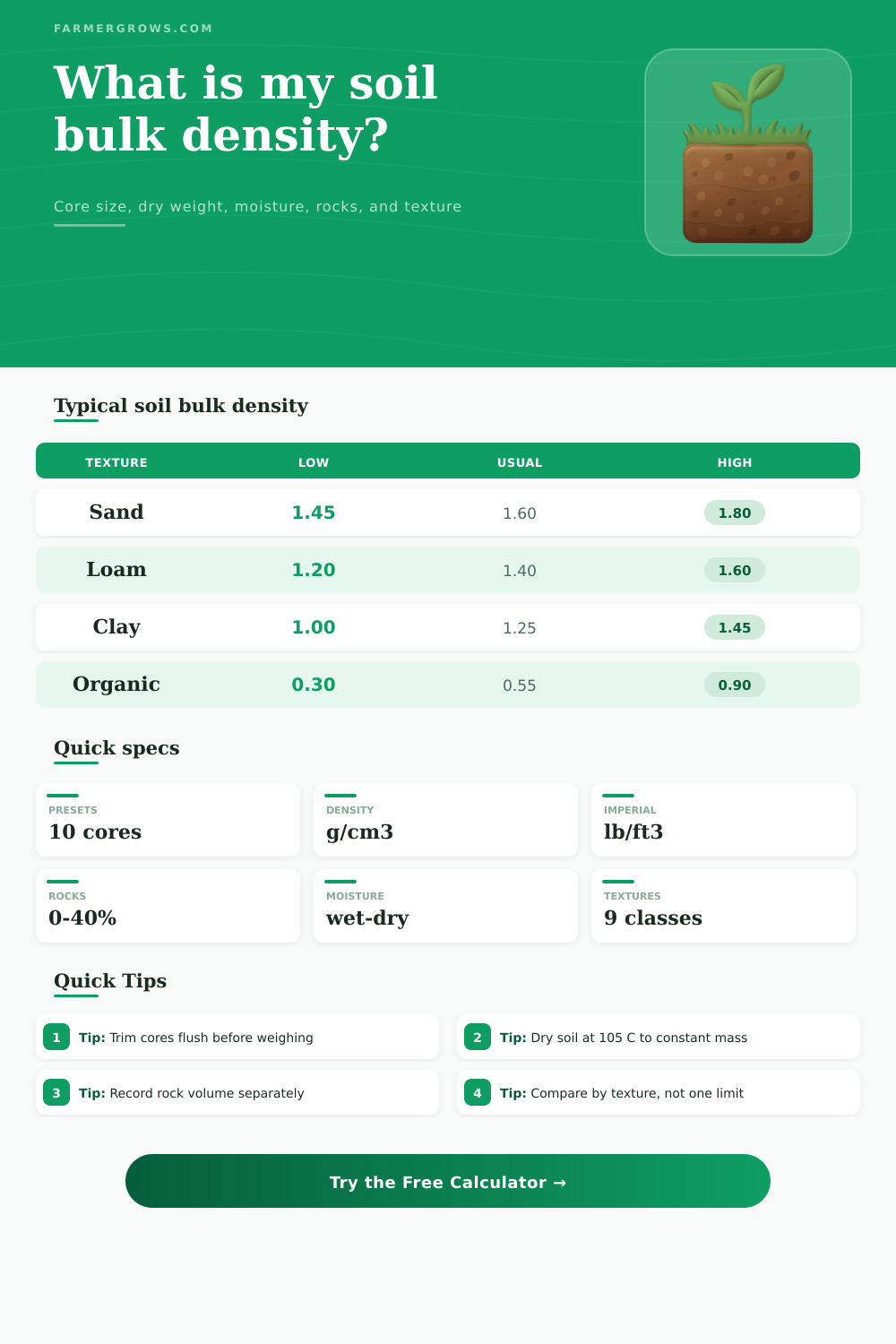
Typical ranges vary with structure and organic matter. The active card highlights the texture selected in the calculator.
Sand
Loamy Sand
Sandy Loam
Loam
Silt Loam
Clay Loam
Silty Clay
Clay
Organic Mix
▥ Bulk Density Reference by Texture
| Texture | Typical low | Usual range | Root caution level |
|---|---|---|---|
| Sand / loamy sand | 1.40 g/cm³ | 1.45-1.80 g/cm³ | Above 1.70 g/cm³ |
| Sandy loam | 1.25 g/cm³ | 1.30-1.65 g/cm³ | Above 1.60 g/cm³ |
| Loam / silt loam | 1.05 g/cm³ | 1.10-1.55 g/cm³ | Above 1.45 g/cm³ |
| Clay loam | 1.00 g/cm³ | 1.10-1.45 g/cm³ | Above 1.40 g/cm³ |
| Clay / silty clay | 0.95 g/cm³ | 1.00-1.40 g/cm³ | Above 1.30 g/cm³ |
| Organic or peat mix | 0.20 g/cm³ | 0.30-0.90 g/cm³ | Use crop-specific limits |
◇ Core Ring Volume Table
| Inside diameter | Core height | Volume | Dry mass at 1.30 g/cm³ |
|---|---|---|---|
| 5.0 cm | 5.0 cm | 98.2 cm³ | 127.6 g |
| 5.4 cm | 3.0 cm | 68.7 cm³ | 89.3 g |
| 7.5 cm | 7.5 cm | 331.3 cm³ | 430.7 g |
| 2.0 in | 2.0 in | 102.9 cm³ | 133.8 g |
| 3.0 in | 3.0 in | 347.5 cm³ | 451.8 g |
▱ Compaction Class Table
| Class | Density signal | Field clue | Sampling note |
|---|---|---|---|
| Loose / tilled | Below texture range | Fragile aggregates, recent tillage | Resample after settling |
| Good aggregation | Middle of texture range | Visible pores and roots | Use as field baseline |
| Moderate compaction | Near upper range | Platy zones or traffic lanes | Compare trafficked and untrafficked cores |
| High compaction | Above caution level | Root flattening or perched water | Sample by depth increment |
| Severe compaction | Well above caution level | Hard pan, poor rooting, slow infiltration | Confirm with penetrometer and roots |
◈ Formula and Conversion Table
| Item | Formula | Metric result | Imperial result |
|---|---|---|---|
| Cylinder volume | π x (diameter / 2)² x height | cm³ | in³ converted to cm³ |
| Dry bulk density | oven-dry mass / core volume | g/cm³ | g/cm³ x 62.428 |
| Gravimetric moisture | (wet mass - dry mass) / dry mass x 100 | % of dry soil | same percent |
| Fine-earth correction | dry mass / (volume x (1 - rock %)) | g/cm³ | lb/ft³ |
| Porosity estimate | 1 - bulk density / particle density | % pore space | same percent |
⚠ Sampling Tips
Soil bulk density are a measurement of how much solid material exist within a specific volume of soil. Soil bulk density is an important measurement in agriculture because soil bulk density impact both how roots of the plant are able to move through the soil, as well as how much water can move through that soil. High bulk density indicate that the soil is packed tightly, while low bulk density indicate that the soil is relatively loose.
Soil bulk density can be determine by placing a core sampler into the soil, which will naturaly capture a cylinder of soil within the metal ring. The bulk density of the soil can be calculate by dividing the oven-dry mass of the soil by the volume of the soil sample (as measured by the core sampler). Bulk density can be expressed in grams per cubic centimeter (gm/cm3), or in pounds per cubic foot (lb/ft3).
What is soil bulk density?
A bulk density calculator can be used to determine bulk density, the calculator accounts for the dimension of the core sampler and the weight of the soil samples. Furthermore, the calculator is also able to account for rock fragment within the soil samples. The bulk density value can be impacted by the texture of the soil.
Soil texture impact bulk density because soils that contain sand particle tend to have higher bulk densities than soils that contain clay particle (due to the smaller size of clay particle). A bulk density of 1.35 gm/cm3 may be good for loam soil, but may indicate a problem for clay soil. Therefore, bulk density value should of be compared to a reference grid that relate bulk densities to soil texture.
The bulk density of soil sample can also be impacted by moisture content. Wet soil sample will have more weight than dry soil sample. To calculate bulk density, it is necessary to dry the soil sample to 105 degree Celsius to remove the water from the soil.
By weighing the soil sample while wet versus when they are oven-dried, the gravimetric moisture of the soil can be determined. Additionally, soil sample may contain rock fragment. These fragment can increase the bulk density of soil sample.
To account for the presence of these rock fragment in soil sample, the percentage of volume that the rock fragment occupy can be entered into a bulk density calculator. The calculator will calculate the bulk density of the soil matrix alone. This value will be a better indicator of how the roots and microbe will grow within the soil.
Bulk density sample can be used to determine the compaction class of soil sample. If bulk density measurement fall within the middle of the range for a given soil texture, the soil sample likely have good aggregation and pore space within the soil. Bulk density near the upper end of the range for soil texture sample may indicate effects from traffic within the soil.
Bulk density that fall above a caution threshold for a specific soil texture may indicate slow infiltration of water within the soil or flattened root within the soil sample. Porosity (the amount of pore space in the soil) can be calculate using particle density measurement and bulk density measurement. The particle density of soil is around 2.65 gm/cm3.
Porosity is determined by dividing the difference between particle density and bulk density by the particle density. Porosity impact the amount of air and water that can be held within the soil sample. Soil sample may have a relatively good bulk density but have poor porosity if the particle density of the sample is relatively low.
Quality bulk density measurement are obtained by properly collecting soil sample with the core sampler. The sampler must be drive in a straight line into the soil. The end of the soil core sample must be trimmed to ensure that the volume of soil is the same as the volume of the metal core sampler.
Finally, the researcher must seal the soil sample when being transport to the laboratory to ensure that the moisture content of the sample does not change prior to taking the wet weight measurement of the sample. A bulk density measurement can be taken at any given time. However, bulk density may change over time due to seasonal moisture content change, tillage operation on the land, or the movement of agricultural vehicle over the land.
To gain an accurate understanding of soil bulk density within a field, several soil core should be sampled from different area of that field. Averaging the bulk density of several soil sample will provide an understanding of the soil within a field as a whole. Finally, by establishing a baseline bulk density measurement for a field, it is possible to determine how that soil change over time.