Cover Crop Seeding Rate Calculator
Estimate seed needed from area, species or mix, seeding method, PLS, germination, target stand, row spacing, termination goal, and overage.
Enter acres to be seeded.
Custom mix shares are scaled to 100% automatically, so partial blends still calculate cleanly.
Calculation Breakdown
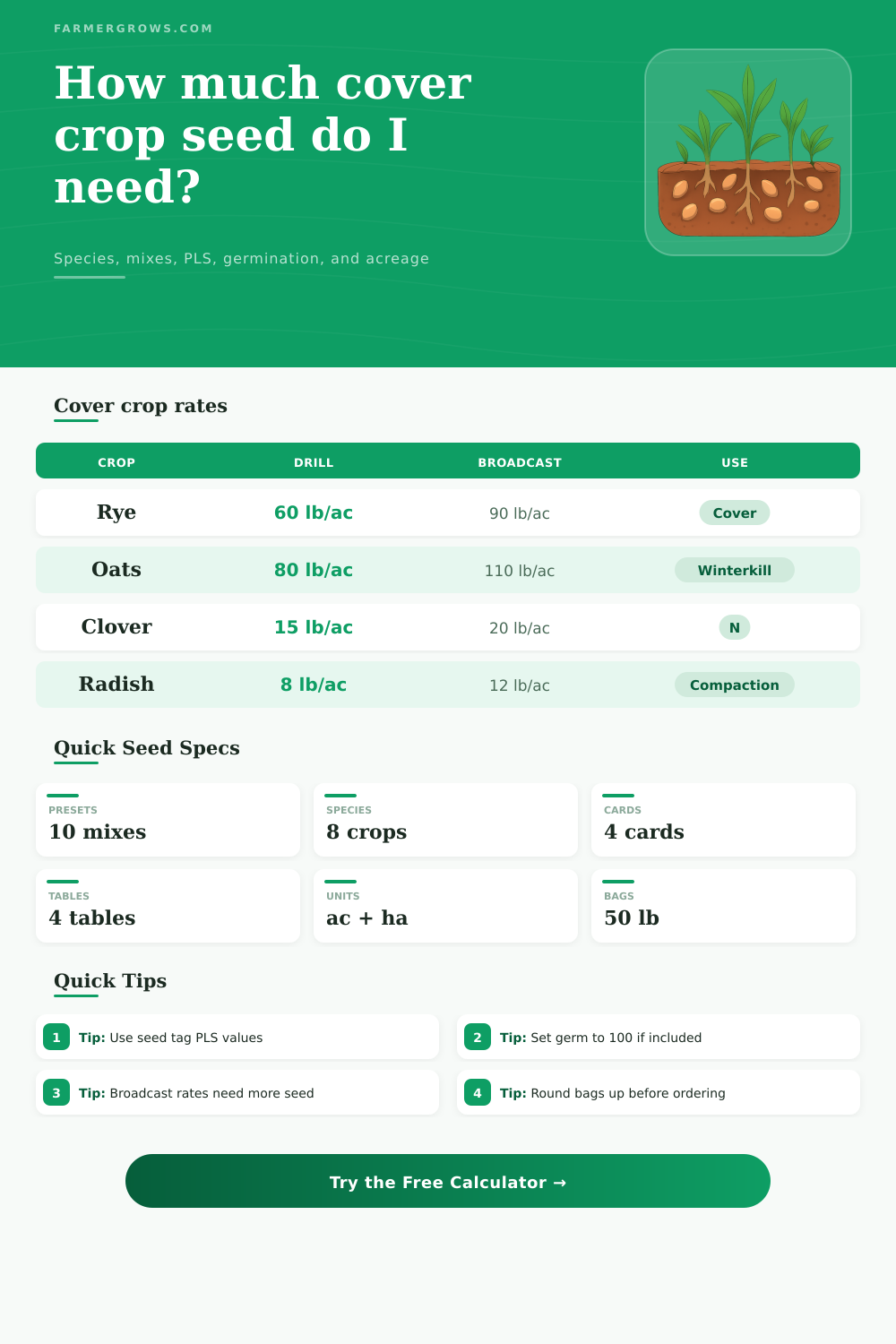
| Species | Drilled Rate | Broadcast Rate | Seeds Per Pound | Common Role |
|---|---|---|---|---|
| Cereal rye | 60 lb/ac | 90 lb/ac | 18,000 | Winter cover and weeds |
| Spring oats | 80 lb/ac | 110 lb/ac | 14,000 | Winterkill biomass |
| Crimson clover | 15 lb/ac | 20 lb/ac | 150,000 | Nitrogen source |
| Hairy vetch | 20 lb/ac | 30 lb/ac | 16,000 | Nitrogen and residue |
| Daikon radish | 8 lb/ac | 12 lb/ac | 32,000 | Nutrient scavenging |
| Austrian winter peas | 70 lb/ac | 100 lb/ac | 4,000 | Legume forage |
| Buckwheat | 50 lb/ac | 70 lb/ac | 15,000 | Summer smother crop |
| Annual ryegrass | 20 lb/ac | 30 lb/ac | 225,000 | Fine-rooted grass cover |
| Named Mix | Typical Drilled Recipe | Full Rate | Best Fit | Watch Point |
|---|---|---|---|---|
| Rye and vetch | 45 rye + 15 vetch | 60 lb/ac | Spring biomass and N | Terminate before rye gets rank |
| Oat, radish, pea | 50 oats + 4 radish + 35 peas | 89 lb/ac | Winterkill soil builder | Seed early enough for peas |
| Pea and oat | 55 peas + 45 oats | 100 lb/ac | Forage or green manure | Large seed needs depth |
| Ryegrass and clover | 15 ryegrass + 8 clover | 23 lb/ac | Living aisle or pasture | Manage spring competition |
| Seeding Method | Multiplier | Why It Changes | Best Use | Calibration Note |
|---|---|---|---|---|
| Drilled or no-till drill | 1.00 | Good placement and contact | Most field seedings | Check cups and seed tubes |
| Broadcast and incorporated | 1.20 | Less uniform placement | Prepared seedbed | Incorporate shallowly |
| Broadcast on surface | 1.35 | Bird loss and poor contact | Rain-aided fall seedings | Time before moisture |
| Aerial or overseed | 1.50 | Canopy and weather losses | Standing crops | Use higher vigor lots |
| Precision planted rows | 0.90 | Accurate singulation | Large seed crops | Confirm seed spacing |
| Management Goal | Multiplier | Typical Stand Target | Useful Crops | Planning Note |
|---|---|---|---|---|
| Standard spring termination | 1.00 | 100% | Rye, oats, clover | Balanced cover and seed cost |
| Winterkill cover | 1.05 | 100-110% | Oats, radish, peas | Needs fall growing degree days |
| Heavy weed suppression | 1.20 | 110-125% | Rye, buckwheat | Prioritize quick canopy |
| Nitrogen green manure | 1.15 | 100-120% | Clover, vetch, peas | Let legumes reach biomass |
| Fall grazing or forage | 1.25 | 120-140% | Oats, peas, rye | Leave recovery residue |
| Low-residue early termination | 0.85 | 75-90% | Radish, oats | Avoid over-thick spring mats |
Cover crop seeding rate is a calculation of how much seed is require to be planted into a field. When calculating the seeding rate for a cover crop, there is alot of different factor that must be considered. Factors to consider include the seeding method, the quality of the seed to be use, and the goals for that cover crop.
Each of these factor will play a role in the determination of how many pound of cover crop seed will need to be planted into a field. One of the factor that determine the seeding rate is the factor of pure live seed percentage. The pure live seed percentage will indicate how many pounds of seed in a bag are composed of live seeds that will germinate, and how many pound are composed of dead seeds.
How to Calculate Cover Crop Seeding Rate
Another important factor to consider is germination rate. Germination will help to indicate how many of the live seeds will actualy grow as a result of the condition within the field in which they are to be planted. Factors such as target stand percentage will help to determine how dense you would like the stand of cover crops to be within the field.
Factors such as row spacing will have an effect upon the rate of seeding because wider rows will require more seed to ensure that each row is cover, and termination goal will also impact the rate of seed to be planted into the field. The seeding method will have a major impact upon the rate of seed that is to be planted into a field. If drill are to be used to plant the cover crop, less seed will be required than if the seed is to be spread across the field.
Broadcasting seed can lead to some of the seed drying out or being eaten by birds, so the farmer will need to plant more seed than if drill were used. Aerial seeding is another method of planting cover crop that will require the highest rate of seeding because some of the seed will be lost during this planting method. If a mix of different species of cover crops are to be planted, then additional factor will impact the seeding rate.
For instance, planting a mix of rye and vetch may lead to more even germination of the species, but the difficulty in planting these two species can make it difficult for the planting rates to even be create for this mixture of species. The calculator will make allowances for mixes of species by also revealing how much of each individual species is to be planted. In addition to factor like species and seeding methods, there are also environmental factor that will impact the seeding rate.
Factors such as slope of the field, amount of residue from previous crop, and the climate within the field will each impact how many seed land in each field. Each of these factor allow for additional seed to be planted into the field in addition to the rate calculated by the calculator; a ten percent overage is provided for normal field, but a twenty percent overage can be made for odd field or fields with blended seed. Finally, the total weight of the seed should be rounded to the nearest bag of seed to ensure that the proper amount of seed will be ordered.
Care must be taken when reading the tag that are provided with the seed bag. Some tag will include the pure live seed percentage within the total number of pounds of the seed bag. Applying both corrections for the pure live seed and germination percentage to that number will result in double-counting those percentage.
In these instances, the germination percentage should be adjusted to 100%. Additionally, row spacing for the fields to be planted with the cover crops must also be considered. Wide row will require more seed to cover each acre of field if the drill is not adjusted.
Reference table can be used to determine the different rate of cover crop seeds to be planted into field. These table can show the difference between drilled planting rate and broadcast rate for different species of cover crops. Additionally, other table can show the impact that different multiplier will have upon the seeding rate.
These table can be useful in determining the seeding rates for cover crops, but they do not replace the need for an individual decision-maker of those rates. Another step in the process of determining the proper seeding rate for a field is the calibration of the equipment that will be used to plant the cover crops. Regardless of the calculation of the seeding rates, the rate will only be accurate if the seeding equipment is properly calibrate.
Calibrating the seed dispersal equipment will allow farmers to ensure that the proper amount of seed is being disperse into the field. This calibration can be performed with calculating the rate of seed that is being dispersed over a measured distance of field; by weighing that amount of seed, farmer can adjust the seeding equipment accordingly. The calculator will determine the rate that is to be applied to a field; however, calibration will confirm that the target rate for that field is achieve.
Aside from simply determining how many pound of cover crop seed will be planted into each field in which those cover crops will grow, another goal for calculating the seeding rate is to determine how many pound of live seed should be planted into the field. Furthermore, the goal is to plant the amount of seed that will allow the cover crop to fulfill its function without overspend on seed purchase. Finally, by removing the mathematical calculation that would typically be performed when calculating the seeding rate, the calculator allows for individual farmer to focus upon the various factor of each field that needs to be seeded with cover crops.