Harvest Yield Calculator
Estimate field yield, marketable harvest, moisture shrink, succession volume, and storage units from crop spacing and growing area.
Leaf lettuce
Tomato
Potato
Wheat
| Crop | Plant or row range | Field range | Best calculator basis |
|---|---|---|---|
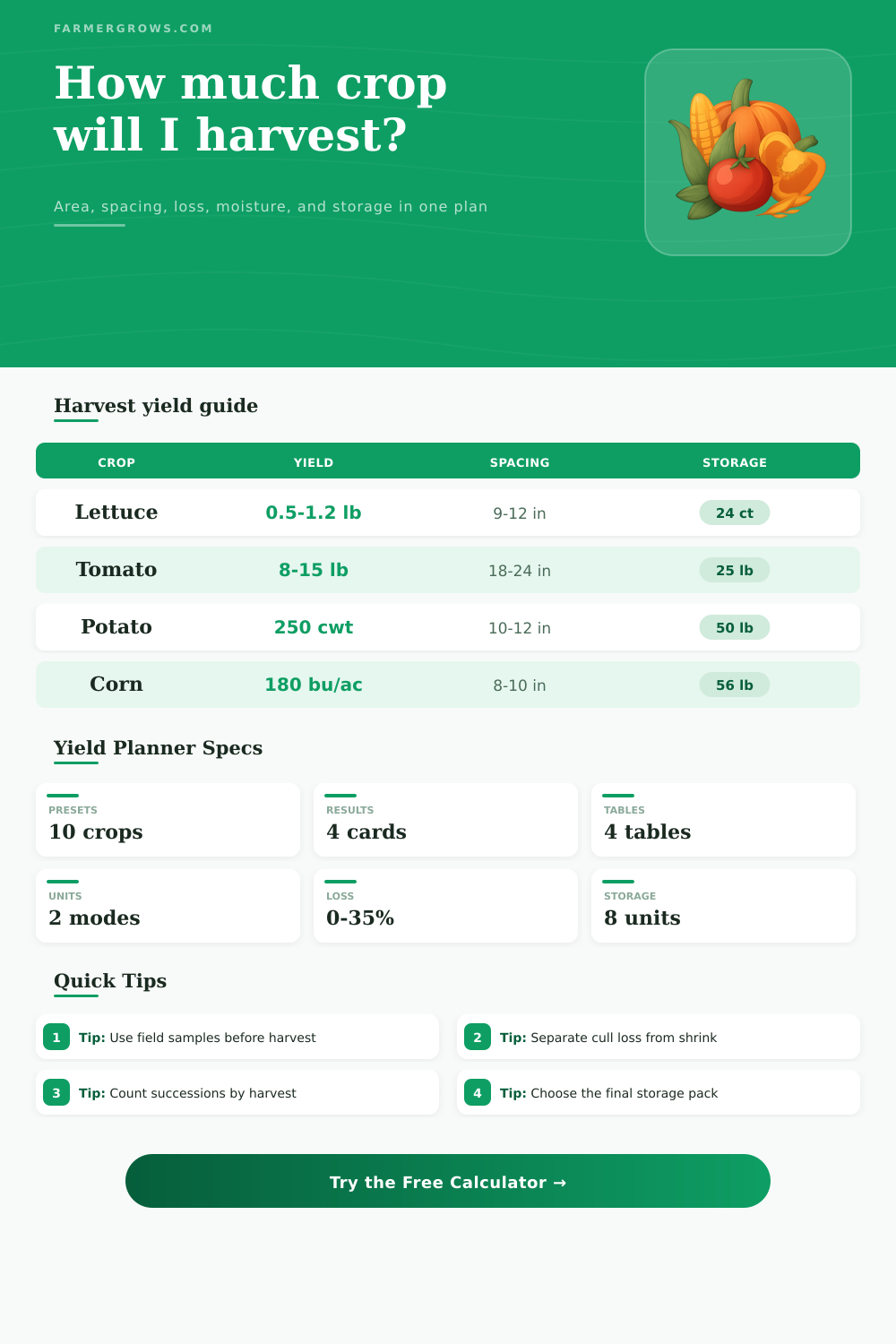
| Leaf lettuce | 0.5-1.2 lb per plant | 12,000-30,000 lb/ac | Per plant for beds |
| Tomato, staked | 8-15 lb per plant | 25,000-60,000 lb/ac | Per plant or acre |
| Sweet corn | 1 marketable ear per plant | 14,000-22,000 ears/ac | Per acre |
| Potato | 1.5-3.5 lb per plant | 200-400 cwt/ac | Per acre |
| Strawberry | 0.5-1.5 lb per plant | 10,000-25,000 lb/ac | Per plant |
| Carrot | 0.8-1.8 lb per row ft | 20,000-40,000 lb/ac | Per row length |
| Spacing pattern | Approx plants/ac | Plants per 100 ft row | Common use |
|---|---|---|---|
| 6 in plants, 18 in rows | 58,080 | 200 | Greens, herbs |
| 12 in plants, 18 in rows | 29,040 | 100 | Lettuce, cabbage |
| 18 in plants, 48 in rows | 7,260 | 67 | Tomato, pepper |
| 30 in plants, 30 in rows | 6,970 | 40 | Sweet corn hills |
| 36 in plants, 72 in rows | 2,420 | 33 | Pumpkin, squash |
| Tree 10 ft by 14 ft | 311 | Not row-based | Orchard blocks |
| Storage unit | Calculator weight | Best crops | Notes |
|---|---|---|---|
| 20 lb produce crate | 20 lb | Greens, cucumbers | Reusable harvest crate |
| 25 lb tomato box | 25 lb | Tomato, pepper | Common wholesale pack |
| 24 count lettuce case | 24 lb | Lettuce heads | Use actual head weight |
| 50 lb sack | 50 lb | Potato, onion | Storage crop bag |
| Corn bushel | 56 lb | Shelled corn | Grain standard weight |
| Wheat bushel | 60 lb | Wheat, soybean | Grain standard weight |
| Adjustment | Typical range | When to use it | Calculator effect |
|---|---|---|---|
| Field harvest loss | 5-20% | Missed, damaged, or unpicked crop | Reduces raw yield |
| Cull and grading loss | 3-15% | Size, blemish, and wash line rejects | Reduces marketable yield |
| Moisture shrink | 0-18% | Grains, dry beans, cured storage crops | Converts wet to storage weight |
| Succession count | 1-8 rounds | Repeated bed plantings or harvest flushes | Multiplies total yield |
Planning a harvest require you to determine how much produce you will harvest from the field and to account for the differences between the estimate of the amount of produce that will be harvested and the actual amount of that produce that is harvested. The estimate of the amount of produce from a field is often different than the actual weight of the produce that is harvested due to various factor. If the estimate of the amount of produce that will be harvested from a field is incorrect, its possible that you will become out of crate with the amount of produce that is available or you may need to hire an extra truck to transport the produce from the field.
The first step in calculating the amount of produce that can be harvested from a field is to determine the total square footage of the area that will be utilized for planting the crops. The total square footage are calculated by multiplying the length of a bed of crops by the width of that same bed. The total square footage of the field can be used to calculate the total amount of plant that can be planted in the field by considering the number of plants that can be planted in a certain area of the field.
How to Plan and Estimate Your Harvest
The number of rows in the field and the distance between each of those rows can be used to calculate the total yield that will be produced by the field. Additionally, multiplying the amount of produce that can be harvested from each individual plant by the total number of plants in the field will produce a figure that indicates the total yield of that field. The calculator provides a way of processing these factors to determine if the yield of the field will be accurate based off the health of the plant that are to be grown in that field.
It is normal for the estimated yield of the field to be not accurate to the actual amount of produce that will be harvested from the field. One of the reasons that yields are not accurate is due to the losses of the produce that occurs both in the field and during the packaging of the produce. Losses of produce in the field may occur due to the fact that the produce is too small, damaged, or missed during harvesting passes of the field.
Losses of produce that occur during packaging may happen during washing of the produce or during grading of the produce. The user can enter both of these percentages into the calculator so that the calculator can reflect the total yield of the field. For instance, if there is a ten percent loss of produce in the field and a five percent loss during packaging, the total loss will be more than fifteen percent of the total yield of the field.
Moisture shrinkage may occur in fields of crops like grains or crops that are cured prior to harvesting. The moisture content in the produce at the time of harvest may have a higher percentage of moisture then the percentage of moisture that is required in the produce when it is delivered to the buyer or stored in a bin. The moisture content percentage can be entered into the calculator so that the calculator indicates the shrinkage of the percentage of the total weight of the produce.
The shrinkage can be utilized in the calculator for crops that will have a significant amount of moisture, but it can be ignored for produce that does not contain as much moisture. Additionally, this factor can be used to calculate the amount of different types of crops that will be grown in a field. Another factor that can be entered into the calculator is the use of succession plantings.
Succession plantings are used to continuously pick from the same field bed. Succession planting is not the same as planting in different fields. The total yield of the produce can be calculated by multiplying the base yield of the planting by a factor that calculates the number of times that the field can be picked during a certain period.
The use of succession planting allows individuals to keep a cooler full of produce for longer periods of time. Additionally, it allows individuals to avoid sending too much produce to the market during a certain amount of time. Individuals can use the calculator to determine in what number of storage unit the produce will be stored.
Storage units may be twenty-five pound boxes of tomatoes, fifty pound sacks of potatoes, or another type of bulk bin that is used for storing produce. Dividing the total weight of the produce by the number of pounds of produce that can be stored in each storage unit will allow individuals to determine the number of storage units that must be staged prior to the arrival of the transport trucks. Knowing the number of storage units will allow individuals to determine if there will be an extra pallet of produce that must be prepared or if the individual has enough storage units in the shed.
Reference tables provide information regarding the spacing that is used in the field and the yield of the produce that may be grown in the field. These tables may change according to the region in which the field is located, the type of produce that is to be grown in the field, and the season in which the field is to be planted with the produce. For instance, a field of lettuce with twelve inch spacing will have different results than a field of lettuce with eighteen inch spacing.
Additionally, produce may have larger heads with wider spacing within the field, but there will be fewer plants in that field. These reference tables can show the yields of individual plants to ensure that they are within the normal band of yields of that particular type of plant. Individuals may make various mistakes when entering the data into the calculator.
For instance, an individual may be unaware that the number of plants in a row may change if the planting rows change from single rows to multi-row beds. Additionally, individuals may enter the total percentage of losses from the field to the market without separating the percentage of losses in the field from the percentage of losses during packaging. Other mistakes may be ignoring the moisture shrink percentage for crops like wheat or beans.
By ignoring the percentage that accounts for the moisture that evaporates from the crop at the time of harvest, the individual may find that the bin weights of the harvested crop is less than the estimate that is entered into the calculator. To avoid these mistakes, individuals can enter fields that separate the percentage of field loss, packaging loss, and moisture loss. The climate in the region where the field is to be planted may also change the accuracy of the estimate of the yield of the field.
For instance, areas that experience heat waves may have an impact upon the size of tomatoes that are grown in the region. Additionally, wet climates may lead to increased field loss due to the impact of precipitation upon the fields. The individual can calculate the yield of the field and enter it into the calculator so that if the weather changes, the individual can enter the new percentages for field loss or yield per plant so that the individual knows how many produce units will be shipped.
This number will be essential to individuals in the field who are walking the rows and those who are in the boxes who will be packing the boxes of produce. The numbers that are calculated in the calculator will allow individuals to have an awareness of the amount of produce that is to be grown in the field and the number of storage units that will be required to store all of the produce. These numbers will allow individuals to prepare the field, storage units, and even transporters of the produce to the market.