Sprinkler Spacing Calculator
Estimate run spacing, row spacing, and head counts from sprinkler type, layout, overlap, pressure, and zone size before you stake a single head.
Pick a common irrigation pattern, then tune the spacing for your actual pressure and wind. Each preset uses a different mix of head type, layout, and zone shape.
Sprinkler Spacing Results
Enter your zone details to estimate spacing and head count.
Equal rows and runs. Best when the area is simple, the throw is consistent, and you want easy stakeout math.
Staggers heads so each point sees more overlap. It is the strongest choice for open turf and broad uniformity.
A practical middle path for rectangles. It keeps spacing tidy while softening dry bands near long edges.
Focuses coverage into narrow lanes. Use it for borders, pathways, and long beds where full squares waste water.
| Head type | Throw | Pressure | Typical use |
|---|---|---|---|
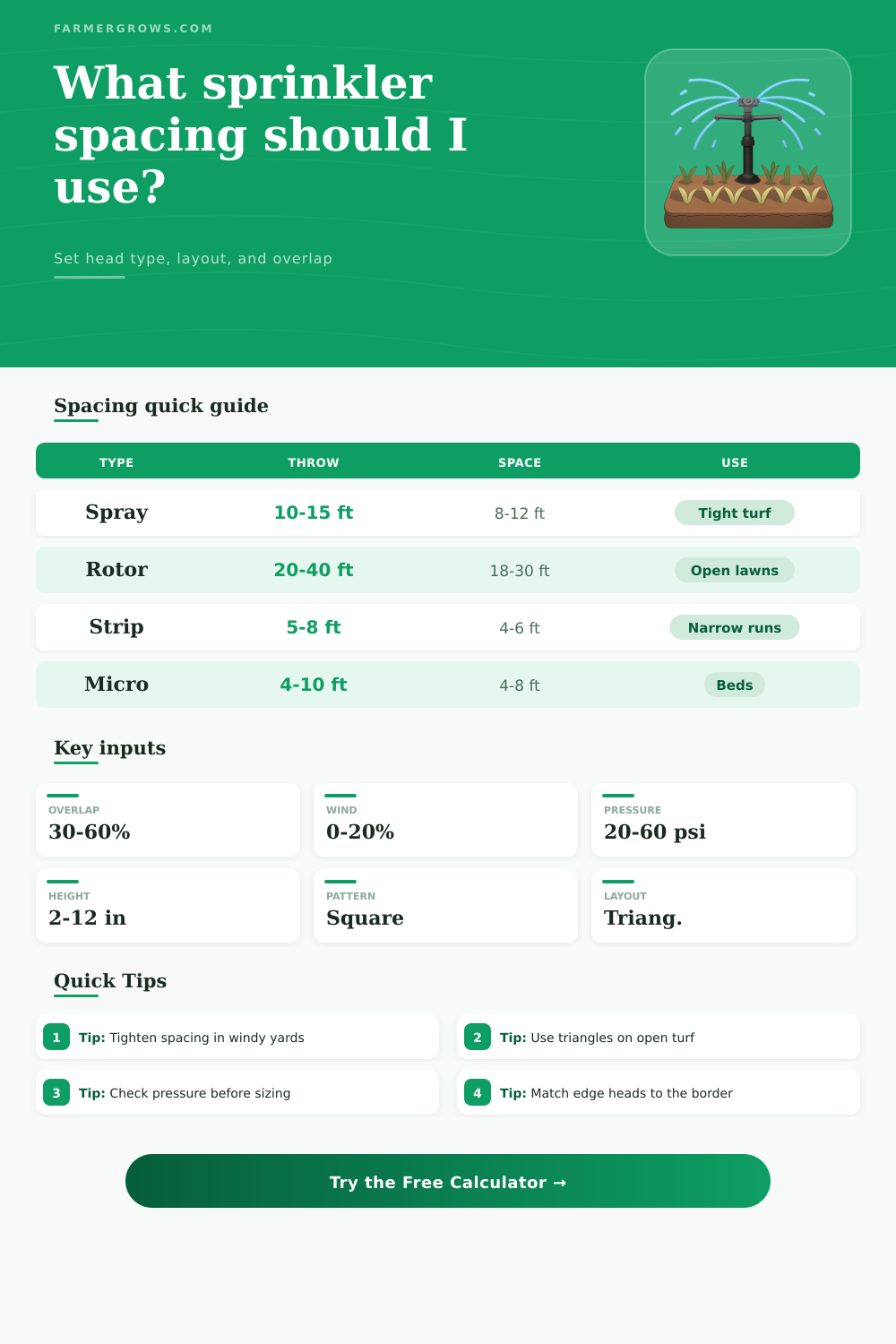
| Fixed spray | 10-15 ft | 20-30 psi | Small lawns |
| Rotor head | 20-40 ft | 35-55 psi | Open turf |
| Rotary nozzle | 12-18 ft | 25-40 psi | Low flow |
| Shrub head | 6-10 ft | 20-35 psi | Corners |
| Strip pattern | 5-8 ft | 15-30 psi | Runs |
| Micro spray | 4-10 ft | 15-25 psi | Beds |
| Layout | Run factor | Row factor | Best use |
|---|---|---|---|
| Square | 1.00 | 1.00 | Simple zones |
| Triangular | 1.15 | 0.87 | Best uniformity |
| Staggered | 1.08 | 0.92 | Long rectangles |
| Strip | 0.72 | 1.00 | Narrow corridors |
| Overlap | Spacing | Good for | Note |
|---|---|---|---|
| 30% | 0.70 x throw | Wide open areas | Lower density |
| 40% | 0.60 x throw | General turf | Balanced |
| 50% | 0.50 x throw | Head-to-head | Standard |
| 60% | 0.40 x throw | Hot wind zones | Tighter grid |
| Zone | Area | Spacing | Heads |
|---|---|---|---|
| 20 x 30 ft | 600 sq ft | 12 ft | 18 |
| 30 x 40 ft | 1200 sq ft | 16 ft | 20 |
| 40 x 60 ft | 2400 sq ft | 18 ft | 24 |
| 50 x 80 ft | 4000 sq ft | 20 ft | 30 |
Use this sprinkler spacing calculator to match head type, layout, and overlap before you dig. It helps keep turf coverage even, reduces dry stripes, and speeds clean zone planning.
Irrigation spacing is a processes that requires precise calculation to ensure that your lawn does not develop dry patch due to improper irrigation spacing. Many people attempts to install irrigation systems for lawns by guessing the distance between the sprinkler head. However, the guessed distance of sprinkler heads can result in uneven coverage of the lawn by water.
Water do not travel in a perfect circle from the sprinkler heads out into the lawn. Wind can affect the water and changes in the water pressure throughout the irrigation system also affect water. It is necessary to calculate the spacing of the sprinkler heads before installing the irrigation system in the lawn to ensure that the lawn receives the proper amount of water and that the grass is not killed due to under-watering.
How to Space Sprinkler Heads for an Even Lawn
The throw diameter of the sprinkler heads as listed in the sprinkler box is a theoretical measurement of the distance that the water from the sprinkler head will travel. However, the actual distance that the water will travel in the backyard may be less than the theoretical distance. Various factor can impact the actual throw distance of the sprinkler heads, such as the height of the sprinkler head and the actual water pressure that exists in the irrigation system pipes.
If the water pressure is too low, the water will not be able to reach the next sprinkler head that is install in the lawn. This will result in a dry spot in the lawn. If the water pressure is too high, the water will become a mist and the sprinkler head will blow it away from the area of the lawn that is intended to be water.
An irrigation calculator can help the designer of the irrigation system account for these factor. Head-to-head overlap is one of the fundamental rule of irrigation. Head-to-head overlap ensures that the water that the sprinkler heads distribute is even across the entire area of the lawn.
A person may think that if the sprinkler head’s throw distance is 15 feet, the distance between the sprinkler heads should be 30 feet. However, this is not true of sprinkler heads. The most amount of water will fall equate to the sprinkler head.
Therefore, the spray from one sprinkler head should reach the base of the next sprinkler head. Head-to-head overlap creates a redundant layer of coverage for the sprinkler heads. The more percentage of head-to-head overlap that is present, the more even the irrigation of the lawn will be.
However, a lower percentage of head-to-head overlap is appropriate for narrow garden bed. The layout pattern that is use for the sprinkler heads for the lawn must match the geometry of the yard. One of the simplest layout pattern for sprinkler heads is a grid pattern.
However, a grid pattern may leave a dry spot in the center of the lawn. Professionals who lay sprinkler heads often prefer a triangular layout pattern. A triangular layout requires more sprinkler heads and more irrigation system pipe than a grid pattern.
However, it is a preferred layout pattern for those who have a wider yard. For long and narrow yards, such as driveways, a strip layout is an efficient layout pattern. The type of nozzle for the sprinkler heads must also be chosen.
Fixed spray heads is good for small area of the lawn. However, they are less efficient than rotors if used to water large area of the yard. The rotors will travel the water further from the sprinkler head and the rotors will move the water at a more slower rate.
This allows the water to absorb into the soil rather than run off the lawn. Micro spray and shrub sprinkler heads are used for planting bed in the lawn. These types of sprinkler heads allow for the targeted delivery of water to these area rather than allowing a rotor system to drown the plants in the planting bed.
Wind may also impact the sprinkler head system. The wind can impact the effective diameter of the sprinkler heads. In area of a yard where there will be high wind, the effective diameter of the sprinkler head will shrink.
For these area, the distance between the sprinkler heads should be tightened to compensate for the drift that the water will have due to the wind. This will prevent parts of the lawn from drying out while other parts of the yard remain wet. The last step in planning an irrigation system for a yard is to determine the total number of sprinkler head that are to be installed in the yard.
A balance must be found between a small number of sprinkler heads but with enough head-to-head overlap to ensure even coverage of the yard. It is more cost-effective to install an extra sprinkler head in the initial installation of the sprinkler system than it is to add sprinkler head later to water area of the lawn that have been dried out due to improper installation of the sprinkler system. Various factor, such as the effect of wind, should of been accounted for in the initial installation plan to ensure that every inch of the turf in the yard receives an even amount of water.