Aquaponics Fish Calculator
Estimate safe biomass, fish count, daily feed, and ammonia load from your tank, grow bed area, species, feeding rate, protein, and temperature.
Aquaponics Fish Output
Safe biomass is limited by tank density, grow-bed feed load, species temperature, and your selected safety margin.
| Species | Safe density | Feed rate | Notes |
|---|---|---|---|
| Tilapia | 25-40 kg/m3 | 1.5-3.0% | Warm, hardy, forgiving |
| Trout | 12-20 kg/m3 | 1.0-2.0% | Cool water, high oxygen |
| Catfish | 20-35 kg/m3 | 1.5-2.5% | Good solids handling |
| Koi | 5-12 kg/m3 | 0.8-1.5% | Ornamental, low feed |
| Perch | 15-25 kg/m3 | 1.2-2.0% | Strong beginner choice |
| Stage | Feed % | Use case | Management note |
|---|---|---|---|
| Fingerlings | 3.0-5.0% | Rapid growth | Small pellets, check daily |
| Juveniles | 2.0-3.0% | Common loop load | Watch ammonia after feeding |
| Subadults | 1.5-2.0% | Stable production | Good target for most systems |
| Market size | 1.0-1.5% | Lower growth rate | Less waste, easier filtration |
| TAN level | Meaning | Action | Response |
|---|---|---|---|
| Under 0.25 ppm | Safe | Monitor | Normal cycling |
| 0.25-0.5 ppm | Watch | Trim feed 10% | Boost aeration |
| 0.5-1.0 ppm | Warning | Test daily | Check solids |
| Above 1.0 ppm | Critical | Cut feed fast | Correct the loop |
| System | Typical density | Feed load | Best fit |
|---|---|---|---|
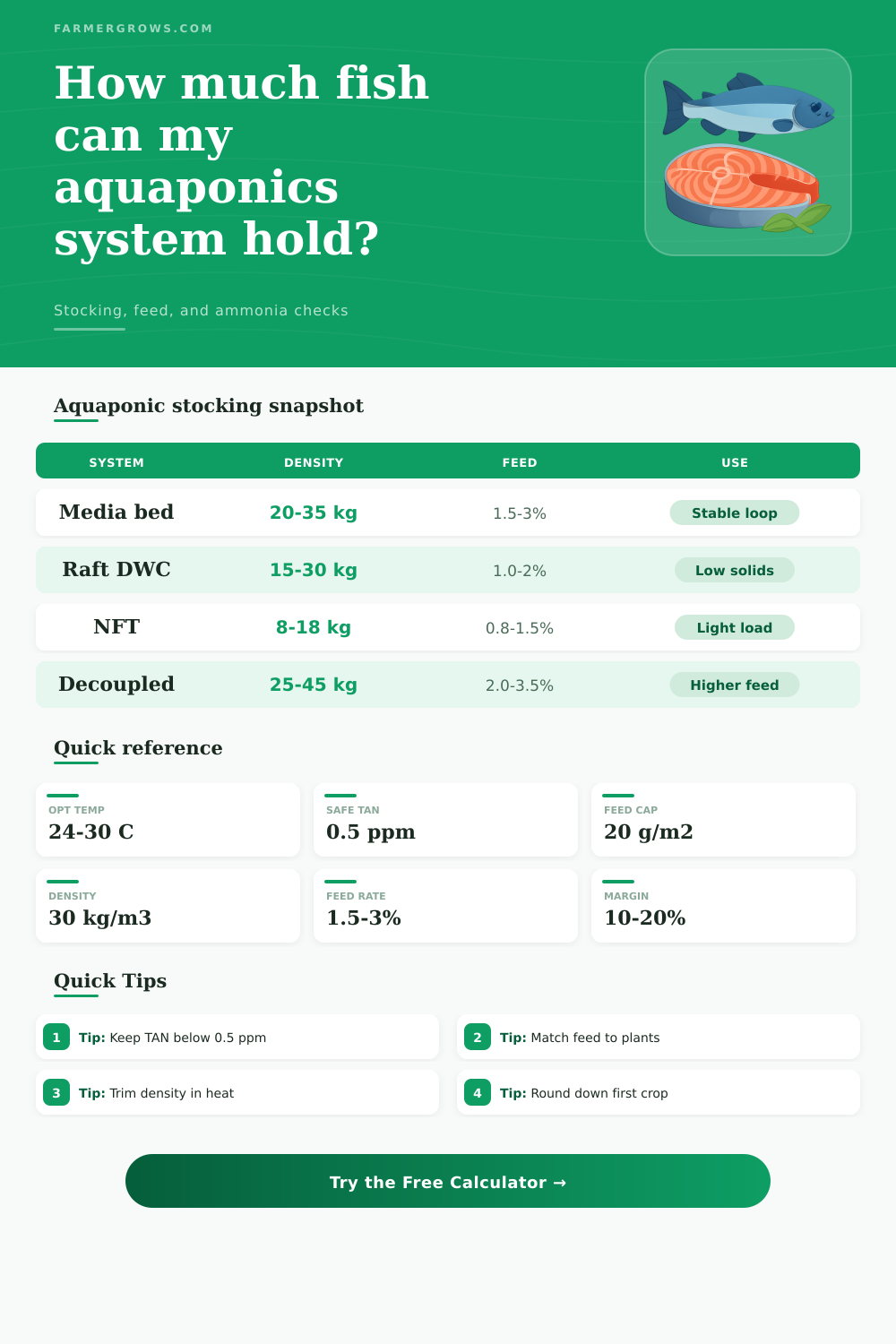
| Media bed | 20-35 kg/m3 | 15-25 g/m2/day | Stable backyard loops |
| Raft / DWC | 15-30 kg/m3 | 10-18 g/m2/day | Leafy green support |
| NFT | 8-18 kg/m3 | 8-14 g/m2/day | Light solids only |
| Decoupled | 25-45 kg/m3 | 18-30 g/m2/day | Higher feed flexibility |
Best for: forgiving backyard setups.
Density: moderate biomass and solids.
Watch: gravel beds clog if overfed.
Best for: leafy greens with stable water.
Density: medium fish loading.
Watch: solids removal matters.
Best for: light fish load, clean water.
Density: lower biomass target.
Watch: channels dislike heavy solids.
Best for: higher feed and tighter control.
Density: top end biomass potential.
Watch: balance both loops carefully.
This aquaponics fish calculator estimates safe biomass, stocking count, daily feed, and ammonia load so you can balance fish health, plant uptake, and system limits before stocking.
Aquaponics is a method of growing plant and fish in a single system. Aquaponics require a balance between the needs of the fish and the needs of the plants. The nitrogen needs of the plant must be balanced with the oxygen needs of the fish.
If these two factor is not balanced, the aquaponics system will fail. Each system has a maximum capacity, and the weakest part of the system establishes that maximum capacity. For example, if the fish tank is too large relative to the grow bed in the system, the grow beds will not be able to process the waste from the fish in the tank.
How to Balance Fish and Plants in an Aquaponics System
Conversely, if the grow beds are too large relative to the fish tank, the plants will not receive enough nutrient from the fish waste. The type of system that a person establishes in aquaponics will impact the amount of biomass that can live in the system. For example, media bed system use gravel and clay to provide support for the plants to grow.
The media in the system act as a biological and mechanical filter for the water. Because of this, media bed systems can support more fish than other systems, such as raft systems or NFT (Nutrient Film Technique) systems, which does not have that media to filter the water. Therefore, raft systems and NFT systems require more discipline to ensure that they are not adding too many fish to the system.
The type of fish that will live in the system will impact the type of system that is created. For example, tilapia can live in warmer water than other fish, and they are generally more forgiving of the mistake that a person may make with the care of the aquarium. Trout, on the other hand, require cooler water in which they live, and the water in which the trout live must have high levels of dissolved oxygen.
If the temperature of the water increases, the amount of dissolved oxygen in the water will decrease. Low level of dissolved oxygen can lead to stress in the trout. Therefore, water temperature is another primary factor in determining the amount of biomass in the system.
One of the most critical aspects of aquaponics is feeding the fish. It might be tempting to feed the fish a large amount of food in order to make the fish grow quickly. However, all of the protein in the food will eventually become ammonia in the water.
Therefore, feeding the fish too much food will create an amount of ammonia that will pollute the system. Finding the proper feed rate for the fish to ensure that they grow but do not overpopulate the system is essential. Knowing the percentage of protein in the feed can predict the amount of Total Ammonia Nitrogen (TAN) in the system.
Therefore, the percentage of protein in the feed must also be tracked to ensure that the system remain healthy. A safety margin must be established in the system. The system should never be stocked to its absolute maximum capacity.
For instance, unexpected event can drastically impact the system. A power outage or a heat wave can make the system unable to establish proper level of oxygen for the fish to survive. Therefore, you should of establish a safety margin of ten or fifteen percent of the maximum capacity of the system to provide a buffer for the beneficial bacteria.
Finally, the limiting factor in the system must be established. The limiting factor is the aspect of the system that prevents the system from supporting more fish or plants. For instance, if the grow beds are the limiting factor, adding too many fish will lead to excess nitrate level in the water, which can be toxic for the fish.
If the fish tank is the limiting factor, stocking the tank with too many fish will lead to stress for the fish. It is important, therefore, to ensure that the capacity of the fish tank and the grow beds is approximately the same to maintain equilibrium in the system. Your wont find a better way to manage the systems size.
Useing a moddern approach to aquaponics is much better then old ways. Most people dont realize that the furnitures in the room doesnt affect the tank but the water quality do. Youll need to recieve regular updates on the nitrogen levels to make sure things stay comfortabley stable.
Its alot of work but the results is worth it.