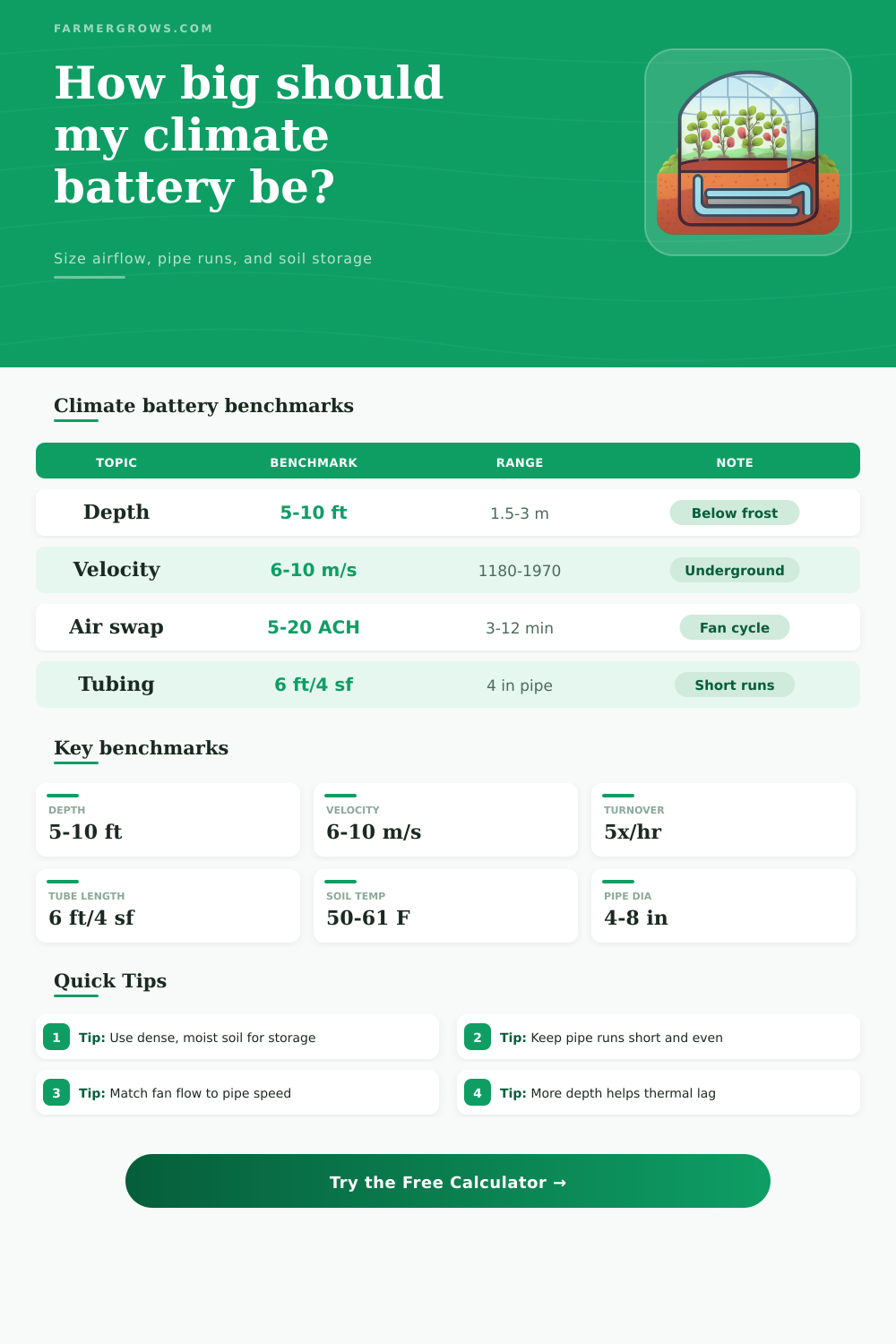
Climate Battery Greenhouse Calculator
Size airflow, pipe runs, burial depth, and soil storage for a climate battery that moves greenhouse heat into the ground and back again.
Pick a real greenhouse layout to seed the fields. Each preset sets footprint, height, airflow, pipe speed, burial depth, storage depth, and soil moisture.
Climate Battery Output
Calculated from greenhouse footprint, ventilation target, buried pipe geometry, and active soil storage.
| Mode | Example | Flow | Note |
|---|---|---|---|
| Minimum cycle | 5 ACH | Turnover in 12 min | HowToGoSolar SHCS |
| Strong loop | 20 ACH | Turnover in 3 min | OneCommunity target |
| Peak cooling | 0.75-1 vol/min | 25.2-33.7k CFM | 950 m3 greenhouse |
| Test rig | 1060 CFM | 3178 ft3 house | VT earth tube study |
| Depth | Metric | Soil band | Note |
|---|---|---|---|
| 5 ft | 1.5 m | Lower band | BC report low end |
| 8 ft | 2.4 m | Field test | VT greenhouse rig |
| 10 ft | 3.0 m | Common band | Below frost line |
| 12 ft | 3.7 m | Deep storage | Near 50 F soil |
| Material | Density | Cp | Volumetric cap |
|---|---|---|---|
| Water | 1000 kg/m3 | 4.18 kJ/kgC | 4.18 MJ/m3C |
| Sandy ground | 1520 kg/m3 | 1.65 kJ/kgC | 2.51 MJ/m3C |
| Wet soil | 1700 kg/m3 | 1.30 kJ/kgC | 2.21 MJ/m3C |
| Concrete | 2400 kg/m3 | 0.75 kJ/kgC | 1.80 MJ/m3C |
| Pipes | Spacing | Example flow | Note |
|---|---|---|---|
| 2 pipes | 5.0 m | 120 cfm | Low density |
| 3 pipes | 2.7 m | 120 cfm | Early gain |
| 5 pipes | 2.7 m | 1633 kWh/yr | Good gain |
| 8 pipes | 1.8 m | 1832 kWh/yr | Strong gain |
A climate battery use the soil to store thermal energy, and a climate battery uses that stored thermal energy to regulate the greenhouse temperature. A climate battery works by absorb the heat from the sun, and then later releasing that heat into the greenhouse. Greenhouse temperature can fluctuate widely; it can be too hot during the day within the greenhouse, and too cold at night.
However, using a climate battery help to prevent these fluctuations in temperature; the climate battery uses the soil as a heat sink to store and release the needed heat energy into the greenhouse as needed. Another factor that impact the effectiveness of a climate battery is the relationship between the movement of the air within the greenhouse and the mass of the soil. In order to effective use the soil as a heat sink, the air must move at a specific rate through the pipes.
How a Climate Battery Keeps Greenhouse Temperature Stable
If the air move too slowly through the greenhouse, the heat will not be able to transfer to the soil to store the energy. However, if the air moves too quickly through the greenhouse, the air will not have time to transfer the heat from the air to the pipes. The depth at which the pipes are buried in the soil is another factor that will impact the climate battery.
If the pipes are buried too shallow in the soil, the heat will escape from the pipes into the atmosphere. Instead, the pipes should be buried deep into the soil where the temperatures is stable. If the pipes are buried deep into the soil, the heat stored in the soil during one month can be used during a later month.
This concept is referred to as a thermal lag. The type of soil in which the pipes are placed will also impact the efficiency of the climate battery. Sandy soil can hold some thermal energy, but moist and dense loam soil will hold more heat energy then sandy soil.
Soil that contains water will release more heat than dry soil; water is a good conductor of heat. Therefore, if the soil becomes too dry, the climate battery will be unable to store as much heat as it should of been able to. The number of pipe runs that are created for the climate battery will impact the movement of the air through the soil.
If there are too few pipe runs, the air will not come in contact with all of the pipe. Therefore, creating multiple pipe runs will allow the air to come into contact with more of the soil, and increase the ability of the climate battery to heat the greenhouse. Using too few pipe runs can cause issues where the air does not come into contact with the pipes; air moves too quickly through the pipes without transfer heat to the soil.
Air changes per hour, or ACH, is used to convey the rate at which the air move through the climate battery. A low ACH means that the air is moving slowly through the climate battery, while a high ACH means that the air is moving fastly through the climate battery. A high ACH is required for the greenhouse to handle the temperature increase that occur on sunny days.
When installing the climate battery, it is important to ensure that the length and resistance of each pipe run are even. If one pipe run is shorter than the others, more air will move through the short pipe run than through the long pipe runs. This would cause the climate battery to not function as intended for the air will not move through each of the pipes.
The pipe runs need to be even in length created in order to allow the fan to move the air through each of the pipes in the greenhouse. Thus, the climate battery will function properly to create a stable temperature within the greenhouse by using the soil to store and move the heat energy. Its important to make sure that you’re setup is moddern and comfortabley designed.
Youll need to recieve alot of advice from experts so that you dont make mistakes with the furnitures. Actually, the rooms size and the sofas length could also affect things based off the airflow.