Greenhouse Light Calculator for DLI and PPFD
Balance crop targets, sunlight loss, photoperiod, fixture count, and daily runtime with a fast greenhouse lighting calculator built for growers.
1Preset greenhouse plans
Quick start: choose a greenhouse scenario to load size, crop target, sunlight, transmission loss, fixture output, and runtime. Every preset auto-runs the calculator.
2Greenhouse light inputs
Lighting results
Target DLI, supplemental DLI, PPFD demand, and fixture count update together so you can size the greenhouse lighting plan in one pass.
3Lighting strategy comparison
Sunlight only
Use when outside DLI already covers the crop target. The calculator will show zero supplemental load and zero fixture demand.
Day extension
Low PPFD for morning and evening fill-in. Good when you need only a small DLI boost without running a full growth schedule.
Supplemental LEDs
Typical canopy PPFD for leafy greens and fruiting crops. The fixture count here is based on average canopy delivery and utilization.
Photoperiod control
Very low PPFD values can hold or trigger flowering responses. That is a different job than growth lighting, so treat it separately.
4Reference tables
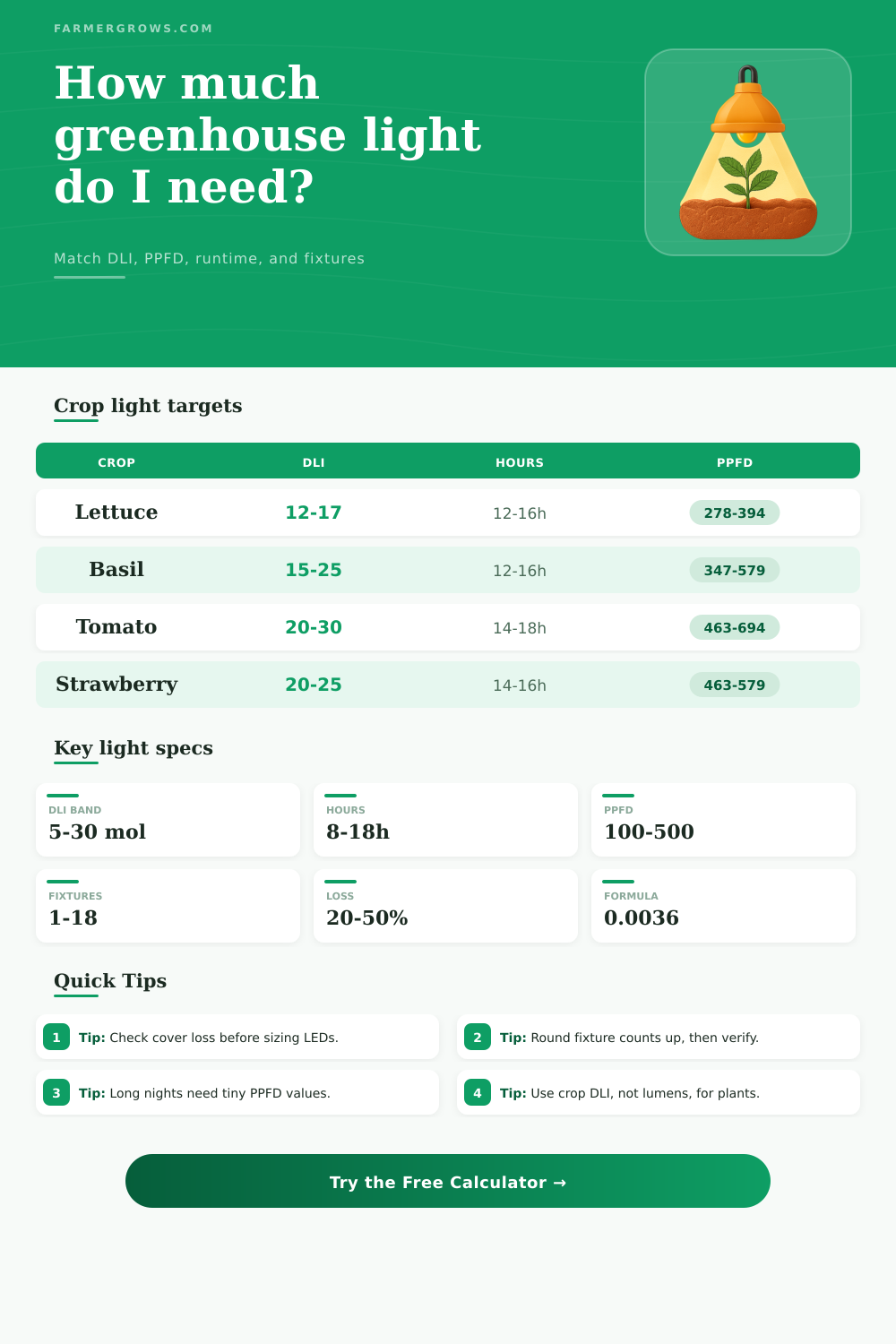
These tables use common greenhouse crop targets and direct DLI/PPFD conversions. They are handy when you want to sanity-check the calculator output before you commit to a lighting plan.
ACrop DLI targets and photoperiod PPFD
| Crop | DLI range | 12 h PPFD | 16 h PPFD |
|---|---|---|---|
| Seedlings | 5-10 | 116-231 | 87-174 |
| Microgreens | 9-12 | 208-278 | 156-208 |
| Lettuce | 12-17 | 278-394 | 208-295 |
| Spinach | 14-20 | 324-463 | 243-347 |
| Parsley | 10-15 | 231-347 | 174-260 |
| Basil | 15-25 | 347-579 | 260-434 |
| Strawberry | 20-25 | 463-579 | 347-434 |
| Tomato | 20-30 | 463-694 | 347-521 |
BDLI to PPFD conversion by photoperiod
| DLI | 8 h | 12 h | 16 h | 18 h |
|---|---|---|---|---|
| 6 mol | 208 | 139 | 104 | 93 |
| 10 mol | 347 | 231 | 174 | 154 |
| 14 mol | 486 | 324 | 243 | 216 |
| 20 mol | 694 | 463 | 347 | 309 |
CPPFD to DLI output by photoperiod
| PPFD | 8 h | 12 h | 16 h | 18 h |
|---|---|---|---|---|
| 100 | 2.9 | 4.3 | 5.8 | 6.5 |
| 150 | 4.3 | 6.5 | 8.6 | 9.7 |
| 200 | 5.8 | 8.6 | 11.5 | 13.0 |
| 250 | 7.2 | 10.8 | 14.4 | 16.2 |
DCommon greenhouse lighting plans
| Plan | Target | Fixture output | Notes |
|---|---|---|---|
| Seedling bench | 7-10 mol | 120-180 umol/s | 14 h fill-in |
| Leafy greens | 12-17 mol | 180-260 umol/s | 16 h growth |
| Fruiting crop | 20-30 mol | 260-350 umol/s | Longer hours |
| Photoperiod cue | 1-3 umol | Night light | Do not count as growth DLI |
5Practical tips
6Short guide
Dial in greenhouse supplemental lighting by matching crop DLI, transmission loss, photoperiod, and fixture output. The calculator shows how much sunlight helps and how many LEDs fill the gap.
Greenhouse grower often have difficulty with the growth of their plant due to a lack of light for those plants. Many greenhouse grower attempt to fix this issue by purchasing light fixture that emit the most brightness for the plants. However, brightness isnt an accurate way of measuring the amount of light that are required by the plants.
Instead, plants require a specific amount of light over a 24 hour period. The amount of light over a 24 hour period is referred to as the Daily Light Integral (DLI). The DLI is important to understand for greenhouse growers, as the DLI represent the total amount of energy that the plants will receive in a single day.
How to Calculate Daily Light Integral and Use Extra Light
There are two different source of light for the greenhouse plants: from the sun and supplemental light fixture. The sunlight that enters the greenhouse is often insufficient for the plants’ requirement, thus supplemental light fixture are used to provide the remaining amount of light that is required by the plants. Calculating the DLI, however, is not a simple process; sunlight is inconsistent throughout the year and the greenhouse covers are not clear cover material.
The DLI calculation must account for the loss of sunlight that pass through the greenhouse covers. For instance, old greenhouse covers or dusty polyethylene film will block some of the sunlight from reach the plants. Thus, the grower must perform the calculation for the percentage of sunlight that pass through the greenhouse covers so that the grower are aware of the amount of sunlight that reaches the plants.
After determining how much sunlight will reach the plants compared to the need of the plants, the grower can decide how to utilize supplemental light fixture to provide the remainder of the required light for those plants. There are two main method of using supplemental light in greenhouses. The supplemental lights can either be utilized to increase the intensity of light that is provided to the plants, or to increase the length of time that the light are provided to the plants.
The intensity of light that is provided to the plants is represented by the PPFD (Photosynthetic Photon Flux Density) rating of the supplemental lights. PPFD represent the rate at which photon hit the leaves of the plants. If there is limited time to provide supplemental light, the PPFD level must be increased to ensure that the plants recieve enough light over that short period of time.
However, if the supplemental lights can run for longer period of time, the PPFD levels can be lower to provide the same amount of light as required by the plants over that longer period. The amount of light that is required by the plant will differ for each category of crop. Thus, the DLI target must be set according to the requirement of the specific plant that are to be grown in the greenhouse.
For instance, the amount of light that is required by seedling plants is less than the amount of light that is required by fruiting tomato plant. Furthermore, microgreen may experience stress if too much light is provided to the microgreen plants. A reference table can be consulted to determine the amount of light that is required by specific plant, and a midpoint of the suggested amount of light can be targeted to allow for some buffer in case the plants do not grow as well as they should.
Many grower will target the minimum amount of light that is required by the plants. However, targeting the minimum amount of light for the plants can lead to sluggish growth of those plant. In addition to the DLI calculation, the amount of light that is provided by the supplemental light fixture must also be accounted for.
Not all of the light that is created by the supplemental light fixture is transferred to the plants. Some of the light will reflect off of the leaves of the plant, other light will reflect off of the greenhouse bench, and some light will become lost in the air within the greenhouse. The rated output of the supplemental light fixture represent the total amount of light that is provided by those light fixture.
However, the rated output of the light fixture is not the same as the amount of light that land on the plants. Accounting for light utilization by the plants can help the grower to purchase the appropriate amount of supplemental lighting for the greenhouse. The growers can always purchase additional supplemental light fixture and simply dim the light, rather than purchasing lighting that may not provide enough light to the plants to allow them to perform efficient.
There are different method for providing supplemental light to the plant within the greenhouse. Two method that can be used include day extension and photoperiod control. Day extension is the process of running low intensity supplemental light fixture during the early morning or late evening of the plants to provide more time for the plants to perform their photosynthetic process.
Photoperiod control is the process that use a small amount of light provided to the plants during the night to send a signal to the plants to either start or stop flowering. Day extension method are used to supply energy for the plants to perform their photosynthetic process, while photoperiod control method are used to provide signal for the plants to either start or stop flowering. These two method must be recognized and distinguished from each other, as mixing the two method can lead to confusing result for the plants that are exposed to both method.
Overall, greenhouse lighting is a matter of cost of electricity versus the value of the crop that is grown in the greenhouse. Rather than simply providing supplemental light to the plants, the grower can treat light as a budget for the day photon. Thus, by calculating the amount of light that is provided by the sun, the amount of sunlight that reaches the plants through the greenhouse cover, and the amount of light that is utilized by the plants, the grower can provide the amount of supplemental light required to supply each plant with the exact amount of light that it need to perform its various process.
Thus, by calculating each of these factor, the grower can ensure that the plants receive the amount of light that is required of them throughout the growing day. They should of considered the DLI more carefuly.