Greenhouse Fertilizer Calculator
Plan greenhouse feed by crop area, application depth, crop target, injector ratio, and stock tank size. The calculator compares N, P, and K demand, then estimates final EC.
Choose a real greenhouse pattern and the calculator fills the crop target, depth, events, blend, and supporting inputs. You can override anything after that.
Greenhouse Fertilizer Output
Mass is sized from the limiting nutrient, then expanded for injector ratio and overage. EC is an estimate that should be checked against leachate.
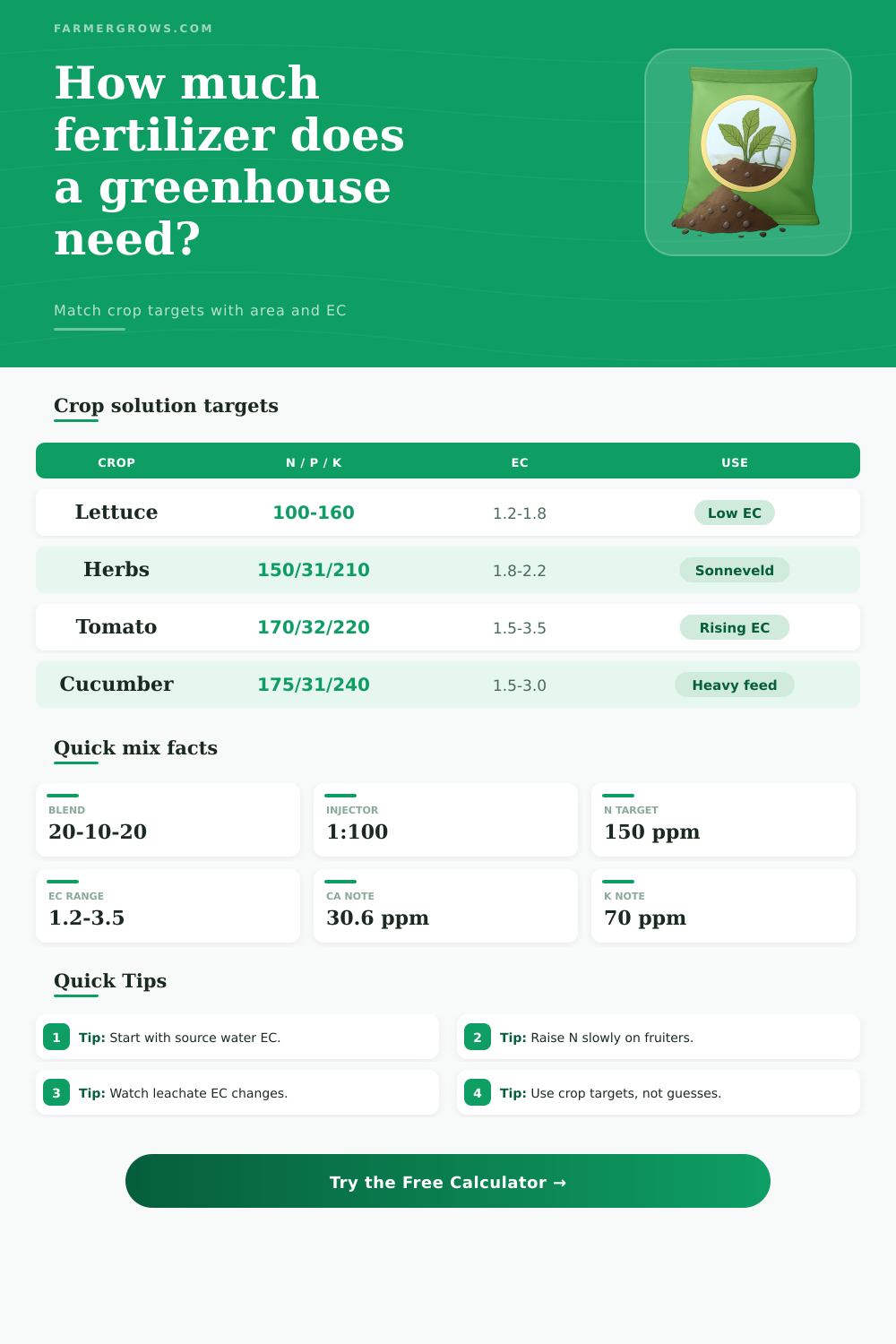
| Crop stage | N / P / K ppm | EC mS/cm | Notes |
|---|---|---|---|
| Lettuce seedlings | 100 / 30 / 160 | 1.2-1.8 | Start gentle |
| Herbs and basil | 150 / 31 / 210 | 1.8-2.2 | Penn State style |
| Tomato and cucumber | 150-200 / 31 / 210-300 | 1.5-3.5 | Increase with age |
| Source water baseline | 0-3 / 0-5 / 0-30 | <=0.5 | Measure first |
| Blend | Guaranteed analysis | Secondary nutrients | Typical use |
|---|---|---|---|
| 20-10-20 | 20 N / 10 P2O5 / 20 K2O | Micros included | Balanced veg feed |
| 18-6-18 | 18 N / 6 P2O5 / 18 K2O | Micros included | Steady leafy growth |
| 17-5-17 | 17 N / 5 P2O5 / 17 K2O | Micros included | General greenhouse use |
| 15-5-25 | 15 N / 5 P2O5 / 25 K2O | High K pattern | Fruiting finish |
| 13-2-13 | 13 N / 2 P2O5 / 13 K2O | Low P, calcium lean | Protected crops |
| 14-0-14 | 14 N / 0 P2O5 / 14 K2O | Low salt profile | Post-transplant |
| 15.5-0-0 | 15.5 N / 0 P2O5 / 0 K2O | 19% Ca | Calcium backbone |
| 10-5-20 | 10 N / 5 P2O5 / 20 K2O | Fruit support mix | Color and set |
| Salt | Label data | Solution note | What it adds |
|---|---|---|---|
| Calcium nitrate | 15.5-0-0, 19% Ca | 25 ppm N gives 30.6 ppm Ca | N plus calcium |
| Potassium nitrate | 13-0-44 | 25 ppm N gives 70 ppm K | N plus potassium |
| Monopotassium phosphate | 0-52-34 | Starter and bloom support | P plus K |
| Magnesium sulfate | 0-0-0, 9.1% Mg | Leaf color support | Mg plus sulfur |
| Injector | Stock multiplier | Typical use | Comment |
|---|---|---|---|
| 1:50 | 50x | Heavy feed | Use carefully |
| 1:100 | 100x | Standard greenhouse | Most common |
| 1:200 | 200x | Light feed | Younger crops |
| 1:300 | 300x | Lean stock tank | Slower release |
| 1:400 | 400x | Very light feed | Starter phase |
Fertigation is a process of adding the correct amount of nutrient to the irrigation system of a plant. You must use fertigation to ensure that the plant recieve the nutrients that they requires. In fertigation, you must understand the relationship between fertilizer mass, the volume of water, and an electrical conductivity of the water.
If the amount of fertilizer are not calculated correctly, then the plants may suffer from nutrient deficiency or salt toxicity. The electrical conductivity of the water that you use for fertigation must be accounted for when you calculate how much fertilizer to add to the irrigation system. The electrical conductivity of the source water already contains mineral that contribute to the electrical conductivity of the water.
How to Mix Fertilizer with Water and Check Salt Levels
If you add fertilizer to the source water, the electrical conductivity will increase. The plants will have difficulty in absorbing the water from the soil if the electrical conductivity is to highly. Therefore, you must add the amount of fertilizer to the electrical conductivity of the source water to determine the total electrical conductivity that the plants will be expose to.
Depending on the growth stage of the plants, you will have to add different amount of nutrients. For example, seedling have delicate root hair that high level of salt will easy damaged. Thus, seedlings will require low concentration of nutrients.
Plants in the vegetative stage require high amount of nitrogen for the plants to develop a strong canopy of leaf. During the flowering stage, plants require more potassium for the development of fruit. If you add too much nitrogen at this stage, the plants will focus on growing leaf instead of flowers and fruits.
The nutrient requirement will change based on the growth stage of the plants. A limiting nutrient is the nutrient that a plant requires in the lowest amount compared to the other nutrients in the fertilizer. If you use a balanced fertilizer but the plant requires a higher amount of potassium, then the potassium will become the limiting nutrient.
The total mass of the fertilizer that you add to the irrigation system must be calculated based on the requirement of the limiting nutrient. If you use a different nutrient to calculate the total mass, you may not provide enough of the limiting nutrient. Most irrigation system use a stock tank and an injector to distribute nutrient to the crops.
The injector will draw the nutrient solution from the stock tank and mix it with the main water line. The concentration of the nutrient solution that is present in the tank must be calculated based on the ratio of the injector and the size of the tank. If the concentration are not correct, then the nutrient concentration in the irrigation system will also be incorrect.
An overage buffer should of been added when calculating the fertilizer amount. The overage buffer is an extra amount of fertilizer (for example, ten percent) that you add to the fertilizer calculation to compensate for the loss of fertilizer in the irrigation system. Some of the loss of fertilizer include evaporation, system dead-space, and leachate.
By adding an overage buffer, you ensure that you dont run out of fertilizer before the irrigation cycle are complete. Electrical conductivity is used to manage the salt load in the irrigation system. Electrical conductivity is measured in parts per million (ppm).
This unit of measurement determine the amount of nutrients in the water. However, electrical conductivity tell you the total strength of the nutrient solution. High electrical conductivity will make it difficult for the plant to absorb the water from the soil.
High electrical conductivity can cause physical problem in the plant. For example, high electrical conductivity can cause blossom end rot in tomatoes. Tip burn is another problem that can occur in plants if the electrical conductivity is too high.
By comparing the electrical conductivity of the irrigation system to the target electrical conductivity, you can ensure the nutrient solution is safe for your plant.