
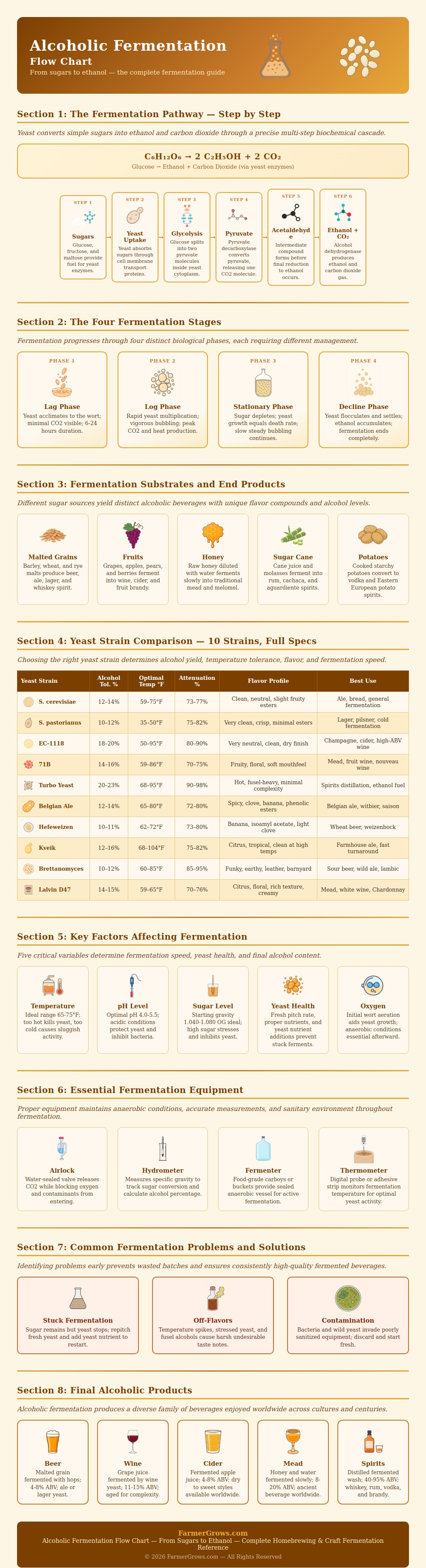
Fermentation are the process in which yeast cells consume sugar and produce ethanol and carbon dioxide as a result. Yeast cells require energy in order to survive, and the yeast cells obtains that energy by eating the sugar molecules that is contained within the liquid. As the yeast cells eat the sugar, the yeast cells produce alcohol and carbon dioxide as a result of that energy consumption.
Thus, fermentation is a process of turning sugar into alcohol and gas. The chemical process for fermentation begins when the yeast cells absorbs the sugar through the membranes of the yeast cells. Once the sugar molecules have entered the yeast cells, the yeast cells perform a process known as glycolysis that breaks the sugar into pyruvate molecules.
How Fermentation Works
Once the yeast cells have broken down the pyruvate molecules, the yeast cells remove carbon dioxide from those molecules and continue through the fermentation process to create ethanol. Thus, the chemical process allow yeast to convert sugar into ethanol. Fermentation is not a process that features a start and stop cycle for the yeast cells; instead, there are four distinct phases of fermentation.
The first phase is the lag phase, wherein the yeast cells are adjusting to their environment. The second phase is the log phase, wherein the yeast cells begin to multiply rapid and to release bubbles. During this stage, the yeast cells create heat, so monitoring of the temperature of the liquid are required.
The third phase is the stationary phase, wherein the yeast cells begin to reach the maximum amount of sugar that they can consume. The fourth and final phase is the decline phase, wherein the yeast cells begin to sink to the bottom of the container. This process is referred to as flocculation.
While many may believe that the fermentation process has failed when the bubbles begin to cease, the cessation of the release of these bubbles is actualy a sign that the yeast cells has entered the decline phase. The characteristics of the beverage that is being fermented are dependent upon the substrate that is used in the process. For instance, using malted grains as the substrate will produce different flavors then if honey was used as the substrate.
Honey ferments at a slower rate than fruit juices due to the different chemical properties of honey. Thus, the substrate will provide the sugar to the yeast cells, but the type of substrate will impact the characteristics of the beverage that is produced. The brewer must select the specific type of yeast strain in the brewing process.
Different types of yeast strain have different tolerances to both temperature and alcohol. For instance, yeast strains like Norwegian Kveik can survive in high temperatures of the climate in which the beer is being brewed. Other types of yeast strains produce chemical compounds known as esters that have a specific flavor to the beverages.
If the desired drink has a neutral flavor, a strain of yeast that exhibit a neutral flavor should be selected. However, if the individual desires beverages with a specific flavor, one should use a type of yeast strain that produces strong esters. In order to ensure that fermentation occurs as desired by the brewer, the brewer must manage the environment in which the yeast cells exist.
The most important factor in managing the fermentation process is the temperature of the liquid. Changes to the temperature can alter the flavor of the beverage. Management of the amount of oxygen that is present in the container in which the beer is brewed is also important.
Oxygen is required at the beginning of the fermentation process in order to allow the yeast to multiply, but it is essential that the yeast removes the oxygen once the yeast begin to ferment the sugar into alcohol. In order to accomplish this, one can use an airlock to allow the carbon dioxide to exit the container while preventing any wild bacteria from entering the container. Errors in the fermentation process typically result from the yeast cells existing in an environment that is not ideal for the survival of the yeast.
If the yeast become stuck in the fermentation process, it is typically because the yeast cells are not in an ideal environment for fermentation. If the sugar remains in the liquid but the yeast cells fail to produce alcohol, this is referred to as a stuck fermentation. A lack of nutrients for the yeast cells or a drop in the temperature of the brewing process typically causes stuck fermentations.
If the yeast becomes contaminated with wild microbes, the result can be the production of mold or vinegar. In this case, the brewer must discard the batch of beer and must sanitize all brewing equipment in order to prevent the introduction of these contaminating microbes in the future. Maintaining a healthy environment for the yeast cells is the goal of the brewing process as a whole.