Incubation Egg Weight Loss Calculator
Measure egg weight at set and through incubation, compare the loss to species targets, and estimate hatch-day weight, humidity direction, and daily pace.
Choose a realistic setting to fill the fields fast. Each preset sets species, egg count, set weight, current weight, day count, target loss, humidity, and temperature.
Egg Weight Loss Results
Comparisons below use the measured start weight, current weight, and the chosen species target.
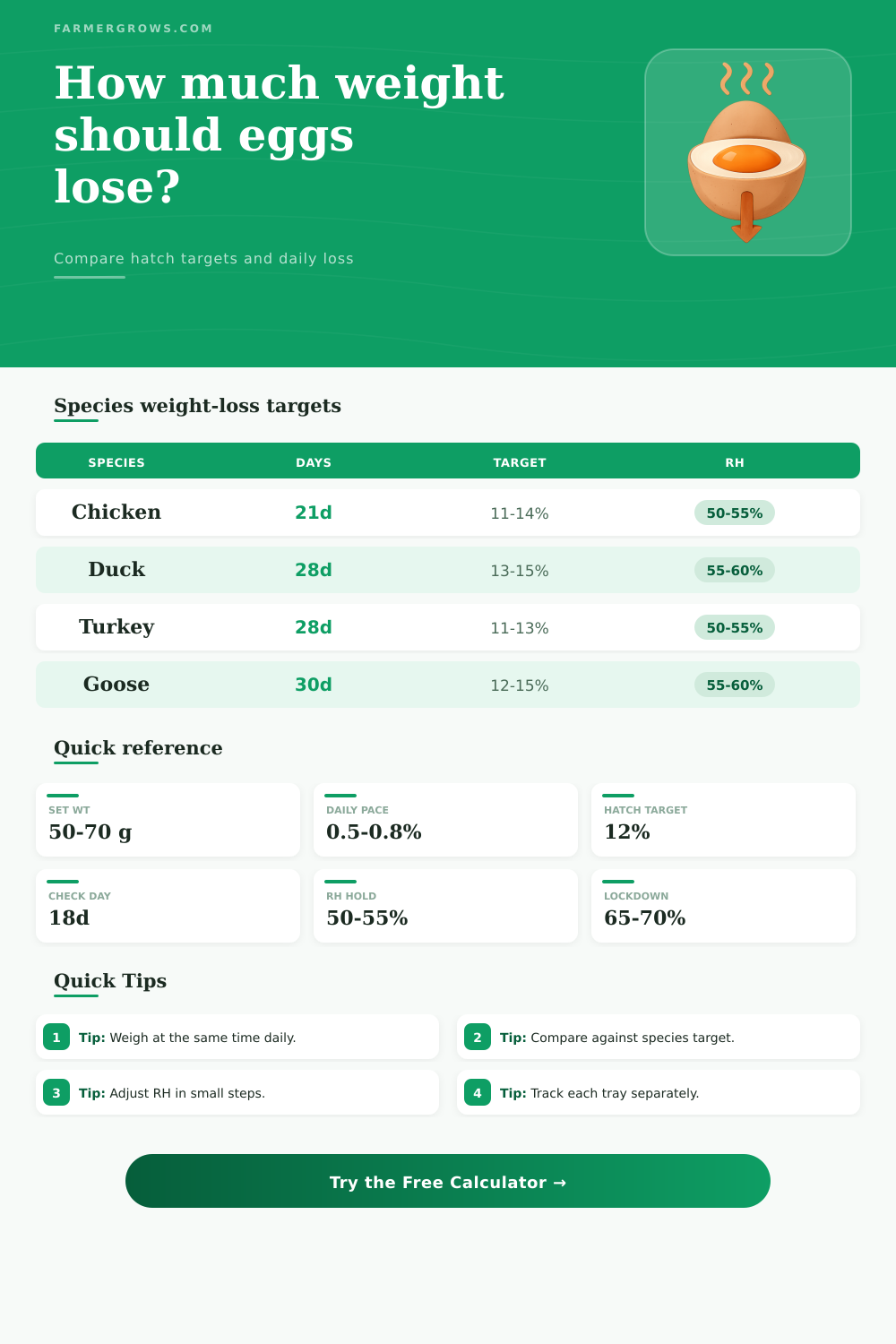
| Species | Incubation | Target loss | Typical RH | Note |
|---|---|---|---|---|
| Chicken | 21 days | 11-14% | 50-55% | Common setting egg |
| Quail | 17 days | 11-13% | 45-55% | Faster moisture curve |
| Turkey | 28 days | 11-13% | 50-55% | Watch large egg shells |
| Duck | 28 days | 13-15% | 55-60% | Waterfowl need more moisture |
| Goose | 30 days | 12-15% | 55-60% | Longer hatch window |
| Guinea fowl | 28 days | 11-13% | 50-55% | Game bird baseline |
| Pheasant | 24 days | 11-13% | 45-55% | Smaller egg, steady loss |
| Checkpoint | Chicken | Waterfowl | What it means |
|---|---|---|---|
| Day 7 | 3-5% | 2-4% | First strong trend check |
| Day 14 | 7-9% | 6-8% | Loss should stay steady |
| Day 18 | 11-14% | 9-11% | Lockdown is near |
| Hatch | 11-14% | 13-15% | Final target window |
| Start weight | 10% loss | 12% loss | 14% loss |
|---|---|---|---|
| 40 g | 36.0 g | 35.2 g | 34.4 g |
| 50 g | 45.0 g | 44.0 g | 43.0 g |
| 60 g | 54.0 g | 52.8 g | 51.6 g |
| 70 g | 63.0 g | 61.6 g | 60.2 g |
| 80 g | 72.0 g | 70.4 g | 68.8 g |
| 100 g | 90.0 g | 88.0 g | 86.0 g |
| Loss signal | Likely cause | RH move | Recheck |
|---|---|---|---|
| Below target | Too wet | Lower 3-5 pts | Weigh in 24-48h |
| On target | Stable shell loss | Hold steady | Weigh at same time |
| Above target | Too dry | Raise 3-5 pts | Check in 24-48h |
| Wide spread | Shell variation | Use tray average | Verify sample size |
An incubator hygrometer measure the humidity in an air within the incubator but does not measure the moisture level inside an incubating egg. Instead, the weight of the eggs will tell you how much moisture is escaping from the egg. As the eggs lose moisture through the porous shell of the eggs, an air cell form inside the eggs.
This air cell is critical to the incubation process because the developing chicken chick need to be able to breathe. If the eggs lose too much moisture through the shell, the eggs may become too light for the chick to be able to break through the shell. If the eggs lose too little moisture, the air cell may become too small for the emerging chick to breathe and drown in the fluid within the egg.
Use Egg Weight to Monitor Incubator Humidity
Thus, monitoring the weight of the eggs will allow you to ensure that the moisture loss from the eggs is correct. To monitor the moisture loss from the eggs, you can use a weight calculator for the incubating eggs. To use the weight calculator, you will need to enter the starting weight and current weight of the eggs.
The starting weight of the eggs is the weight when the eggs were first collected from the chicken, and the current weight is the weight of the eggs at the present time. The calculator will provide a percentage loss in weight for the eggs. This percentage can tell you whether the humidity within the incubator is too high (if the percentage is too low) or too low (if the percentage is too high).
Different species of bird will have different requirements for humidity and weight loss in the incubating eggs. For instance, the requirements for chicken eggs will be different than duck or goose eggs. Duck and goose eggs will require higher humidity levels than chicken eggs because the waterfowl have different shell structure for there eggs.
To determine the proper humidity levels for the eggs of the species that you are incubating, you can consult the reference tables that is available regarding proper humidity levels for each species. If you use the humidity tables for chicken eggs for duck eggs, the duck eggs will not hatch correctly. The weight calculator will allow you calculate the weight of the eggs on the day of hatch so that you can make any necessary adjustments to the incubator prior to the hatch day.
You should not make any major changes to the humidity within the incubator based off the weight of the eggs. Instead, because the loss of moisture from the eggs occur slowly within the incubator, you should only make small changes to the humidity. For example, if the weight calculator tells you that the humidity should be changed, you should only make small adjustment to the humidity within the incubator and then wait forty-eight hours prior to making further changes to the humidity within the incubator.
After forty-eight hours, the eggs will have time to adjust to the change in humidity within the incubator. Otherwise, if you make major change to the humidity within the incubator, you may move the eggs from too dry to too wet. Not all eggs will lose moisture at the same rate within the incubator.
Some eggs may lose moisture at a faster rate than others due to the differences in the porosity of each shell. Thus, you should weigh a sample of the eggs within the incubator tray to determine the average weight of the eggs within that tray. This average will be more accurate than the weight of an individual egg.
Candling the eggs will allow you to view the air cell within the eggs, but it will not be as accurate as the digital scale that measure the weight of the eggs. The loss of weight within incubating eggs is critical to ensure that the air cell within the eggs is of the correct size for the emerging chicks. The air cell must be of a size that allow the chicks to breathe, but not so large that the chicks lose the buoyancy that they need to be able to hatch the egg.
While the lockdown period for the incubating eggs is important, it is only one part of the incubation process. The loss of weight of the eggs during the first eighteen days of incubation is another very important part of the incubation process. If the loss of weight of the eggs is not correct during those first eighteen days, no amount of humidity adjustment during the lockdown period will fix the size of the air cell within those eggs.
Thus, monitoring the weight of the eggs is one way to provide you with a data-driven method for managing your incubation process.