🌾 Corn Silage Bunker Capacity Calculator
Estimate bunker volume, tons, dry matter, and feed days from bunker width, length, wall height, and packed fill depth.
| Width | Length | Peak Depth | Corn Tons |
|---|---|---|---|
| 20 ft | 60 ft | 8 ft | ~202 tons |
| 24 ft | 80 ft | 10 ft | ~403 tons |
| 30 ft | 100 ft | 12 ft | ~756 tons |
| 36 ft | 120 ft | 14 ft | ~1,270 tons |
| Silage Type | Density | DM % | Tons / 1,000 cu ft |
|---|---|---|---|
| Corn silage | 42 | 35% | 21 tons |
| Grass haylage | 38 | 45% | 19 tons |
| Alfalfa silage | 40 | 40% | 20 tons |
| Sorghum silage | 40 | 35% | 20 tons |
| Small grain | 38 | 40% | 19 tons |
| Width | 8 ft depth | 10 ft depth | 12 ft depth |
|---|---|---|---|
| 20 ft | 3.4 tons | 4.2 tons | 5.0 tons |
| 24 ft | 4.0 tons | 5.0 tons | 6.0 tons |
| 30 ft | 5.0 tons | 6.3 tons | 7.6 tons |
| 36 ft | 6.0 tons | 7.6 tons | 9.1 tons |
Silage Density Reference
| Crop | Density | DM% | Note |
|---|---|---|---|
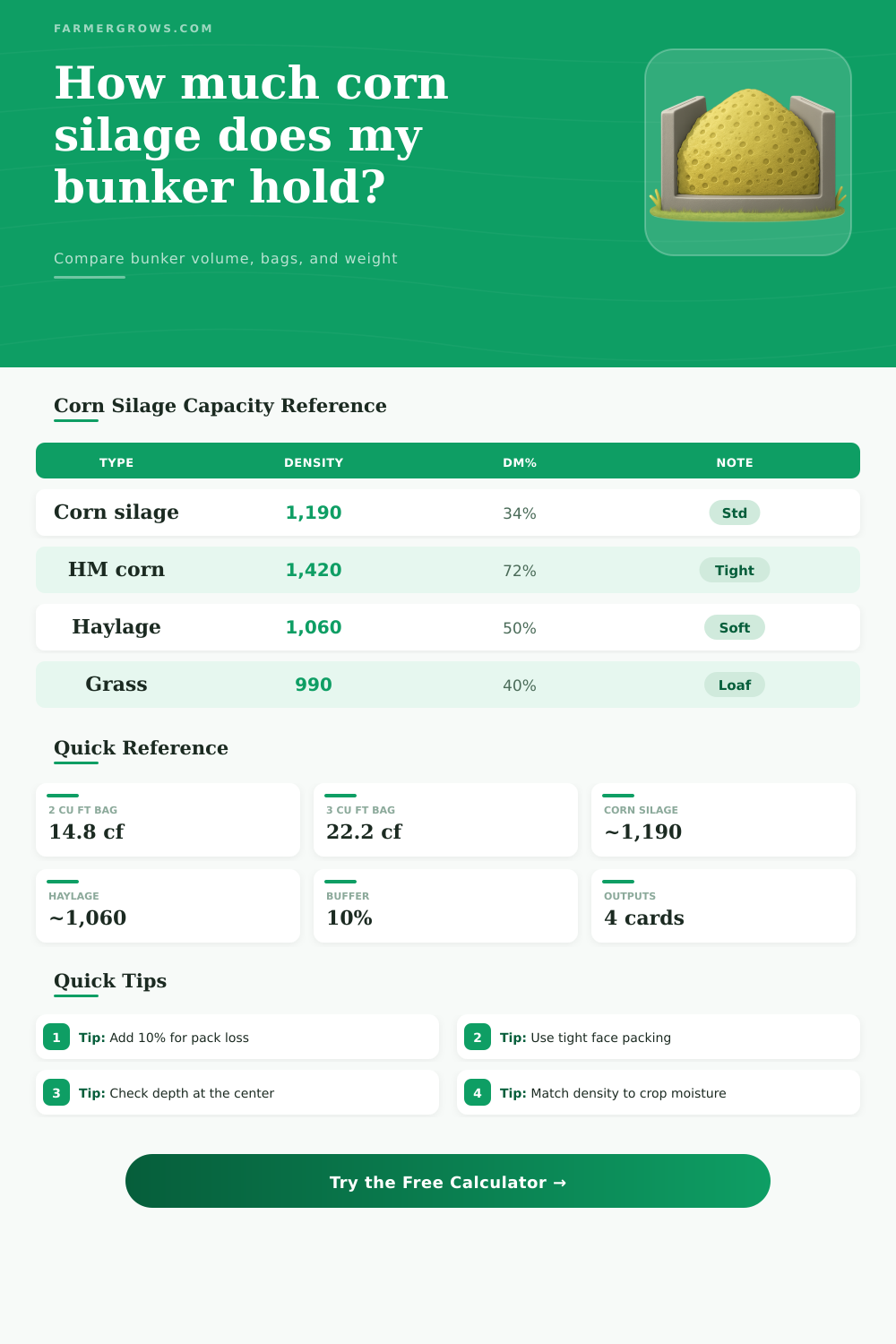
| Corn silage | 42 | 35% | Standard |
| Haylage | 38 | 45% | Looser pack |
| Sorghum | 40 | 35% | Stalky crop |
| Alfalfa | 40 | 40% | Leafy forage |
Comparison Grid
Short and wide
Low face exposure and easy packing for fast feedout.
Tall and compact
Saves pad space when wall height is the limiting factor.
Long wedge
Good for rolling harvest and variable crop deliveries.
Custom survey
Best when your bunker footprint is irregular or split.
A denser pack reduces spoilage and makes the capacity estimate more realistic.
Hold back enough headroom for settling so corn silage does not spill over the wall.
Bunker capacity is a critical measurement to determine if a farm has enough feed to last through the winter. If a person dont calculate the bunker capacity correctly, then they will eventually run out of hay. Additionally, they will have to purchase hay from another farm at high price.
To calculate the amount of feed a bunker will hold, a person must understand the dimensions of the bunker and the density and shrinkage of the silage that will be stored within the structure. A bunker consist of a flat concrete floor, the sidewalls of the bunker, and the wedge of silage that is loaded into the structure. The width of the concrete floor will determine the base width of the bunker.
How Much Silage a Bunker Can Hold
The height of the peak of the silage will determine how much silage can be stored within the slope of the stored silage. If the angle of the slope is very steep, it will be much more difficult to pack the silage into the bunker. The silage will be less stable on a very steep slope than it will on a gentle slope.
However, the gentle slope will require the use of more dirt to create the slope of the bunkers. The moisture content of the silage will also play a major role in the density of the silage within the bunker. If the silage is very wet, it will pack better into the bunker, but it may be more difficult for the silage to ferment within the bunker.
The density of silage is the weight of the silage within a volume. Corn silage will contain approximately 42 pound of weight per cubic foot of volume. Grass haylage will contain less weight due to the fact that the stems of the grass will not pack as tightly as the ears of corn will.
Dry matter percentage is another factor to consider in silage. Silage is fed to cows according to the dry matter that they can digest, not the weight of the silage that is fed. Corn silage will contain 35 percent dry matter, while haylage will contain 45 percent dry matter.
A bunker may contain many ton of wet silage, but the silage will shrink to fewer tons of dry matter after it loses its water content. Silage will shrink during the storage of the silage in a bunker. Depending on the size and the dimensions of a bunker, silage can lose between 5 and 10 percent of the total amount of silage that was loaded into the bunker.
If the silage is exposed to the air for long periods of time, it will heat up and turn into compost. To avoid this from occurring, a person should remove silage from the bunker each day by cutting into the silage. Between 6 and 12 inches of silage should be removed each day.
This will prevent the silage from getting in contact with air within the bunker. The amount of silage that is required to feed a herd will be fed to the cows daily. For example, if a farm has 100 cows in the barn, and each cow will eat 60 pound of silage per day, the total amount of silage that must be provided daily is three tons.
The dimensions of a bunker will vary depending on the amount of silage that must be stored within it. Dairy farms that have 24 feet of width and 80 feet of length can hold approximately 400 tons of silage. Smaller farms that contain 60 head of cows will require a bunker that is 20 feet in width and 60 feet in length.
Large dairy farms that contain 400 cows may require a bunker that is 40 feet in width and 150 feet in length. The slope of the silage that is loaded into the bunker can be adjusted. A 2:1 ratio for the slope of the silage is used for aggressive packing.
A 3:1 ratio is used for creating safer slopes for the silage when it is loaded to greater heights within the bunker. Another factor that must be considered in the loading of silage into the bunker is the technique that is used. The silage should be loaded into the bunker in thin layer.
The layers of silage should be packed by treading on the silage with large tires or tractors. The tractors should reach a pressure of 700 pound per cubic yard of tracked area on the silage. When the silage is loaded into the bunker, the faces of the silage should be sheared with defacer bucket.
After the silage has been loaded into the bunker, it should be covered quickly with poly sheeting. The sheeting should be placed over the silage with additional tires to ensure the silage is covered. Additionally, the sheeting should be overlapped to prevent silage from getting in contact with air.
If the silage is not covered appropriately, the top 10 percent of the silage will turn into sludge due to contact with air. Bunker dimensions for silage are often between 20 and 36 feet in width. The length of the bunkers is often between 60 and 150 feet.
Bunkers that are narrow in width are easier to pack. However, they will require the silage to travel further to be removed by large tractors. Wider bunkers allow for more silage to be easily removed by large tractors.
However, the silage that is removed from a wide bunker will be thinner in the area of the bunker that is removed. Additionally, as the width and depth of the bunker increases, the capacity of the bunker increases. A 24-foot wide bunker that is 10 feet deep can hold 5 tons of silage per linear foot of length.
However, a 24-foot wide bunker that is 8 feet in depth will hold 4 tons of silage per linear foot. A person can make many mistake when loading silage into a bunker. If a person overfills the bunker, rain will enter the bunker and turn the silage into a liquid.
If a person underpackages the silage, the silage will not reach the proper density and the capacity of the bunker will be less than the calculation of the silage capacity. To prevent this, silage should be loaded into the center of the bunker. Silage will settle into the center of the bunker, so the depth of the silage should be measured in the center of the bunker.
Finally, 10 percent of the calculated silage capacity should be provided as a buffer to account for any unexpected event that may occur such as rain that prevents the silage trucks from delivering silage to the farm.