Mushroom Manure Calculator
Estimate area, depth, volume, bag count, nutrient load, and wet weight for fresh or aged mushroom manure, also called spent mushroom compost.
Choose a common lawn, bed, or orchard use case to load dimensions, depth, moisture, buffer, and bag size in one click.
Mushroom Manure Output
Calculated from the selected area, depth, grade, moisture state, and purchase buffer.
| Measure | Wet wt | Wet vol | Note |
|---|---|---|---|
| pH | 6.6 | Typical | Near neutral |
| Carbon:N | 13:1 | Balanced | Active compost |
| Total N | 1.12% | 6.40 lb/yd3 | Primary N source |
| Phosphorus | 0.29% | 1.67 lb/yd3 | Modest P load |
| Potassium | 1.04% | 5.89 lb/yd3 | Useful K source |
| Organic matter | 25.86% | 146.73 lb/yd3 | High OM content |
| Bulk density | 574.73 lb/yd3 | Wet volume | Measured average |
| Soluble salts | 13.30 mmho/cm | Wet basis | Use thin layers |
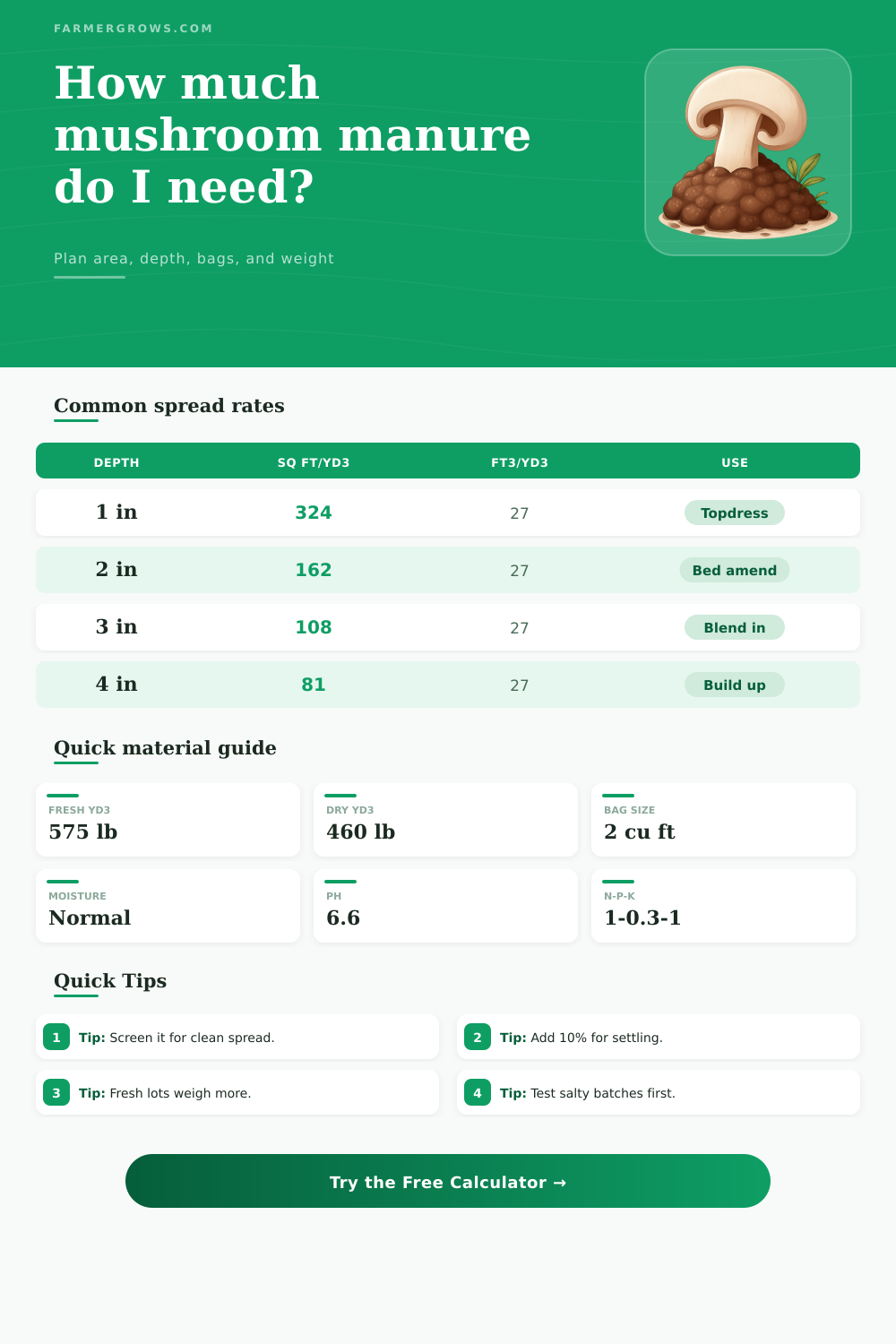
| Depth | Sq ft/yd3 | m2/m3 | Use |
|---|---|---|---|
| 1 in | 324 | 30.3 | Light topdress |
| 2 in | 162 | 15.2 | Bed amendment |
| 3 in | 108 | 10.1 | Blend-in layer |
| 4 in | 81 | 7.6 | Thicker refill |
| 6 in | 54 | 5.0 | Deep build |
| Package | Volume | At 1 in | At 2 in |
|---|---|---|---|
| 0.75 cu ft | 0.75 | 9 sq ft | 4.5 sq ft |
| 1.5 cu ft | 1.5 | 18 sq ft | 9 sq ft |
| 2 cu ft | 2.0 | 24 sq ft | 12 sq ft |
| 3 cu ft | 3.0 | 36 sq ft | 18 sq ft |
| 40 L | 1.41 | 16.9 sq ft | 8.5 sq ft |
| 50 L | 1.77 | 21.2 sq ft | 10.6 sq ft |
| Project | Area | Depth | Yards |
|---|---|---|---|
| Garden bed | 100 sq ft | 2 in | 0.62 yd3 |
| Lawn patch | 250 sq ft | 1 in | 0.77 yd3 |
| Yard strip | 1,000 sq ft | 1 in | 3.09 yd3 |
| Orchard ring | 5,000 sq ft | 0.5 in | 7.72 yd3 |
Spent mushroom compost is a material made from the leftovers of commercial mushroom farms. The spent mushroom compost contain materials like straw, manure, and peat. Because spent mushroom compost contains nutrient that benefit the soil, and because spent mushroom compost retain moisture for the soil, many person use spent mushroom compost to improve the quality of there soil.
Thus, people can use spent mushroom compost in there lawns or in their vegetable bed. Because spent mushroom compost is heavy when wet, it is important to order the proper amount of spent mushroom compost for the area that you wish to treat. If you order too little spent mushroom compost, you will have to order from your supplier again before your project is complete.
How to Measure, Buy, and Use Spent Mushroom Compost
However, if you order too much spent mushroom compost, you could end up with excess compost that may attract flies to your project or you could waste your money. To calculate how much spent mushroom compost you should of order, convert the area of your garden to cubic feet of compost. Add ten percent to that total to account for how much spent mushroom compost will settles into the soil.
Depending on the goal for your treated area, you may wish to apply the spent mushroom compost to that area to a certain depth. If your goal is to topdress your lawn, apply the spent mushroom compost to a depth of one inch. One inch of spent mushroom compost will release the nitrogen slow enough to allow the grass to remain unsmothered.
For vegetable bed, apply the spent mushroom compost to a depth of two or three inches. Two or three inches of spent mushroom compost will provide enough nutrients like nitrogen and potassium to the soil for the plant in your vegetable beds. For raised bed or low spot in your yard, four inches or more of spent mushroom compost may be needed.
However, four inches of spent mushroom compost is very heavy. Another factor to consider when purchasing spent mushroom compost is the grade of the spent mushroom compost. Screened spent mushroom compost is smooth to the touch and is best for use around ornamental plant.
Coarse orchard mix are different than screened spent mushroom compost; coarse orchard mixes are best for use in tree rings to help provide moisture to the root of those trees. Additionally, the moisture content of the spent mushroom compost will change it’s weight and how much area it cover. When wet, spent mushroom compost will be heavier than when it is dry.
It is important to be careful when using fresh spent mushroom compost. Because fresh spent mushroom compost can contain high level of soluble salts, it could damage the roots of tender plant. For instance, blueberries are a salt sensitive plant; thus, you should use caution when placing spent mushroom compost near blueberry plants.
Instead, use aged spent mushroom compost that has lower levels of salts. Additionally, if your yard has acidic soil, you may want to use lime to even out the pH of your soil before adding spent mushroom compost. To make the purchasing process easier for you and your yard, many company offer mathematical presets to calculate how much spent mushroom compost you will need.
These presets allow you to input the dimension of your yard or garden, including if it is in the shape of a rectangle, a circle, or a triangle. Based off the dimensions of your garden, the mathematical presets will calculate for you how many yards of spent mushroom compost you will need to cover your entire area, as well as how many bag of spent mushroom compost you should purchase. Additionally, these presets will also calculate the total weight of the spent mushroom compost so that you can ensure that it will be appropriate for the weight capacity of your truck.
Thus, these mathematical presets will help you to not waste any spent mushroom compost and to ensure that you have the amount that you need for your yard or garden project.