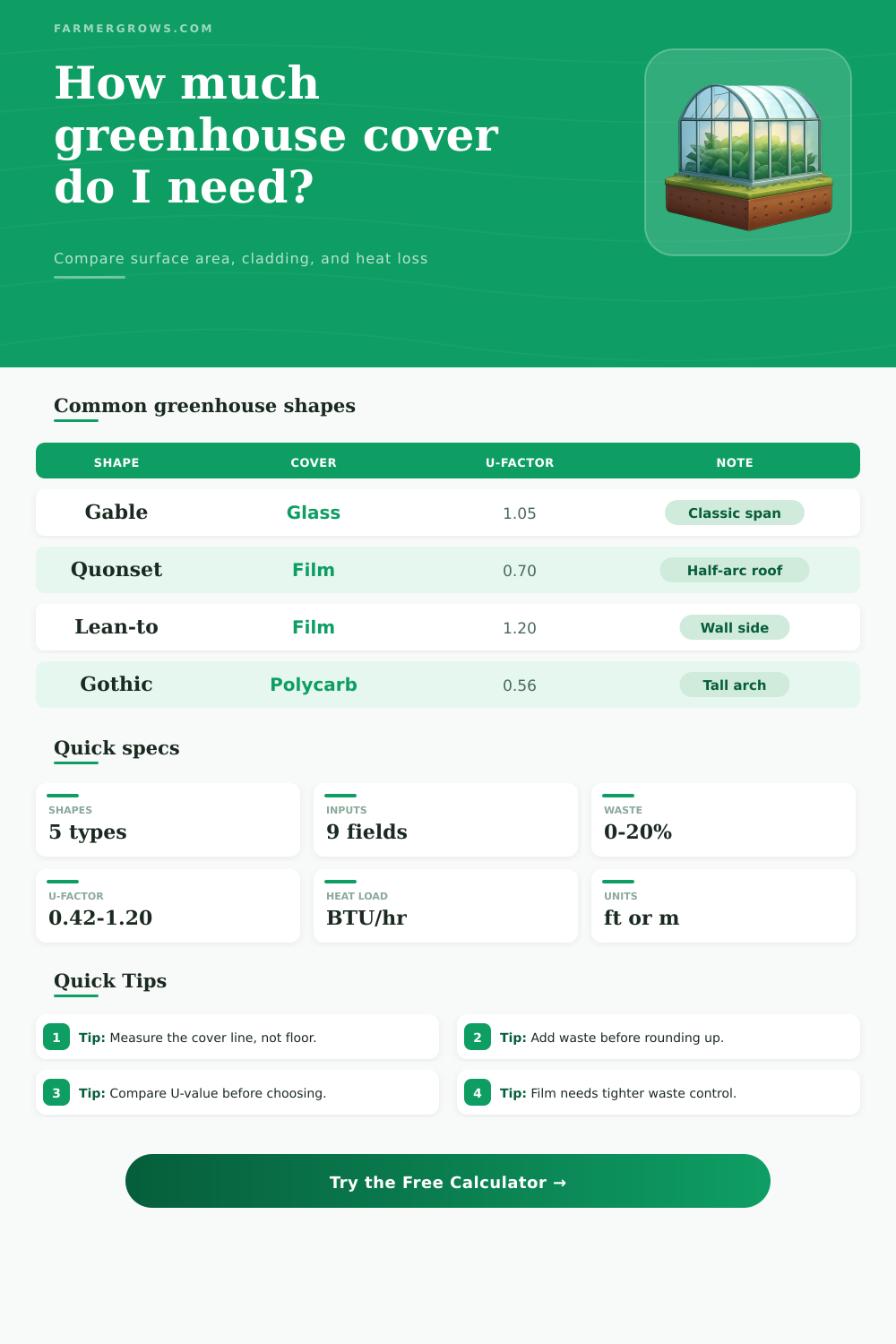
Greenhouse Surface Area Calculator
Measure roof, wall, and end cover area, then compare glazing choices and heat-loss load before you cut film or order panels.
Pick a real structure size to seed the fields. Each preset sets shape, dimensions, waste allowance, and a matching glazing type so you can jump straight into the calculation.
Greenhouse Surface Output
Calculated from the chosen shape, cover material, and design temperatures.
| Shape | Surface method | Main pieces | Note |
|---|---|---|---|
| Gable | Roof + walls + ends | 2 slopes, 2 sides | Best for even spans |
| Quonset | Half-cylinder shell | Arc roof + end caps | Good film use |
| Lean-to | Roof + exposed face | One roof slope | Counts wall side |
| Gothic | Arch approximation | Elliptic roof arc | Better snow shed |
| Structure | Example size | Surface area | Source note |
|---|---|---|---|
| Quonset house | 50 x 20 ft | 1884 ft² | Half-cylinder example |
| A-frame house | 30 x 100 ft | 5956 ft² | Roof, walls, gables |
| Freestanding greenhouse | 12 x 16 ft | 586.4 ft² | Heat-loss example |
| Gable house | 32 x 100 ft | 5390.6 ft² | Roof and end breakdown |
| Cover | U-value | R-value | Light |
|---|---|---|---|
| Glass, single 3 mm | 1.05 | 0.95 | 90% |
| Poly film, single | 1.20 | 0.83 | 85% |
| Poly film, double | 0.70 | 1.43 | 77% |
| Polycarb twin wall 8 mm | 0.56 | 1.64 | 80% |
| Type | -30°F zone | 30°F zone | Note |
|---|---|---|---|
| Lean-to, single | 330 | 140 | Btu/ft² |
| Lean-to, double | 220 | 70 | Better retention |
| Freestanding, single | 360 | 120 | Higher load |
| Freestanding, double | 225 | 85 | Lower load |
To calculate the amount of covering material that will be needed to construct a greenhouse, it is necessary to calculate the surface area of the greenhouse frame. The floor area of the greenhouse is the area of the ground within the greenhouse, but the surface area of the greenhouse is the area of each of the panels that will cover the greenhouse. The area of the roof and the wall panels will be more greater than the area of the floor, so ordering only enough material to cover the floor will result in not having enough covering material for the greenhouse.
For greenhouses with different shapes, there are different methods to calculate the area of the roof panels. For greenhouses with gable roofs, the area of the roof panels will be greater than the area of the floor. For greenhouses with arched roofs, such as hoop houses, the area of the roof panels will again be greater than the area of the floor panels.
How to Measure Greenhouse Area and Order Covering Material
For lean-to greenhouses, in addition to measuring the length of the roof, it is also necessary to measure the rise of the roof to determine the area of the roof panels that will be needed. To ensure that there is enough material for the greenhouse, it is typical to order extra greenhouse covering material. Extra material is ordered to account for the loss of material during the cutting of the greenhouse cover lines.
It is typical to order ten to fifteen percent extra material, since the greenhouse material may shrink when stretched, and any cutting of the greenhouse panels may not be performed perfectly to the specifications required. Extra material will also be needed for the overlapping of the greenhouse panels, trimming the edges of the greenhouse panels, and to account for potential measurement error. The type of covering material that is use for the greenhouse will also impact the amount of heat that is contained within the greenhouse and that leaves the greenhouse.
If single layer poly (single poly) film is used for the greenhouse cover lines, the single poly film will have a high U-value; heat will leave the greenhouse through the single poly film more easy than with other greenhouse cladding materials. If double inflation poly film is used for the greenhouse cover lines, air will be trapped within the greenhouse, limiting the amount of heat that leaves the greenhouse; double inflation poly film will have a lower U-value than single poly film. Twin-wall polycarbonate will have a very low U-value, which means that it will provide high levels of insulation for the greenhouse; however, it will diffuse the light that enters the greenhouse more than single poly film do.
Finally, if glass is used for the greenhouse cover lines, the most light will enter the greenhouse; however, because the glass has a high U-value, more heat will be required to maintain the desired greenhouse temperatures. The total amount of heat that leaves the greenhouse can be calculated by multiplying the U-value of the greenhouse cladding material by the surface area of the greenhouse, and the difference between the greenhouse’s internal temperature and its external temperature. The surface area of the greenhouse can be determined by its shape, the U-value of the cladding can be determined by the type of cladding that is to be used for the greenhouse, and the difference between the internal and external temperatures can be determined by the desired greenhouse temperature and the external temperature.
By using cladding that has a lower U-value than the greenhouse’s current U-value, the amount of heat that leaves the greenhouse will be less. Some mistakes that are made when constructing greenhouses include using the area of the floor to determine the total area of the greenhouse that will be covered in covering material, and forgetting to measure the area of the end walls of the greenhouse. If the area of the floor is measured instead of the greenhouse frame, the greenhouse will not have enough material to cover its roof.
If the area of the end walls of a greenhouse are forgotten, heat will leave the greenhouse through the end walls. Additionally, the greenhouse must also be constructed to withstand wind and hail; wind loads may require the use of stiffer polycarbonate cladding material, while hail may require the use of thicker twin-wall polycarbonate cladding. To order greenhouse covering material for the greenhouse that is to be constructed, it is first necessary to calculate the total surface area of the cover lines of the greenhouse, and to calculate the total BTU load that will be required to heat the greenhouse.
These calculations should of been printed out, and the measurements of the greenhouse surface area and BTU load required should be provide to the greenhouse covering material supplier. By measuring the cover lines of the greenhouse instead of the ground, the required amount of covering material for the greenhouse will be ordered.