Koi Pond Liner Calculator
Estimate liner cut size, underlayment coverage, and pond volume from your real pond dimensions. The calculator keeps the layout fish-friendly and adds practical edge allowance for curved or stepped builds.
Pick a real pond layout to seed the calculator. Each preset sets shape, dimensions, depth, overlap, underlayment margin, and liner type so you can jump straight to the fit check.
Koi Pond Liner Output
Calculated from the pond footprint, depth, and allowances above.
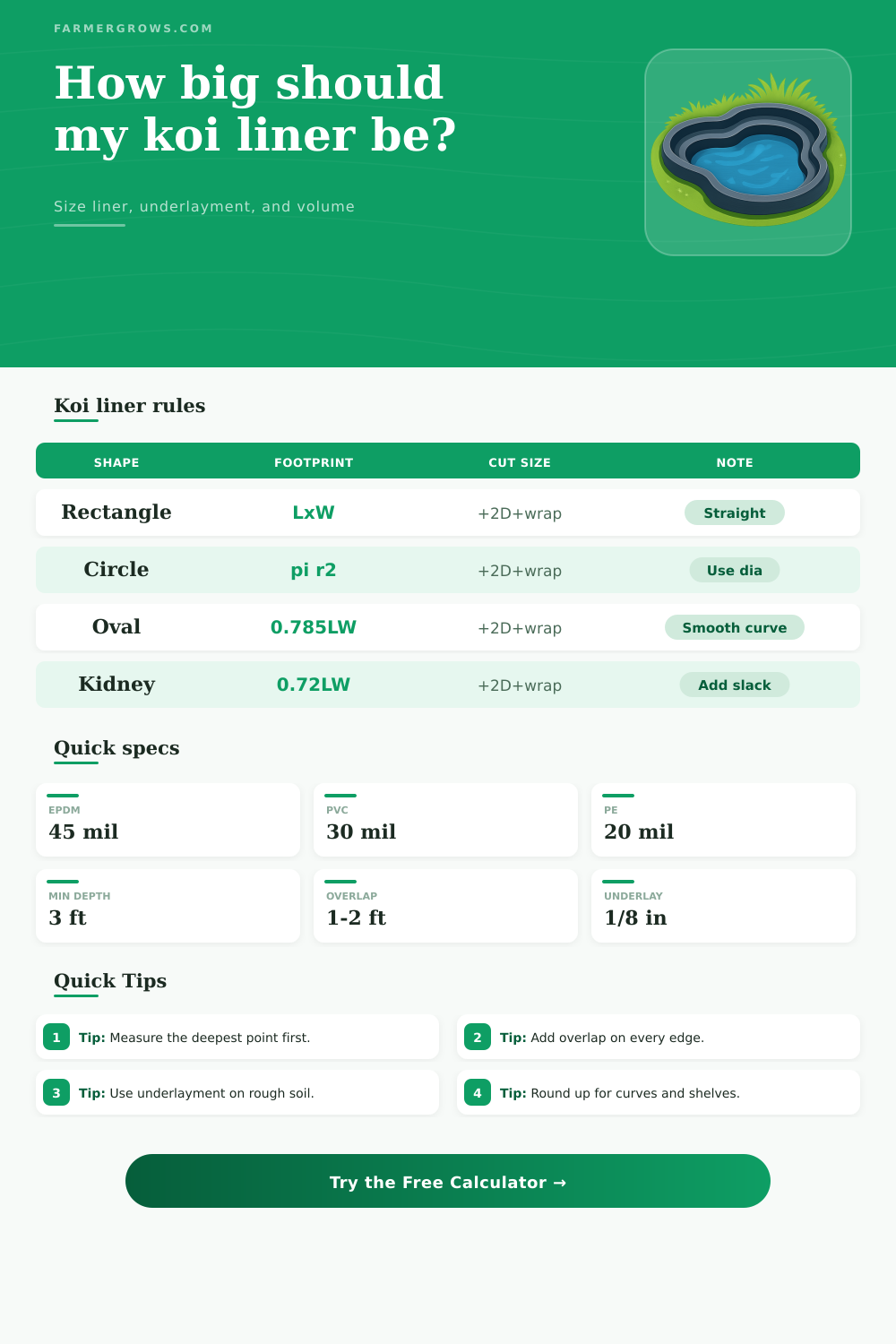
| Shape | Footprint formula | Liner cut formula | Best use |
|---|---|---|---|
| Rectangle | Length x width | L+2D+wrap | Straight walls |
| Circle | Pi x r2 | Dia+2D+wrap | Round koi ponds |
| Oval | 0.785 x L x W | L+2D+wrap | Soft curves |
| Kidney | 0.72 x L x W | L+2D+wrap | Organic outline |
| Material | Thickness | Real data | Practical note |
|---|---|---|---|
| EPDM | 45 mil | Fish-safe, UV, ozone, oxidation resistant, 20-year guarantee | Best curve fit |
| PVC | 30 mil | Fish-grade, UV stable, 10-year warranty | Easy to seam |
| Polyethylene | 20 mil | Very good UV resistance, stiffer than EPDM | Large simple ponds |
| Underlayment | 1/8 in | Blocks punctures and vents gas | Protective layer |
| Product | Available sizes | Type | Use note |
|---|---|---|---|
| Boxed EPDM | 8x10 to 20x25 | 45 mil | Handy for smaller ponds |
| Roll EPDM | 5x100 to 30x50 | 45 mil | Better for longer runs |
| Rock pad roll | 15x150 | 1/8 in | Protects liner from stone |
| Weighted tubing | 3/8x100 | PVC, fish-safe | Useful for aeration lines |
| Depth | Guidance | Why it matters | Source note |
|---|---|---|---|
| 2 ft | Suggested minimum in warm climates | Gives koi a cooler bottom zone | Aquascape guide |
| 3 ft | Common koi minimum | Better winter buffer | Next Day Koi |
| 3-4 ft | Conservative start depth | Helps with predators | Koi pond builders |
| 5 ft+ | Deep zone for larger fish | More space and stability | Cold climate ponds |
To calculate the size of the liner for your koi pond, you must account for more than the area that your pond will occupy on the surface. You also must account for the descent into the depth of your pond, as well as the ascent back up to the surface rim of your pond. If the liner is too small, it will bunch up at the curve of your pond.
If it is too large, you will have wasted money on purchasing pond liner that you wont be able to use. You must account for the depth of your pond in the size of the liner that you purchases for your pond. The depth of your pond will determine the amount of liner that your pond liner must travel.
How to Measure the Liner for Your Koi Pond
In calculating the depth, you must add twice the depth of your pond to the length of your pond and the width of your pond. For instence, if your pond is three feet deep, you will have to add three feet to the depth of the pond to the depth of the ponds descent into the water. Then, you will have to add three feet to the length of the pond liner to account for the three foot descent into the pond.
Thus, the pond liner must travel three feet down into the pond and three feet up the other side of the pond to reach the surface of the pond. The shape of the pond will also impact the amount of liner that you need for your pond. Pond liners that are oval in the shape will require less liner than rectangular ponds of the same length and width.
Therefore, oval pond require eighty percent of the pond to be lined. Kidney shaped ponds require seventy-two percent of the pond to be lined. In any case, you must always round up the measurements for the length and width of the pond to ensure that the pond liner can account for all of the curves and shelves within the pond.
The materials for your pond liner will also play a key role in the function of your pond. EPDM liner materials are forty-five mil in thickness. The benefit of EPDM liner is that it can fold onto the shelves within the pond.
PVC liner materials are thirty mil in thickness. The benefit of using PVC liner is that you can join the two sections of liner together to form a continuous liner. Polyethylene liner materials are stiffer than the other liner materials and are used for large, simple ponds.
An underlayment is also important to place beneath the pond liner. The underlayment prevents the pebble within the pond from piercing the pond liner. Additionally, the underlayment provides a cushion for the pond liner that will prevent the pond roots from damaging the liner.
The underlayment will include an extra half foot of liner that you can tuck beneath the pond liner. It is also important to make a distinction between the average depth of your pond and the maximum depth of your pond. The average depth of the pond is used to calculate how many gallons of water the pond will hold.
The volume of water will determine the number of koi that live in the pond. The maximum depth of the pond is the depth of the deepest part of the pond, and this will determine the size of the pond liner for your koi pond. The depth of the pond liner must reach the maximum depth of the pond.
Additionally, koi requires a minimum depth of three feet in their ponds. This depth will allow the fish to lie on the bottom of the pond during the hot summer month or during the winter months when the ponds may freeze. Without enough depth, the koi will become stressed due to the heat waves that may roll through your area.
The volume of the pond is calculated by multiplying the area of the pond by the depth of the pond. The result will show you the number of gallons of water that the pond will contain. Knowing the number of gallons of water will allow you to determine how many koi the pond can support.
If the pond contains less water than desired, waste will quickly build up in the pond and stress the pond filter. If the pond contains too much water with insufficient pond circulation, dead zones will form in the pond. Additionally, the pond liner must allow for enough space for the koi to swim in it.
Koi can grow to two feet in length. To calculate the size of the liner that is required to line your pond, follow these step:
Measure the length and the width of the pond. Measure the depth of the pond.
Add twice the depth of the pond to the length and the width of the pond. Add one to two feet to the length and the width of the pond to allow for the overhang of the liner over the pond edge. Add an extra half foot of liner to the length and the width of the pond for the underlayment.
Round the length and width of the pond up to the nearest foot.