Greenhouse Orientation Latitude Calculator
Use latitude, season, tilt, and shadow geometry to choose a greenhouse ridge direction, a practical roof angle, and a daylight-friendly layout for the site.
Pick a climate band to seed latitude, hemisphere, season snapshot, roof style, and a practical tilt for the first pass.
Orientation and light results
Results update as latitude, season, tilt, and shading geometry change.
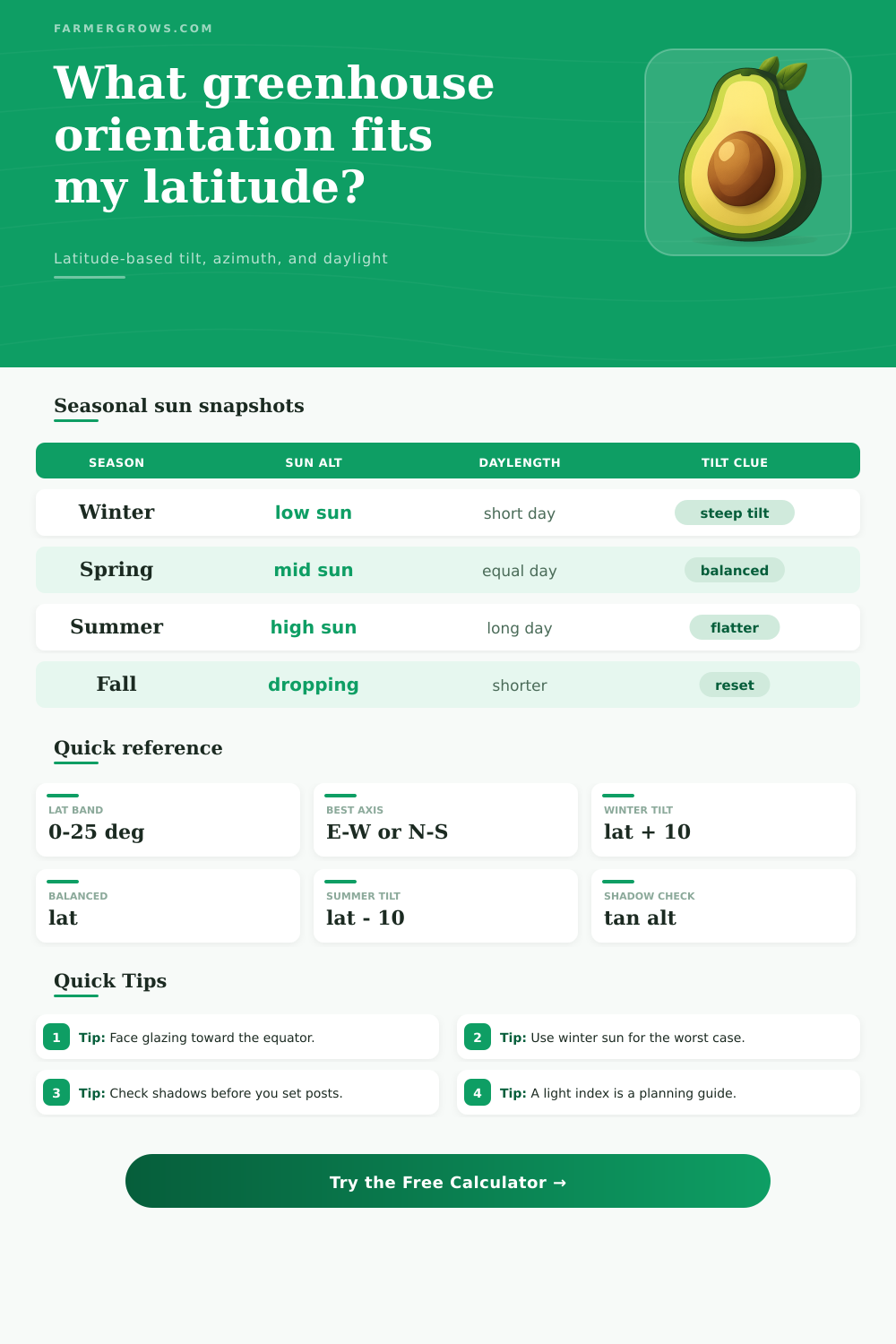
| Season | Day rule | Noon sun | Light note |
|---|---|---|---|
| Winter | solstice day | lowest | longest shadows |
| Spring | equinox day | mid range | balanced daylight |
| Summer | solstice day | highest | short shadows |
| Fall | equinox day | mid range | reset for winter |
| Priority | Tilt rule | Axis rule | Best use |
|---|---|---|---|
| Winter gain | lat + 10 | east-west | Maximize low sun |
| Balanced light | lat | north-south | Even daily light |
| Summer cooling | lat - 10 | north-south | Reduce midday load |
| Annual compromise | lat - 5 | east-west | Middle ground |
| City | Lat | Local season | Practical note |
|---|---|---|---|
| Miami | 26N | Warm winter | Gentle tilt works |
| Denver | 40N | Cold winter | Favor winter gain |
| Sydney | 34S | Cool winter | Face toward north |
| Christchurch | 43S | Snow risk | Check shadow reach |
Greenhouse orientation is the process of position the greenhouse to capture sunlight. Greenhouse orientation is necessary because the direction of the greenhouse will determine the amount of light that the plant in that greenhouse will recieve. If the greenhouse is built in such a way that the plants do not receive enough sunlight, it can negatively impact the growth of the plant.
The position of the sun change throughout the year, so that must also be considered when orienting the greenhouse. One of the first factors to consider in determining the orientation of the greenhouse is the latitude of the greenhouse. The latitude of the location will determine the angle at which the sun will hit the greenhouse.
How to Position a Greenhouse for the Best Sunlight
At latitudes between 0 and 25 degrees, the sun will remain high in the sky throughout the year. Greenhouses in these areas may have gentle slope in their roofs to allow for the greenhouse to capture sunlight. In areas between 25 and 45 degrees, however, the sun will be lower in the horizon during the winter month.
Greenhouses in these areas will have steeper-pitched roofs to allow for the greenhouse to effectively capture sunlight during winter months. The position of the sun can be represented by the angle of the solar noon altitude. The solar noon altitude impact the length of the shadows that the greenhouse may experience, as well as the angle at which sunlight enter the greenhouse.
Another factor to consider in greenhouse orientation is the hemisphere in which the greenhouse is to be built. The hemisphere will impact the direction in which the greenhouse should face the equator. In the southern hemisphere, the equator is to the north of where the greenhouse will be built.
In these locations, the greenhouse should be constructed to face towards the north in order to maximize the amount of sunlight that the greenhouse receives. If greenhouse buildings in the southern hemisphere face towards the south, they may not provide enough sunlight to the plant that are growing within that greenhouse. Another factor that may impact the orientation of the greenhouse is the style of the roof.
For instance, gable roof provide even weights on each side of the roof, as well as create an angle for sunlight to enter the greenhouse. Hoop houses, in contrast, have roofs in the shape of hoops to allow for the structure to shed snow off the greenhouse roof. The downside to this shape is that the angle of the greenhouse roof may be flatter than gable roofs.
Lean-to greenhouses are built against a wall, and lean towards the sun in order to allow for the maximum amount of sunlight to enter the greenhouse. Additionally, the orientation of the greenhouse roof can be adjusted according to what type of sunlight is required for the greenhouse. For instance, if the intention is to build the greenhouse to receive the maximum amount of light during the winter months, then the roof should have a steeper roof than if the intention was to provide the greenhouse with the best amount of light during the summer months.
During the winter, the sun is lower in the horizon, so a steeper roof will allow sunlight to enter the greenhouse. During the summer, however, the sun is higher in the sky, so a flatter roof will deflect some of the sunlight. The number of daylight hours in a given location changes with the time of year.
Additionally, the number of daylight hours change with the latitude at which the greenhouse is built. At high latitudes, there are fewer daylight hours during the winter months than in the summer months. Additionally, shadows will be longer at winter solstice than at the spring and fall equinoxes.
During the equinoxes, the length of daylight at the greenhouse location is even throughout the day. Additionally, the percentage of sunlight that passes through the greenhouse glazing impact the amount of light that enters the greenhouse. The percentage of sunlight that passes through the greenhouse glazing is referred to as the transmission percentage.
Different types of glazing allow for different percentages of sunlight to enter the greenhouse. For instance, poly film scatters the sunlight more than glass covering for greenhouses. Additionally, the percentage of sunlight that enters the greenhouse may change with time.
Dust and age of the greenhouse glazing can reduce the transmission percentage. One factor that will impact the orientation of the greenhouse is the ridge axis of the greenhouse. If the ridge run north and south, this will allow sunlight to move evenly across the greenhouse.
Additionally, a ridge axis that runs north and south is beneficial in greenhouse design if the goal is to provide even light to the plants. An east-west ridge axis will allow the greenhouse to capture sunlight during the winter months when the sun is at its lowest arc. Finally, in addition to the ridge axis, it is also possible to adjust the azimuth of the greenhouse to the position of any hill or obstructions in the area.
For instance, if there is a hill in the area, the azimuth can be adjusted to ensure that the greenhouse is not shaded by that hill. Additionally, a light index can be used to determine the score of the greenhouse according to the amount of sunlight that enters the greenhouse. A high score indicate that the greenhouse is optimized for sunlight.
Another factor to consider in the orientation of the greenhouse is the shadows that may occur. Shadows will prevent sunlight from reaching the greenhouse. These shadows can be created by various object around the greenhouse, such as trees.
At low altitudes of the sun, shadows will extend out from objects such as trees. For instance, if the tree is eight feet in height, the shadow will extend to a distance of twenty feet from the tree. Therefore, before building a greenhouse, it is necessary to check the setback distance of the greenhouse from other objects.
Additionally, shadows will be tested during the winter months when the sunlight is the lowest in the sky. If the shadow created by an object such as a tree do not impact the greenhouse during the winter months, it will not create shadows on the greenhouse during the remaining months of that year. Finally, there are various environmental factors that may impact the orientation of the greenhouse.
For instance, the wind and snow that may enter the greenhouse may require the greenhouse to be built with strength in mind, rather than with maximizing the amount of sunlight that enters the greenhouse. Additionally, in areas near the equator, heat within the greenhouse is an issue. In these locations, the greenhouse must be constructed to allow for proper ventilation.
In temperate zones, however, one must consider the month in which there is the least amount of sunlight. Prioritizing light in the lean months of the year will ensure that the greenhouse will allow for the plants to grow properly during the winter months. Before building the greenhouse, it is a necessity to walk the site at solar noon during the winter solstice.
During the winter solstice, it is possible to see any hill, buildings or hedges that may create shadows on the greenhouse during the daylight hours. Various strategy exist for greenhouses that are built in different latitudes. For instance, if the greenhouse is to be built in a latitude between zero and fifteen degrees, the sun will be high in the sky.
In these locations, the greenhouse roof can be pitched to have a gentle slope. In the latitude between thirty and forty-five degrees, the seasonal difference of sunlight are the most pronounced. Therefore, winter sunlight is important to consider in the design of the greenhouse.
Finally, in the latitudes above forty-five degrees, the sun is low in the horizon. In these locations, the greenhouse roof will have a steep-pitched roof to allow sunlight to enter the greenhouse. In the building of any greenhouse, there will be tradeoffs in the design.
Each choice has a benefit, but also a negative aspect to that choice. For instance, if greenhouses have steeper roof slope, the greenhouse will receive more winter sunlight. However, the downside of steeper slopes is the possibility of overheating in the summer, as well as potential damage from the wind.
If greenhouses are built with a north-south ridge axis, the sunlight will be even throughout the greenhouse. However, in the mornings, the greenhouse will experience shadows during the winter months. One compromise in the design of greenhouses is to use a roof tilt that is built at the latitude of the greenhouse minus five degree.
This angle is the middle ground in growing various type of plants. In addition to these consideration, any mistake are sure to lead to the greenhouse not functioning as it is meant to when the greenhouse is built.