🏗 Land Grading Calculator
Estimate fill volume, bag count, and material weight for pads, terraces, driveways, and leveled yard areas.
Use the shape tool for a pad, yard, or terrace footprint. The calculator converts metric or imperial entries, then adds your chosen overage for settling and compaction.
💧 Grading Results
Estimate fill volume and material demand for your grading layout.
Calculation Breakdown
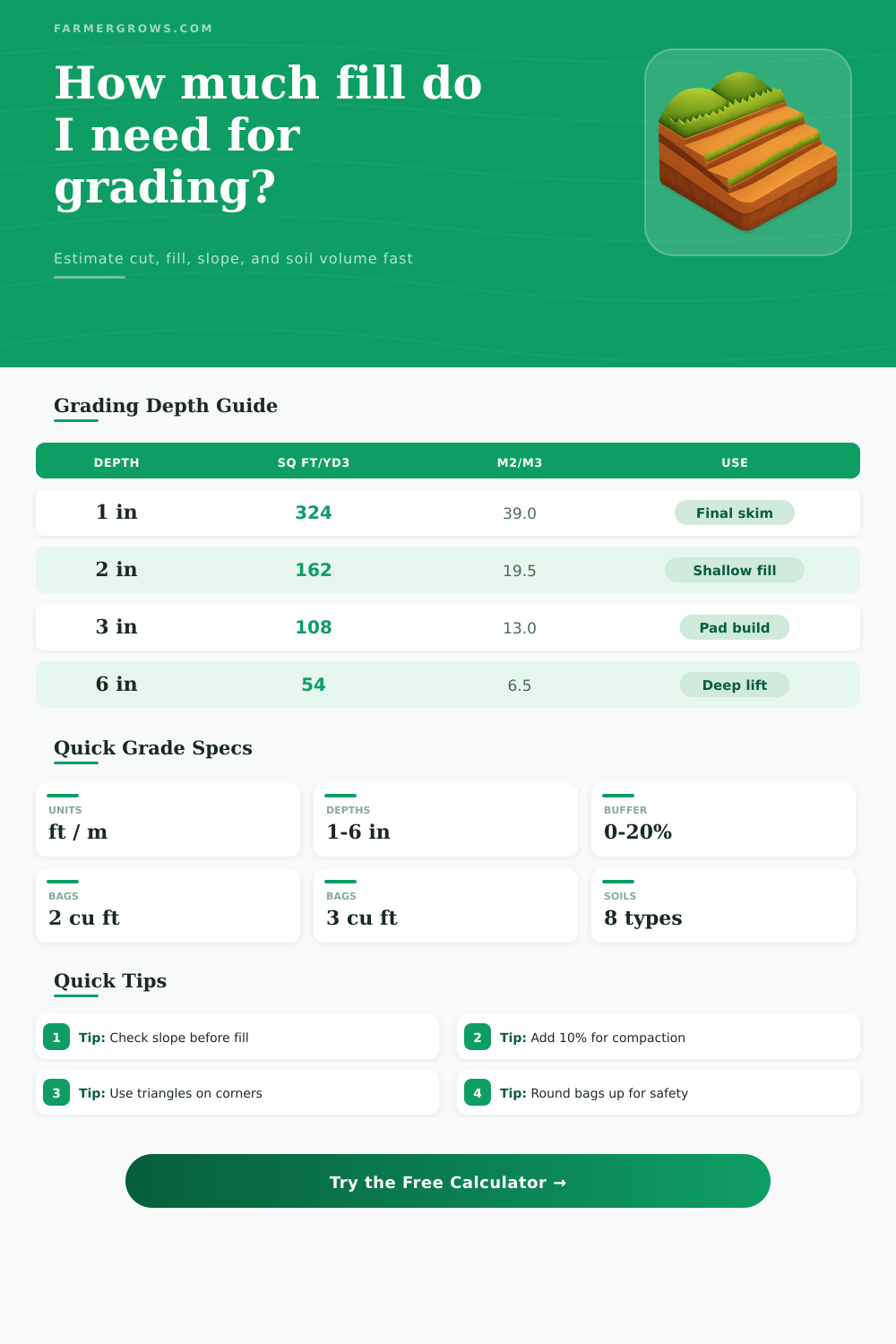
| Depth | Sq ft per yd3 | M2 per m3 | Best use |
|---|---|---|---|
| 1 in | 324 | 39.0 | Final skim |
| 2 in | 162 | 19.5 | Shallow fill |
| 3 in | 108 | 13.0 | Pad build |
| 4 in | 81 | 9.8 | Crown slope |
| 6 in | 54 | 6.5 | Deep lift |
| Package | Volume | Per yard | Coverage at 3 in |
|---|---|---|---|
| 2 cu ft bag | 2 cu ft | 13.5 bags | 24 sq ft |
| 3 cu ft bag | 3 cu ft | 9 bags | 36 sq ft |
| 1 cu ft bag | 1 cu ft | 27 bags | 12 sq ft |
| Bulk yard | 27 cu ft | 1 yard | 324 sq ft |
| Project | Area | Cubic yards | 2 cu ft bags |
|---|---|---|---|
| Small yard pad | 120 sq ft | 1.11 yd3 | 15 bags |
| Barn apron | 60 sq ft | 0.56 yd3 | 8 bags |
| Driveway crown | 180 sq ft | 1.67 yd3 | 23 bags |
| Orchard terrace | 240 sq ft | 2.22 yd3 | 30 bags |
Land grading are the process of reshaping the dirt to create flat surface or specific slope to the land. Land grading is used to build sheds on a flat pad, ramps to barns to ensure they is smooth, and terraces for plants to aid drainage. Land grading is necessary to prevent water from pooling on the land in uneven patch.
Additionally, land grading is necessary to prevent gravel from scattering from driveways. If land is graded correct, the property will work with the land. However, if graded incorrectly, there will be the need to purchase fill material in the future to even out the land.
How Much Soil You Need for Land Grading
Calculating the amount of soil that will be required for land grading are the first step in the land grading process. The user calculates the volume of soil by multiplying the length of the area by the width of the area to get the total surface area of the plot. Then, the depth of the soil is multiplied by the total area to determine how much soil will be required to level the land.
For triangular areas, use the formula for the area of a triangle, using the base and the height of the triangle. For circular areas like garden beds, calculate the area of a circle. The shape of the area to be graded will impact the amount of soil need.
A skinny driveway will require less soil than a square pad of the same perimeter. The depth of soil that will be layered onto the land determine how much area will be covered by one cubic yard of soil. A one-inch layer of soil will cover approximately three hundred square feet per cubic yard.
A two-inch layer will cover half of the area that a one-inch layer cover. Three-inch and four-inch layers of soil is used for building pads and creating slope for drainage. A six-inch layer of soil is used for deep lifts of the land to create even slope.
Building pads will require more soil than deep lift. Thin layers of soil will cover more area per cubic yard than deep lift of soil. The type of material that will be used will impact the weight of the soil that will be used in the land grading process.
Topsoil weigh approximately two thousand two hundred pound per cubic yard. Topsoil is suitable for building pad for gardens. Fill dirt and clay weigh up to twenty-six hundred pound per cubic yard.
Fill dirt and clay is used to create driveways that can support the weight of vehicle. Gravel base weighs approximately three thousand pound per cubic yard. Gravel base is ideal for areas that will experience heavy traffic.
Compost blend are light in weight. Compost blends are used in raised garden beds as the soil drain quickly. Soil will compact by ten to twenty percent during the land grading process.
If the compacted soil is not account for, the soil pad will sink during the growing season. Decide whether soil will be purchased in bag or in bulk. A bag of soil that contains two cubic-feet of soil will cover twenty-four square feet if the depth are three inches.
Thirteen or fourteen bag of soil will contain one cubic yard of soil. A bag that contains three cubic feet will cover more area than a two-cubic-foot bag. However, three-cubic-foot bags may not come in neat stack for bulk purchases.
Purchasing soil in bulk is a betterer deal for properties that will require more than one cubic yard of soil. For example, fifteen bag of topsoil will be needed to grade a small pad in the yard. Twenty-three bag of topsoil will be required to build a driveway crown.
Before grading the land, perform a survey of the high and low point of the site. Place stake at the high and low points of the land. Calculate the average depth of soil that will be required to even the land.
Flat calculation do not account for deep depression in the land. Test the soil by squeezing a handful of soil. If the soil crumble easily, use sandier soil.
If the soil form a ball in the hand, use clay to prepare the land. Grades of two percent will allow water to run off the land without pooling. A two percent slope is steep enough to allow water to drain from the land while remaining mowable by grass cutter.
Many mistake occur when grading land. Common mistake include only measuring the surface area of the site to be graded. People also fail to consider the depth of the land when purchasing soil.
A buffer of soil should of been added for settling land, especially if the soil is organic. Add five percent more soil in case of rainfall before grading the land. Water weigh differently than dry soil.
Always round the number of bag of soil needed to the next highest bag to ensure that the purchase of soil will be sufficient for the job.