💧 Submerged Culvert Flow Calculator
Estimate drowned-barrel discharge, barrel velocity, and head loss for round or box culverts under high tailwater.
This calculator blends a submerged-head orifice check with a Manning barrel check, then reports the governing flow for farm lanes, road dips, and low outlet crossings.
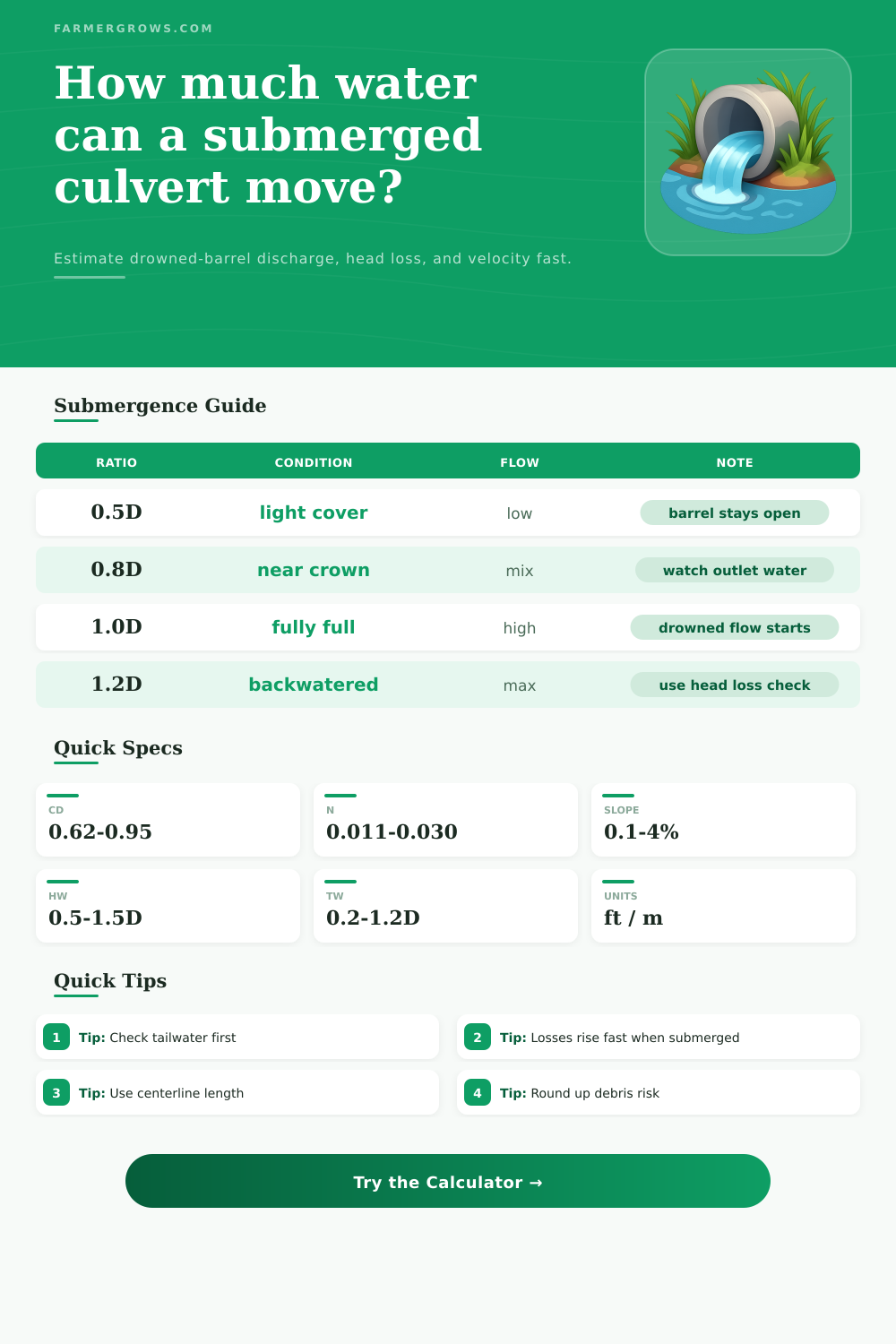
| Tailwater / crown | Condition | Flow behavior | Check |
|---|---|---|---|
| 0.50 | Light cover | Mostly open | Use Manning |
| 0.80 | Near crown | Mixed regime | Watch losses |
| 1.00 | Fully full | Drowned flow | Energy split |
| 1.20 | Backwatered | Pressure line | Head loss |
| Entrance type | Cd | K note | Use |
|---|---|---|---|
| Projecting | 0.62 | 1.10 | Least polished |
| Square edge | 0.72 | 0.90 | Common field |
| Headwall | 0.80 | 0.70 | Better entry |
| Beveled | 0.92 | 0.55 | Best entry |
| Material | n | Roughness | Typical use |
|---|---|---|---|
| Concrete | 0.012 | Smooth | Long life |
| HDPE smooth | 0.011 | Very smooth | Low drag |
| Corrugated metal | 0.024 | Rough | Field fit |
| Concrete box | 0.013 | Moderate | Heavy loads |
| Shape | Size | Crown | Note |
|---|---|---|---|
| Round | 24 / 600 | Small run | Light duty |
| Round | 36 / 900 | Medium run | Farm lanes |
| Box | 48 x 36 | Low profile | Shallow cover |
| Box | 72 x 48 | Large flow | Road crossing |
Submerged culvert flow occur when the tailwaters rise high enough to cover an outlet of the culvert. Submerged flow alter the flow through the culvert. Culverts is typically sized for conditions when the tailwaters is low, which is refered to as free flow.
With higher tailwaters covering the outlet of the culvert, the culvert is in a submerged flow condition. Submerged flow limits an amount of water that can pass through the culvert. Submerged flow alters the flow regime in the culvert from open channel flow to pressure flow.
What Is Submerged Culvert Flow
In order to manage the submerged flow in a culvert, it is first important to understand the submergence ratio of the culvert. The submergence ratio is a measurement of the height of the tailwaters relative to the culvert crown. When the tailwaters reach the crown of the culvert, the submergence ratio is 1.0 or greater.
When the submergence ratio is greater than 1.0, the culvert begins to act more like an orifice than a drain. The size of the orifice that exists in the culvert is dependent upon the head difference between the culvert invert and the tailwaters. The head difference is the vertical difference between the water levels in the culvert and tailwaters.
The greater the head difference, the more greater the flow through the culvert. The discharge capacity of culverts in submerged flow are affected by several factors. The entrance conditions to the culvert will affect the discharge coefficient of the culvert.
For instance, a projecting lip on the culvert will create more turbulence in the flow than a beveled headwall. The discharge coefficient will be higher for a beveled headwall than for a projecting lip; higher coefficients allow more flow through the culvert. The roughness of the materials that make up the culvert will also affect the flow; materials that are rougher to the touch, like corrugated metal, will allow more friction to the moving water than smooth materials like HDPE.
Additionally, the length of the culvert will affect the flow; longer culverts will exhibit greater friction losses than shorter culverts. Finally, the diameter of the culvert will also have an impact on the flow; larger culverts will allow for greater flow than smaller culverts. Calculators are available that can determine the capacity of a culvert in submerged flow conditions.
These calculators allow the user to input the dimensions of the culvert barrel, the shape of the culvert barrel, the slope of the culvert, and the amount of debris that may be clogging the inlet of the culvert. The calculator will output the discharge rate, the velocity of the water within the culvert, the total head loss within the culvert, and the submergence ratio. The manager of the culvert should monitor the velocity of the flow within the culvert; velocities above 10 ft/s can lead to erosion within the culvert, but velocities below 2 ft/s can lead to sediment build up within the culvert.
Exit losses are often an issue with culverts that those calculating the capacity of the culvert ignore. The exit losses create additional head loss within the system; the exit loss coefficient can double the minor losses created by the culvert when the tailwaters cover the culvert outlet. These losses will increase the head loss within the culvert, which will decrease the capacity of the culvert to move water.
Additionally, the type of soil in which the culvert is installed will impact the headwater buildup within the culvert; soils like clay will hold the water for longer periods of time than soil like sand. Culverts come in a variety of shape, each of which have the advantages of its specific shape. For instance, box culverts have a rectangular cross section.
The rectangular cross section of the culvert allows for a better hydraulic radius than round culverts of the same cross sectional area. Culverts with a better hydraulic radius can handle more water before becoming full, and experience a reduction in the risk of settlement within the culvert. Additionally, different submergence ratios can expect different types of flow.
For instance, if the submergence ratio of the culvert is less than 80%, the flow within that culvert will be mostly in the range of Manning’s flow; however, if the submergence ratio reaches 100%, the flow will be governed by orifice flow rules. Each of the culvert calculation websites have presettings for common scenarios for farm lanes and driveways. These presets allow for the manager of the culvert to load realistic water and slope values into the calculator.
The users of the culverts can also switch between metric and imperial units within the calculator. Finally, the calculations can be printed so that they can be used as notes at the site where the culvert is installed. These notes will include information about the area of the culvert, the hydraulic radius of the culvert, the velocity within the culvert, the total head loss, the submergence ratio, and whether the flow in that culvert is limited by orifice flow or friction.
These calculations will assist in the management of the culvert in such a way that the water can pass through the culvert without causing a backup within the culvert.