🚧 Culvert Length Calculator
Estimate the barrel length for farm lanes, driveway crossings, roadside drains, and skewed runs before you order pipe.
This planner estimates ordering length from road width, fill height, side slope, projection, and skew. It is a practical first pass for farm lanes, ditch crossings, and roadside drains.
Imperial uses feet, inches, and cfs. Metric uses meters, millimeters, and m3/s.
Size Summary
Runoff, recommended culvert size, capacity, velocity, and cover check from the current inputs.
Calculation breakdown
| Diameter | Area | Full flow @1% | Typical use |
|---|---|---|---|
| 12 in | 0.79 sq ft | 1.8 cfs | Driveway edge |
| 18 in | 1.77 sq ft | 5.8 cfs | Farm lane ditch |
| 24 in | 3.14 sq ft | 13.8 cfs | Pasture swale |
| 36 in | 7.07 sq ft | 37.0 cfs | Road crossing |
Values above are quick planning guides. The calculator below still recomputes the full Manning result from your own inputs.
| Surface | C | Storm response | Typical use |
|---|---|---|---|
| Roof | 0.90 | Fast | Outlets |
| Gravel | 0.40 | Moderate | Drive lanes |
| Pasture | 0.25 | Slower | Grass catchment |
| Pavement | 0.95 | Very fast | Aprons |
If the catchment mixes roof, gravel, and soil, choose the coefficient that best reflects the peak runoff path into the culvert.
To determine the length of the culvert pipe that you will needing to install under your road, you must first decide on the length of the culvert pipe. If the culvert pipe that you install is too short, the embankments that exists along the road will collapse into the ditch. If, however, the culvert pipe that you use is too long, you will spend excess moneys on the culvert pipe installation.
In order to determine the length of the culvert pipe that is required for installation, you must measure the width of the road, the slope of the embankment, the angle of the ditch, and any end treatment of the culvert pipe. To determine the length of the culvert pipe, begin by measuring the width of the road. The width of the road, however, isnt the total length of the culvert pipe that will be needed for installation.
How to Measure the Length of a Culvert Pipe
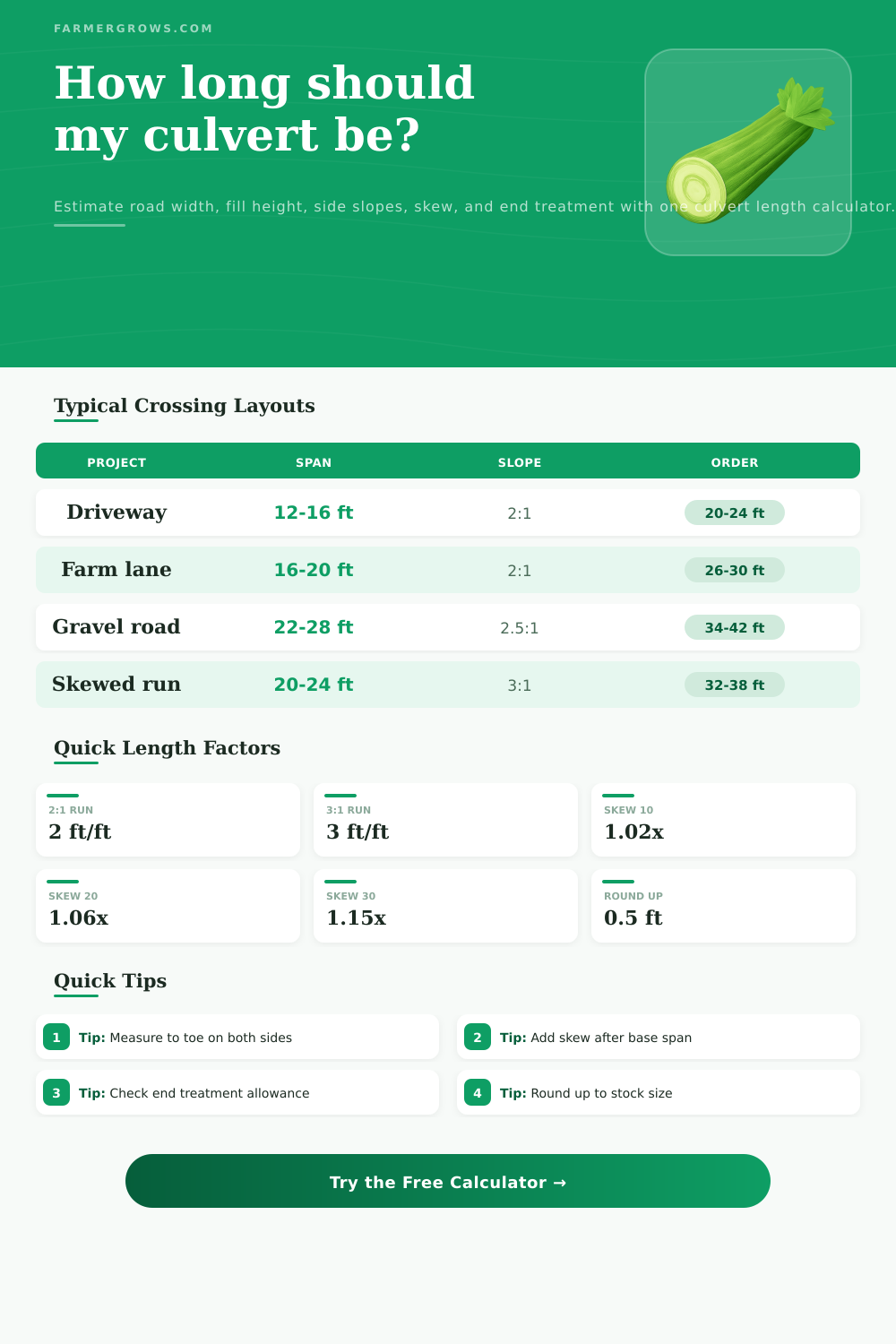
Along the road, there are embankments of specific widths that must be accounted for in the length calculations of the culvert pipe. The type of soil of that area, as well as the height of the fill that will be used in constructing the embankments, determines the width of these embankments. For instance, if the road is sixteen feet wide, but has four feet of fill along a two-to-one slope on each side of the road, the total length that the culvert pipe must span to clear these embankments will be twenty-four feet.
This measurement is, however, not the entire length of the culvert pipe that will be needed for installation. The angle of the ditch, referred to as the skew of the ditch, will also impact the length of the culvert pipe that is required for installation. Many ditches are not constructed in a way that they are perpendicular to the road.
In these instances, the skew will require additional length for the culvert pipe to appropriately span the distance between the two embankments. For example, a skew of only ten degrees will require the culvert pipe to be only approximately two percent longer than the distance that was calculated from the road width and the width of the embankment slopes. A skew of thirty degrees, however, will require the culvert pipe to be fifteen percent longer than the distance that was calculated based upon the road and its embankments.
You must determine the distance from the toe of the slope on one side of the road to the toe of the slope on the other side to ensure that the culvert pipe will accurately span the distance between the embankments. In addition to the skew of the ditch, the end treatments of the culvert pipe will also impact the length of the culvert pipe. You must provide six to twelve inches of length to each end of the culvert pipe to allow for beveling of the ends of the culvert pipe, as well as for the installation of guards that will help to prevent debris from clogging the inlet of the culvert pipe.
In addition to providing for these end treatments, however, it is also possible that headwalls will be constructed at each end of the culvert pipe. These headwalls may also impact the length of the culvert pipe that will be required for installation. In any instance, the length of the culvert pipe should always be rounded up to the nearest length of stock culvert pipe; purchasing pipes that are too short will result in costly fees being placed upon the road construction project for custom-fabricated culvert pipe.
The amount of water that will run across the road can also impact the length of the culvert pipe. In areas where there are large amounts of water that will run across the road, the culvert pipe that is constructed will need to be of a larger diameter. These requirements for the culvert pipe will increase the depth of the trench in which the culvert pipe will be constructed.
The amount of water that will run across the road is related to the coefficients of runoff of the area. For instance, areas that contain only gravel will exhibit different coefficients of runoff than areas that contain grass-covered land, or even land that contains roofs. Additionally, it is also recommended to include a buffer of ten to fifteen percent of the length of the culvert pipe to allow for leaves and other sediment that may enter the culvert pipe and lead to clogging of the pipe.
The material from which the culvert pipe will be constructed will also impact the length of that pipe. For example, the culvert pipe can be made of materials like concrete, corrugated HDPE, or even pre-fabricated concrete sections. Culvert pipes made of concrete, for instance, require a minimum of twelve inches of cover of the culvert pipe over the crown of the pipe.
Culvert pipes made of corrugated HDPE, however, require a minimum of twenty-four inches of cover of the culvert pipe over the crown of the culvert pipe. The height to which the embankments will be constructed will impact whether or not the requirements for the cover of the culvert pipe will be met. In addition to the requirements of the cover of the culvert pipe, the slope of the culvert pipe will cause the outlet of the culvert pipe to be lower than the inlet of the culvert pipe.
By considering all of these factors, it is possible to determine the length of the culvert pipe that will be required for installation under the road. Many individuals, however, make several mistakes during the installation of culvert pipe. For instance, many individuals may measure the distance from the crown of the road on each side to the toe of the embankment on each side, but fail to consider that the bottom of the ditch will be lower than the road.
Additionally, some individuals may err in the measurement of the skew of the ditch; they may measure the distance from the road shoulder on each side to the toe of the slope on each side, rather than measuring the distance from the toe of the slope on each side of the road to the toe of the other side of the slope. These types of mistakes can be avoided bystaking the toes of each slope of the embankment along the road; these markers will ensure that any measurements that are made are accurate. In order to calculate the length of the culvert pipe, it is first necessary to measure the road width, add the length of the embankments, account for the skew of the ditch, and add the length for any end treatments and end projections.
Additionally, it is also necessary to consider the material of the culvert pipe and the amount of water that will run across the road during calculations of the length of the culvert pipe. By considering each of these factors in the construction of the road and the culvert pipe that will cross under that road, the length of the culvert pipe will be the correct length to allow water to correctly flow through the culvert pipe, and ensure that the road remains stable and does not succumb to the elements.