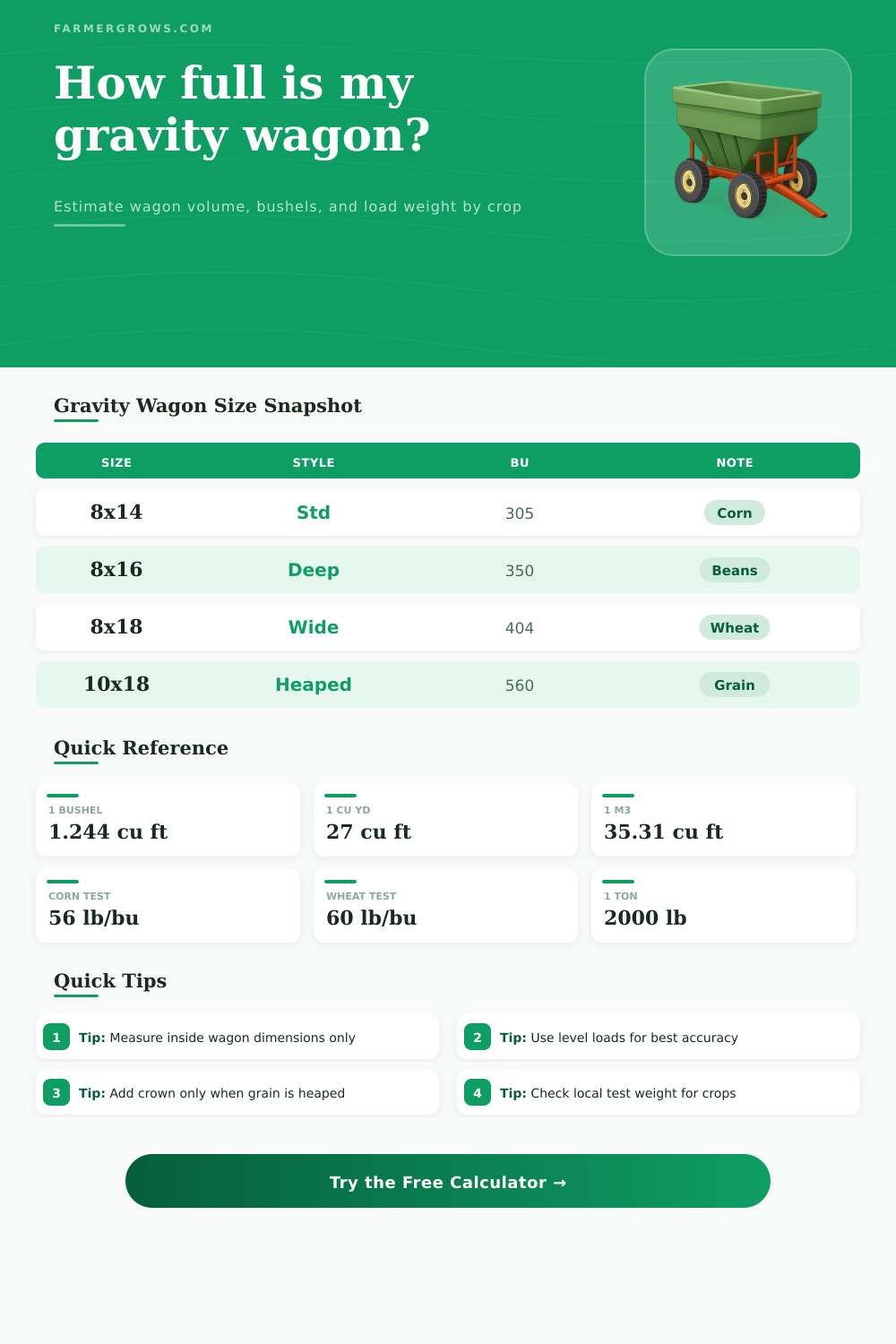
Gravity Wagon Capacity Calculator
Estimate bushels, cubic feet, and grain weight from wagon dimensions.
| Grain | lb/bu | cu ft/bu | Note |
|---|---|---|---|
| Corn | 56 | 1.244 | Dry grain |
| Soybeans | 60 | 1.244 | Light load |
| Wheat | 60 | 1.244 | High wt |
| Oats | 32 | 1.244 | Bulkier |
| Bed size | Level bu | Heaped bu | Use case |
|---|---|---|---|
| 8x6x2.5 | 96 bu | 104 bu | Pickup |
| 12x7x3 | 203 bu | 220 bu | Short box |
| 16x8x4 | 412 bu | 446 bu | Level load |
| 40x8.5x5 | 1,366 bu | 1,470 bu | Semi |
| Unit | Imperial | Metric | Note |
|---|---|---|---|
| 1 bu | 1.244 cu ft | 35.24 L | US bushel |
| 1 cu ft | 0.803 bu | 28.32 L | Inverse |
| 1 cu yd | 27 cu ft | 21.65 bu | Bulk vol |
| 1 m3 | 35.31 cu ft | 28.37 bu | Metric |
| Crown | Extra vol | Load type | Note |
|---|---|---|---|
| 0.5 ft | 8-10% | Light heap | Small crown |
| 1.0 ft | 10-15% | Common | Normal heap |
| 1.5 ft | 15-20% | Deep crown | High load |
| 2.0 ft | 20%+ | Very high | Spill risk |
To estimate the capacity of an gravity wagon, you must measure the internal dimension of the gravity wagon bed. Many people makes the mistake of measuring the exterior of the gravity wagon. However, the exterior of a gravity wagon include the rails and the braces.
Measuring the exterior will result in incorrect estimating the capacity of the gravity wagon. To obtain the internal dimensions of the gravity wagon, use a tape measure to measure the length, the width, and the depth of the interior of the gravity wagon. Once you have obtained the length, width, and depth of the gravity wagon, you can calculate the volume of the grain that can be loaded into the wagon.
How to Measure the Capacity of a Gravity Wagon
A level load mean that the grain is flat across the top of the gravity wagon. To calculate the volume of a level load, you can multiply the length of the gravity wagon by the width of the gravity wagon, then multiply that result by the depth of the gravity wagon. A heaped load is similar than a level load, except that the grain forms a mound or crown on top of the gravity wagon.
The crown that forms with a heaped load increase the capacity of the gravity wagon by 10 to 15 percent. When calculating the volume of a heaped load, you can consider the crown on top of the gravity wagon a pyramid with a certain height. In calculating the volume of a pyramid, you have to divide the result by three.
The type of grain that you are to load into a gravity wagon will change the weight of the load within the gravity wagon. For example, corn has a standard test weight of 56 pounds per bushel. Soybeans and wheat has a test weight of 60 pounds per bushel.
Because soybeans and wheat are heavier than corn, they will place more stress on the axles of the gravity wagon. Another factor that will influence the weight of the load is the settling of the grain. When grain is loaded into a gravity wagon, the grain settles into the wagon over time.
Due to settling, there will be a reduction in the volume of the grain that is transport by the gravity wagon. The volume of grain can be reduced by 2 to 10 percent due to settling. When planning the load of the gravity wagon, account for grain settling so that the weight of the grain match the weight that is measured on a scale.
Once you calculate the volume of the grain that is within the gravity wagon, you can find the number of bushels of grain within that volume. There are 1.25 cubic feet in a bushel of grain, so divide the total number of cubic feet of grain by 1.25 to find the number of bushels. Once you know the number of bushels and you know the test weight of the grain in pounds per bushel, you can calculate the total weight in pounds of the grain.
For example, if there are 400 bushels of corn within the gravity wagon, and corn weighs 56 pounds per bushel, then the total weight of the grain is 400 times 56, which equals 22,400 pounds. Knowing the total weight is crucial when using the gravity wagon because you have to remain within the legal weight limit of the gravity wagon. Exceeding the legal weight limits can result in fines and damage to the gravity wagon.
Accuracy is necessary in measuring the capacity of a gravity wagon. If the measurements of the gravity wagon are incorrect, it can create problem in the operation of the gravity wagon. For example, if you overestimate the capacity of the gravity wagon, you might load the gravity wagon with too much grain.
This can damage the gravity wagon. Furthermore, if you underestimate the capacity of the gravity wagon, you will have to make more trips to transport the same amount of grain. This will waste your time and fuel.
To avoid these problems, measure the dimensions of the gravity wagon using a tape measure, account for the height of the crown of a heaped load of grain, and account for the settling of the grain during transport of the gravity wagon.