Spreader Setting Calculator
Estimate a starting dial setting, product load, coverage per bag, and calibration strip weight for rotary or tow-behind spreaders.
Start with the label rate, then tune from a short test strip. Keep the same walking speed, the same pass width, and the same overlap for each test run.
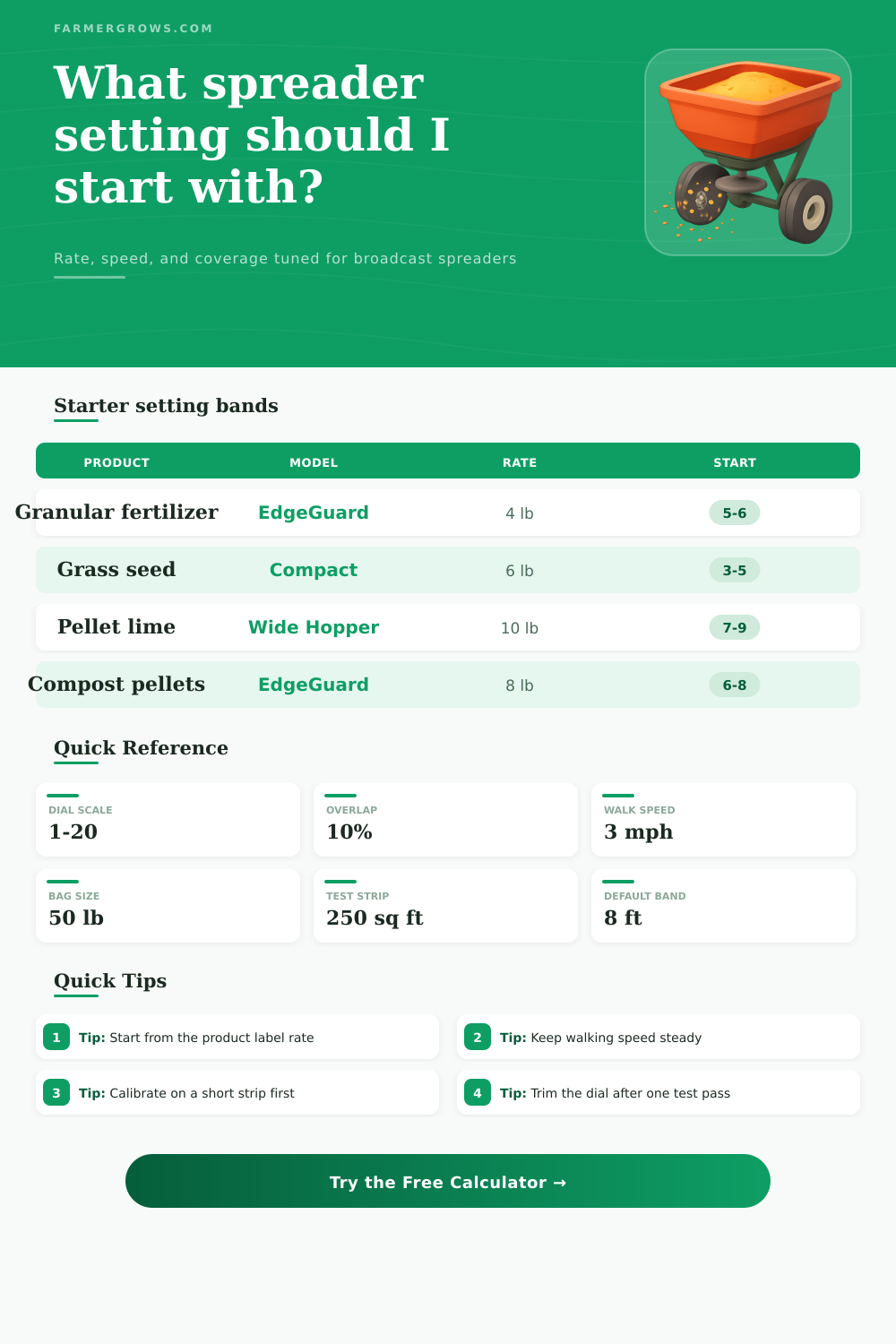
Starter setting bands
| Material | Model | Rate | Start |
|---|---|---|---|
| Granular fertilizer | EdgeGuard | 4 lb | 5-6 |
| Grass seed | Compact | 6 lb | 3-5 |
| Pellet lime | Wide hopper | 10 lb | 7-9 |
| Compost pellets | EdgeGuard | 8 lb | 6-8 |
Model dial bands
| Model | Light | Medium | Heavy |
|---|---|---|---|
| Compact walk-behind | 3-4 | 4-6 | 6-8 |
| EdgeGuard rotary | 4-5 | 5-7 | 7-10 |
| Wide hopper rotary | 5-6 | 6-8 | 8-12 |
| Tow-behind rotary | 6-8 | 8-11 | 11-15 |
Coverage and bag guide
| Bag weight | Rate | Covers | Notes |
|---|---|---|---|
| 25 lb | 6 lb | 4,167 sq ft | Fine seed or low load |
| 40 lb | 10 lb | 4,000 sq ft | Lime and blends |
| 50 lb | 4 lb | 12,500 sq ft | Standard lawn feed |
| 50 lb | 15 lb | 3,333 sq ft | Sand or coarse granules |
Calibration strip guide
| Strip length | Spread width | Strip area | Best use |
|---|---|---|---|
| 100 ft | 8 ft | 800 sq ft | Fast spot test |
| 250 ft | 8 ft | 2,000 sq ft | Most lawn checks |
| 250 ft | 10 ft | 2,500 sq ft | Wide hopper test |
| 500 ft | 12 ft | 6,000 sq ft | Tow-behind calibration |
Compact walk-behind
EdgeGuard rotary
Wide hopper rotary
Tow-behind rotary
Calibration tip: If the test strip looks light on one side, reduce speed before changing the dial. If the pattern is heavy and narrow, widen the band or lower overlap one step at a time.
- Keep the spreader level and walk straight through the full strip.
- Close the gate before turning at the end of the row.
- Recheck the label if you switch from seed to pellets or sand.
Broadcast spreading is a process of applying materials to lawn using a spreader. Several variable need to be managed when using a spreader because the spreader dial does not always indicate the amount of material that will be applied to the ground. These variables includes the flow rate of the material, the walking speed of the person using a spreader, the particle size of the material, and the width of the spread pattern.
The flow rate refers to amount of material that exits the spreader through the gate and onto the spinning plate. Although the spreader dial control the spreaders gate opening, the dial does not account for the different weight of materials. For example, grass seed tends to be lighter than lime pellets.
How to Use a Lawn Spreader
Therefore, grass seed will flow differently through the spreader gate than lime pellets. Another factor that will impact the flow rate is the walking speed of the person using the spreader. If the person walks quick, the material will take less time to pass through the gate of the spreader.
Therefore, the person will apply less material per square foot as they walk quickly on the lawn. However, if the person walks slow, the person will apply more material per square foot of lawn. To ensure that the spreader apply the correct amount of material to the ground, spreaders include a calibration strip.
This strip features a strip of lawn measuring 250 feet in length. Using this strip, the person using the spreaders can test the spreaders before applying the material to the lawn. Using the calibration strip, the person spreading the material should spread it on the calibration strip and collect the material.
Once the person collects the material, it should be weighed. The weight will indicate whether the person should increase or decrease the setting on the spreaders dial. If the weight is too low for the recommended amount of material to be applied, the dial should be increased.
However, if the weight is too high, the spreader should decrease the setting on the dial. The width of the spread pattern, also known as a band width, is the area where the material will land even across the lawn. Most spreaders have a band width between 5 and 12 feet.
The band width of a walk-behind spreader will be narrower than the tow-behind spreader. The tow-behind spreaders are create to cover more ground than the walk-behind spreaders because of the wider band width of the tow-behind spreader. To ensure that there are no gap in the lawn that does not receives the necessary amount of material to thrive, there must be overlap between the passes of the spreader.
Overlapping each pass by 10% will ensure that no lawn area will be missed. However, if there is no overlap, there will be bare patch in the lawn. If there is too much overlap, there may be too much of the material applied to certain areas of the lawn.
The type of material that a person will apply to the lawn will also change the way in which a person use the spreader. For instance, fine fertilizers will flow more easily through the gate of the spreader than coarse sand. If coarse sand is placed in the spreader, it may clog the spreader if not using the correct setting on the spreader dial.
If the material contain moisture, it may stick to the inside of the hopper of the spreader. If this occurs, the material will not apply evenly to the lawn. Therefore, the material should be dry when applying it to the lawn using the spreader.
Additionally, if different types of materials are to be applied to the same lawn, the spreader should be cleaned between applications to ensure that the residue from one material does not affect the even spreading of another material. To ensure the even spreading of the material, the person should maintain a walking speed throughout the spreading process. If the person speed up or slows down while spreading the material, the density of the material will change.
Additionally, when turning the corners of the lawn, the person should close the gate of the spreader to avoid applying extra material to the end of the row of lawn. By maintaining a constant walking speed and overlap of each pass, the material will be even across the entire area of the lawn. Maintaining even spreading of the material is the most important part of broadcast spreading because it will ensure that each lawn area will receive the same amount of nutrients or seed as the product label state for that particular material.