Screw Conveyor Calculator
Estimate capacity, mass flow, horsepower, torque, and motor size for grain, feed, fertilizer, and abrasive bulk solids. Test presets, then fine tune pitch, fill, and incline.
Pick a real layout first. Each preset sets diameter, shaft, pitch, speed, length, incline, fill, efficiency, margin, and flow style.
Screw Conveyor Output
Calculated from the dimensions, flow style, and material settings above.
| Screw dia | Typical shaft | Usual pitch | Common use |
|---|---|---|---|
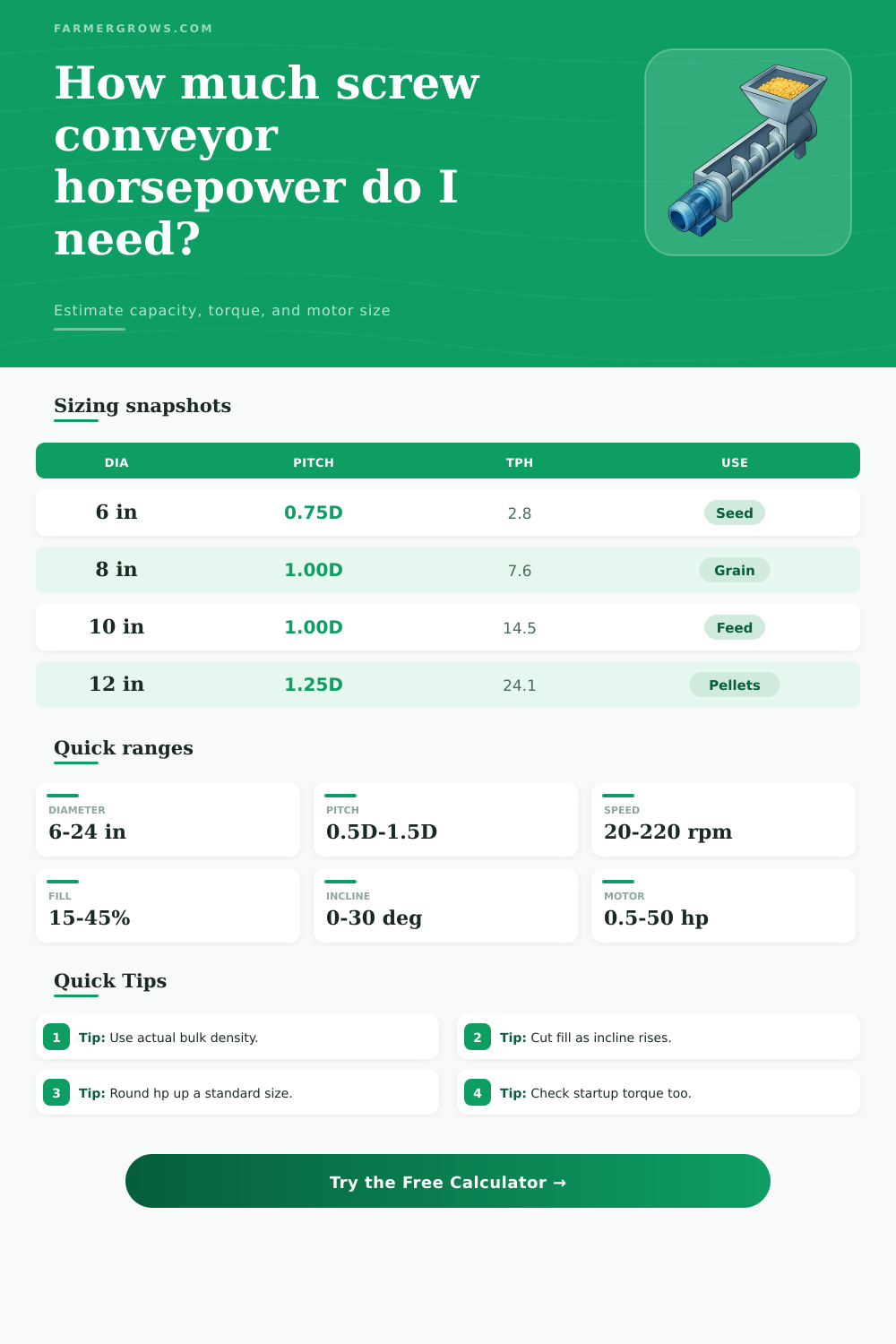
| 6 in | 1.5 in | 0.75D | Seed and light feed |
| 8 in | 2.0 in | 1.00D | Grain transfer |
| 10 in | 3.0 in | 1.00D | Feed and meal |
| 12 in | 3.5 in | 1.25D | Pellets and blends |
| 14 in | 4.0 in | 1.25D | Longer farm runs |
| 16 in | 4.5 in | 1.50D | High volume reclaim |
| 18 in | 5.0 in | 1.50D | Dense bulk solids |
| 24 in | 7.0 in | 1.50D | Large live bottoms |
| Material | lb/ft3 | kg/m3 | Behavior note |
|---|---|---|---|
| Corn | 45 | 721 | Good baseline grain |
| Wheat | 48 | 769 | Stable dry grain |
| Soybeans | 47 | 753 | Moderate flowability |
| Pelleted feed | 38 | 609 | Steady, low dust |
| Fertilizer | 65 | 1041 | Dense and abrasive |
| Dry sand | 100 | 1602 | Heavy and demanding |
| Sawdust | 18 | 288 | Light and fibrous |
| Lime blend | 55 | 881 | Fine, dusty, compact |
| Angle | Capacity factor | Power factor | Use note |
|---|---|---|---|
| 0 deg | 1.00 | 1.00 | Horizontal baseline |
| 5 deg | 0.95 | 1.03 | Small rise |
| 10 deg | 0.89 | 1.06 | Watch fill closely |
| 15 deg | 0.82 | 1.10 | Flow starts to slide back |
| 20 deg | 0.74 | 1.15 | Check motor margin |
| 25 deg | 0.66 | 1.21 | Strong derate zone |
| 30 deg | 0.58 | 1.28 | Use conservative loading |
| Scenario | Pitch | Fill band | Typical rpm |
|---|---|---|---|
| Metering feed | 0.5D | 15-25% | 120-220 |
| Balanced transfer | 0.75D | 20-35% | 80-160 |
| General farm use | 1.0D | 25-40% | 60-130 |
| High volume reclaim | 1.25D | 30-45% | 40-110 |
| Open core handling | 1.5D | 20-35% | 35-90 |
Screw conveyors is used to move bulk materials from one location on a screw conveyor to another. Screw conveyors rely on the interaction of the screw and the bulk solids to move the material. Screw conveyors are comprised of a screw and shaft.
The diameters of the screw creates the cross-section of the conveyor. The diameter of the shaft create the empty core of the screw. The bulk solids moves in an annulus, which is the space between the screw and the shaft.
Screw Conveyors: Parts and How They Move Materials
The pitch of the screw are the distance between the flights of the screw. The pitch determine the amount of bulk solids that the screw will move during each single rotation of the screw conveyor. Short pitch are often used for metering tasks because they allow for more precise control of the material moving through the screw conveyor.
Long pitch will move more material through the system, which is why operators often utilize long pitches during reclaim tasks. Screw conveyors are measured in revolutions per minute, or RPM. High RPM setting can lead to the production of dust from the bulk solids and surges in the screw conveyor.
Low RPM settings may not provide enough turn per minute to move the bulk solids at the required rate. The amount of bulk solids filling the screw conveyor should be maintained between 15 and 45 percent of the screw’s diameter. Filling the screw to 100 percent will create potential issue with jamming of the system.
Additionally, a screw that are filled to 100 percent of its diameter is difficult to move. Bulk solids of different densities will have different weight. For instance, corn weighs 45 pounds per cubic foot while dry sand weighs 100 pounds per cubic foot.
Due to these densities, more power is required to move dry sand than corn. The incline of the screw conveyor will impact the capacity of the conveyor. An incline will increase the amount of power required to move the bulk solids through the system.
Additionally, the incline will impact the capacity of the conveyor. When a screw conveyor is on an incline the capacity will decrease due to the gravitational pull of the bulk solids moving backward through the system. For instance, at a 30 degree incline the capacity of a screw conveyor may drop by as much as 40%.
Additionally, the length of the screw conveyor will increase the lift and the friction of the screw conveyor. More friction of solids moving through the system will require more power to move the bulk solids. Efficiency of a screw conveyor is a measurement of how much energy is lost in the system.
Efficiency of gearboxes used in the system are between 82 and 92%. The power of the motor that will run the screw conveyor will be measured in horsepower. The drag of the bulk solids, the lift of the incline, and the torque required to start the screw conveyor will determine the horsepower required to operate the screw conveyor.
The startup torque is the amount of force required to start the screw conveyor moving with bulk solids on it. This amount of required force is usually higher than the torque required to maintain the movement of the bulk solids through the system. The system will calculate the horsepower required.
The next standard size of motor should of been selected so that the motor have headroom for the requirements of the system. For instance, if calculations require 4.2 horsepower the next higher standard motor size is 5-horsepower. A larger motor will be able to handle wet loads or loads that is heavier than the loads that is expected of the system under standard conditions.
Depending upon the type of bulk solids that the screw conveyor must convey, different type of flights may be required for the screw conveyor. Standard pitch flights are used in general tasks. Half-pitch flights are used in metering hoppers to control the output of the bulk solid.
Short pitch flights are used in systems to steady the discharge of the bulk solid from the conveyor. Ribbon flights are used in systems that move wet bulk solids or fibrous waste. Additionally, if the bulk solid is abrasive, the screw flights will wear down.
Abrasive bulk solids include sand and lime, for instance. There are different types of reference tables that can be used in the planning of screw conveyors. For instance, tables can be used to determine the proper diameter of the screw and the shaft of the screw conveyor.
A 6-inch screw with a 1.5 inch shaft is used for small tasks. For large systems larger diameters are required. A second reference table includes a list of the densities of the bulk solids that the conveyor system will move.
For instance, sawdust is much less dense than sand. If the system is to be used on an incline reference tables will be used to calculate the incline corrections to provide the correct amount of ton per hour that the system can move. Finally, if the bulk solids to be moved by the system are wet, additional consideration must be made for these types of solids.
Wet bulk solids are typically more dense than dry bulk solids. Therefore, more power will be required to move these type of solids.