Belt Conveyor Capacity Calculator
Estimate gross and design capacity, belt load, shift total, and pulley speed for grain, feed, fertilizer, and other bulk material runs. Test presets, then fine tune the capacity.
Pick a real setup first. Each preset sets belt width, speed, length, lift, trough, fill factor, and drive efficiency for a common farm conveyor.
This calculator is tuned for agricultural and yard conveyors, so it prioritizes flow, density, lift, and pulley speed instead of cost or purchase guidance.
Capacity Output
Estimated flow, belt loading, and pulley demand from the settings above.
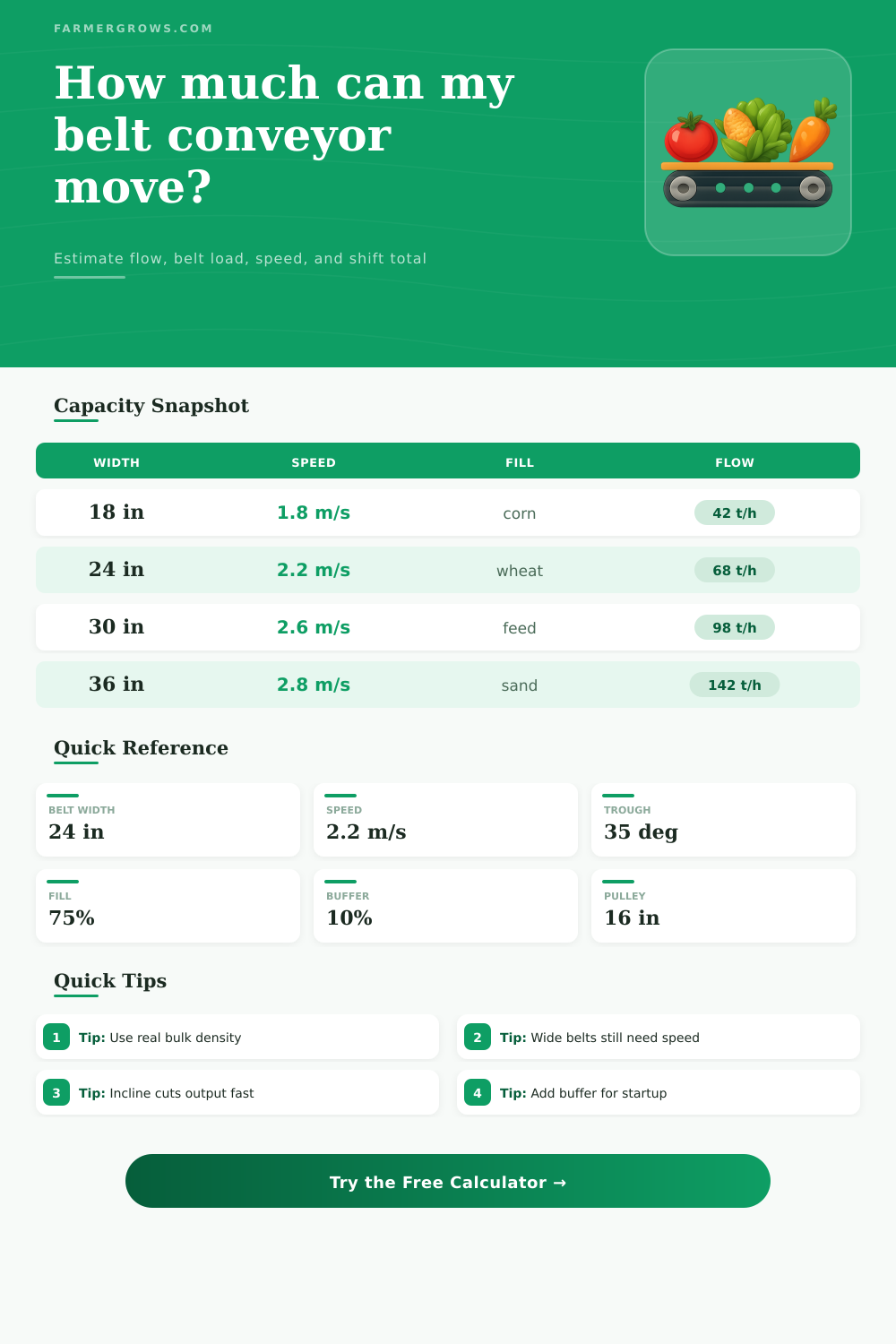
| Belt width | Practical speed | Typical use | Notes |
|---|---|---|---|
| 18 in | 1.8 m/s | Small feed line | Gentle loading |
| 24 in | 2.2 m/s | Grain transfer | Balanced duty |
| 30 in | 2.6 m/s | Fertilizer run | Higher output |
| 36 in | 3.0 m/s | Bulk handling | Heavy service |
| Width | Trough | Flow band | Common use |
|---|---|---|---|
| 18 in | 35° | 35-55 t/h | Seed line |
| 24 in | 35° | 55-85 t/h | Bin unload |
| 30 in | 35° | 90-135 t/h | Feed mill |
| 36 in | 35° | 130-190 t/h | Bulk yard |
| Pulley | Speed at 2 m/s | Best for | Note |
|---|---|---|---|
| 12 in | 318 rpm | Fast feed | Higher belt wear |
| 16 in | 239 rpm | Balanced run | Common choice |
| 20 in | 191 rpm | Gentle load | Lower belt stress |
| 24 in | 159 rpm | Slow bulk | Good for lift |
Conveyor belt capacities refers to amount of material that a conveyor belt can move within a specific time periods. Understanding the conveyor belt capacity is essential to operating a conveyor belt efficient. If the capacity of a conveyor belt is too low, the belt will accumulate the material to be transported, causing a blockage of the belt.
In contrast, if the capacity is too high, it can waste the energy of the system and cause wear and tear on the components of the conveyor belt. The cross-section area of a conveyor belt is a primary consideration in determining its capacity. The width of the belt and the trough angle of the conveyor determine the cross-sectional area.
What Affects Conveyor Belt Capacity
The wider the conveyor belt, the more area the belt will have to move the material. Similarly, a steeper trough angle will allow more of the material to rest on the edge of the belt. However, there is a risk of the material spilling off the conveyor belt.
The fill factor has to be considered so that the belt does not become overfilled with the material to be transported. Bulk density convert the volume of the material that is moved on the conveyor to the weight of that material. For instance, a cubic foot of dry sand will weigh more than a cubic foot of wheat.
The bulk density of the material being conveyed change the weight of the conveyor belt. The speed at which the conveyor belt moves will significantly impact the capacity of the belt. The faster the belt moves, the more material will be transported on the belt in a given hour.
However, if the speed is too great, there will be the production of dust, and some of the material may fly off the belt. Another consideration will be the diameter of the pulley that the belt will turn and the revolutions per minute that the pulley will make. These two will dictate the speed at which the conveyor belt turn.
The incline of the conveyor belt will impact its capacity. The gravitational pull on the materials will work against the movement of the belt. An incline will reduce the amount of material that the belt can move per unit of time and, therefore, reduce the total conveyor belt capacity.
Finally, another consideration for the conveyor belt’s capacity will be the friction of the material on the belt and the duty class of the belt. Higher class duty mean there is more friction between the materials and the belt, which means there is more power required to move the conveyor belt. The characteristics of the materials will impact the performance of the belt conveyor system.
For instance, wet corn is denser than dry corn, which means it require more capacity or slower speeds on the conveyor belt system. Silage is sticky and tends to fill the corner of the conveyor belt differently than grain. Fertilizer granules are abrasive and cause more wear and tear on the conveyor belt system than non-abrasive materials.
Sand is very dense and will require conveyor belt systems to move at low speeds to avoid causing damage to the belt. Calculating the outputs of a conveyor belt system can help ensure that the conveyor belt is design correctly. Design capacity considers surges in the material that will be moved.
Belt load is the mass of the material measured per unit of length. The drive power of the conveyor belt system will determine the size of the motor that will move the belt, and the speed of the pulley will tell the operator if the conveyor belt system may vibrate or cause damage to the bearings of the conveyor belt. Many people make mistakes when they are creating a conveyor belt system.
For example, if they make a conveyor belt system that can reach high speeds but does not check the RPM of the pulley, it could result in the failure of the conveyor belt system. If they do not account for the surge capacity of the belt, the material might fly off the belt. It is also important to account for the weight of the empty conveyor belt system.
The calculation of the total load that the conveyor belt system will carry should also account for the weight of the empty belt. Finally, the efficiency of the belt system should also be accounted for. Most conveyor belt systems are only 85% efficient due to dust and the resistance of the system components.
The capacity of a conveyor belt system is not isolated from the rest of the system. The capacity of the conveyor belt system is connected to the hoppers and bins that receive the materials to be move by the conveyor belt. If a loader cannot feed a hopper at the same rate as the conveyor belt moves, then the conveyor belt will idle even if it have a high capacity.
Shift total are used to measure the performance of the conveyor belt system. By measuring the throughput of the system, it is possible to determine if changes are needed to the trough angle or the speed of the conveyor belt to improve the capacity of that system.