Auger Flight Calculator
Estimate helix angle, capacity, mass flow, and flight steel weight from auger diameter, pitch, speed, incline, and material data for practical farm or feed handling work.
Pick a field-tested starting point. Each preset sets the conveyor style, material, diameter, pitch, length, speed, fill, incline, and flight thickness for a fast first pass.
Auger Flight Output
Calculated from the diameter, pitch, speed, incline, material, and flight style above.
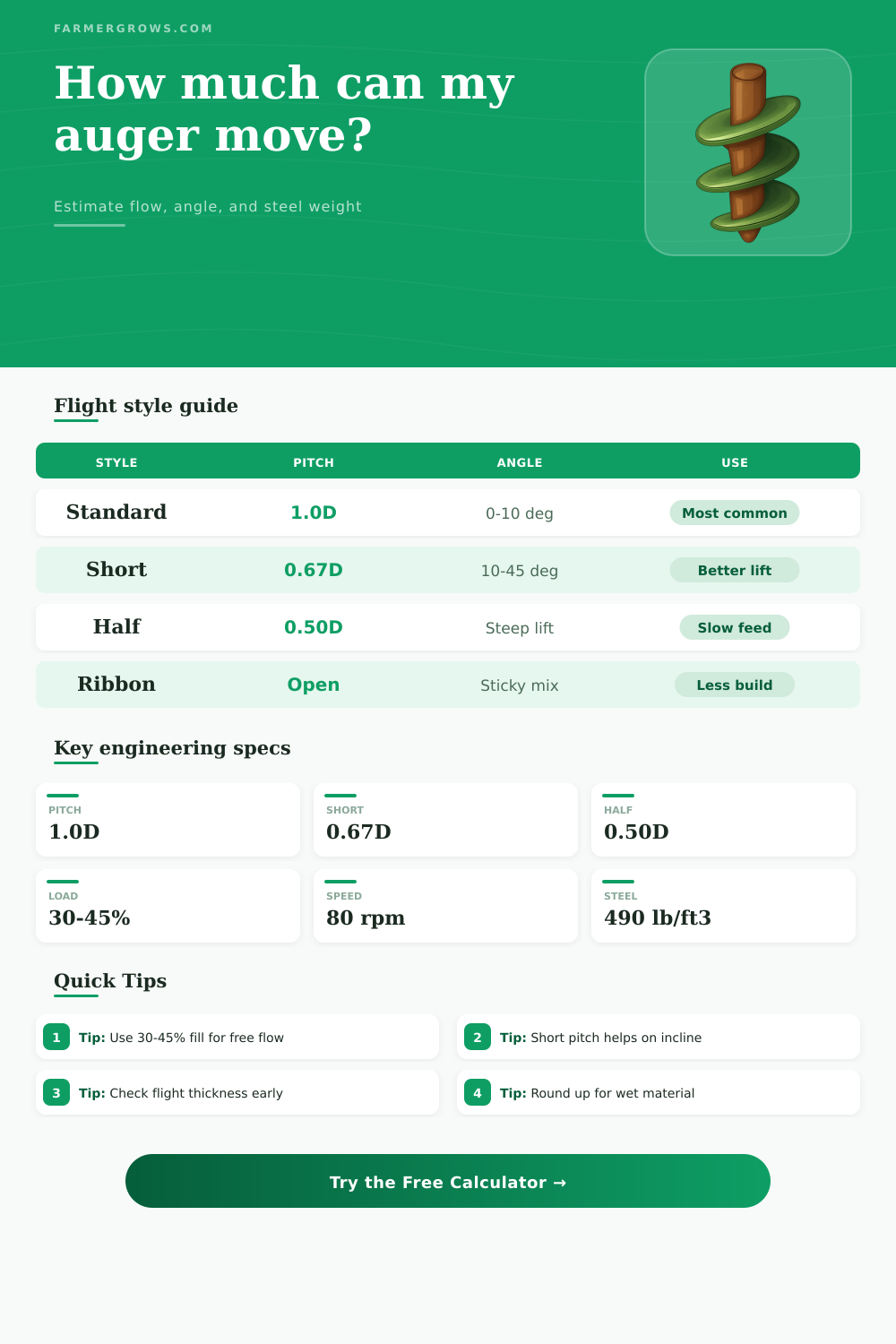
| Style | Pitch ratio | Typical angle | Engineering note |
|---|---|---|---|
| Standard pitch, single flight | 1.00D | Horizontal to 10° | Most common screw type |
| Short pitch, single flight | 2/3 D | Inclined and vertical | Used to raise material |
| Half pitch, single flight | 1/2 D | Steeper lift | Slower feed, more control |
| Long pitch, single flight | 1.5D | Low incline | Moves more material per turn |
| Double flight | 1.00D | Even discharge | Two flights 180° apart |
| Ribbon flight | Open core | Sticky service | Helps reduce buildup |
| Screw dia. | Flight thickness | Part family | Approx weight |
|---|---|---|---|
| 12 in | 3/16 in | 12F512 | 7.2 lb |
| 12 in | 1/4 in | 12F516 | 9.6 lb |
| 12 in | 3/8 in | 12F524 | 14.4 lb |
| 16 in | 3/16 in | 16F612 | 13.0 lb |
| 16 in | 1/4 in | 16F616 | 17.5 lb |
| 16 in | 3/8 in | 16F624 | 26.0 lb |
| 18 in | 1/2 in | 18F632 | 48.0 lb |
| 20 in | 1/2 in | 20F632 | 53.0 lb |
| 24 in | 1/2 in | 24F732 | 80.0 lb |
| Screw dia. | Max rpm | Capacity at max rpm | Capacity at 1 rpm |
|---|---|---|---|
| 4 in | 139 | 57 ft³/hr | 0.4 ft³/hr |
| 6 in | 120 | 179 ft³/hr | 1.5 ft³/hr |
| 9 in | 100 | 545 ft³/hr | 5.5 ft³/hr |
| 12 in | 90 | 1,161 ft³/hr | 12.9 ft³/hr |
| 16 in | 80 | 2,496 ft³/hr | 31.2 ft³/hr |
| 20 in | 70 | 4,375 ft³/hr | 62.5 ft³/hr |
| 24 in | 65 | 7,085 ft³/hr | 109.0 ft³/hr |
| 30 in | 60 | 12,798 ft³/hr | 213.3 ft³/hr |
| Material | Density | Loading band | Material factor |
|---|---|---|---|
| Corn meal | 32-40 lb/ft³ | 30A | 0.5 |
| Soybean meal, cold | 35-45 lb/ft³ | 30A | 0.6 |
| Wheat | 45-48 lb/ft³ | 45 | 0.4 |
| Wheat flour | 33-40 lb/ft³ | 30A | 0.6 |
| Wood chips, screened | 10-30 lb/ft³ | 30A | 0.6 |
| Wood bark | 8-16 lb/ft³ | 30B | 1.5 |
| Urea prills, coated | 43-46 lb/ft³ | 45 | 1.2 |
| Triple super phosphate | 50-55 lb/ft³ | 30B | 2.0 |
Screw conveyors uses flighting to move material through a conveyor. The flighting is the helical sheet that wraps around central shaft of the conveyor. Flighting push the material through the conveyor in a corkscrew motion.
However, if the pitch or the angle of the flighting is wrong, it will not efficient move the material through the system, and it can pose a problem for the next machine in the line or cause the material to fall back into the system. The geometry of the flighting will determine the function of a screw conveyor. The outside diameter will determine the size of the bite that the conveyor will make with the material.
How Screw Conveyors Work and How to Size Them
The diameter of the shaft will create the empty core in the center of the conveyor. The pitch of the screw will determine how high the step is within the spiral of the flighting. A standard pitch will be the same then the diameter of the conveyor.
This will be used in the horizontal runs of the conveyor. For inclines, the pitch can be shortened to two-thirds of the diameter of the conveyor. This creates more lift for the material to climb the incline.
However, it means the screw conveyor will move at a slow rate. The helix angle is a result of the pitch and the diameter of the conveyor. This will determine whether the material glide on the conveyor or if the conveyor fights against the force of gravity.
The type of material impact how the conveyor must be operated. For materials like wheat, the fill factor can be as high as 45% of the trough. Soybean meal take up more of the trough and is stickier, so the capacity should of drop to 30% for the fill factor.
The bulk density of the materials should factor into all calculations of the conveyor. The bulk density of wheat is 46 lbs per cubic foot. However, the bulk density of wood shavings is much lower than that of wheat.
The moisture content of the materials can impact the bulk density. For instance, cornmeal with more moisture will clump more than dry cornmeal. The fill factor refers to the amount of the trough that is filled with material.
For free-flowing materials, the sweet spot will be a fill factor between 30% and 45% of the trough. The speed of the screw conveyor will be measured in revolutions per minute. An eight-inch auger will move at 70 rpm to move grain.
A twelve-inch auger will move at 90 rpm if the load is thirty percent of the auger. If the speed of the auger increase without shortening the pitch of the conveyor, the material will centrifuge out of the flighting of the auger. The incline of the conveyor will impact the capacity of the conveyor.
A ten-degree incline will have a small effect on the capacity of the conveyor. However, a twenty-degree incline will reduce the capacity of the conveyor to eighty-five percent of the conveyor’s capacity when fully loaded and moving at its optimal speed. At a thirty-degree incline, the capacity of the conveyor will drop to sixty-five percent of its maximum capacity.
The reason for the drop in the capacity of the conveyor is that the material will begin to slip back down the helix of the conveyor as it climbs the incline. The weight of the steel used to construct the screw conveyor is another consideration. For instance, an auger that has a quarter-inch thick flighting and is twenty-four feet in length will weigh two hundred pound.
Using thicker steel will combat the abrasion caused by materials like fertilizer. However, using thicker steel will increase the dead load on the drive system of the auger. Ribbon flights will reduce the mass of the auger.
Using ribbon flights will be of benefit when conveying sticky materials like bark. There are preset settings for the different type of materials that can be conveyed. For unloading grain from silos, the preset settings will use an eight-inch standard auger at seventy rpm and a five-degree incline and a forty-five percent fill.
For conveying fertilizer, a ten-inch auger with a denser load at a slower rpm will work best. For conveying wood shavings, a twelve-inch auger with ribbon flights will be best because wood shavings has a low bulk density. There are several steps involve in calculating the capacity of the auger.
The first step is finding the annulus area of the auger from the diameters of the auger flights. Then, finding the gross volume by multiplying the area of the annulus by the pitch of the conveyor auger. Then, applying the style factor for the type of auger, the fill cap for the type of material that will pass through the conveyor, and the incline derate according to the incline of the conveyor.
Multiplying the effective volume that passes through the auger per revolution by the RPM of the auger and sixty will provide the capacity in cubic feet per hour. Multiplying the volume of material by the bulk density will provide the mass of the material conveyed per hour. The helix angle can be found using geometric formulas using the pitch and the diameter of the auger flights.
However, all of these calculations assume that the inlet of the auger will provide a steady feed to the conveyor that will not flood the hopper of the auger. A common mistake is to try to increase the volume of the material that passes through the conveyor without considering the pitch of the auger in relation to the incline of the conveyor. For instance, a standard pitch will be best for an auger that is performing a level lift of the material.
However, a short pitch will be better for the auger to perform a steep lift of the material so that the pitch can hold the material without the conveyor having to move at a fastly rate. Double flights will even out the discharge of the material through the conveyor. Ribbon flights will help with the conveyor to fight any buildup of materials in situations like moving wet shavings.
Capacity tables can help to benchmark your work. For instance, a twelve-inch auger can move at ninety rpm and handle twelve hundred cubic feet of material per hour at a thirty percent fill. This is the maximum capacity that the auger can set at.
The sizing of the shaft that the flights will attach to is another consideration. For instance, the shaft should not be too thin because it will whip under the torque of the motor that will turn the shaft. For conveyors with an eight-inch diameter, a two-point-eight-seven-five-inch shaft is sufficient.
The thicker the steel on the flights, the more durable the conveyor will be. For instance, three-sixteenths of an inch will be enough for a conveyor that will move light load of material. However, if the conveyor will move phosphate, the thickness of the steel should be three-eighths of an inch.
In the real world, there are problems with the conveyors. For instance, vibration will loosen the couplings that join the different sections of the conveyor. Additionally, the bearings in the conveyor will overheat if the conveyor is not properly aligned with other conveyors in the system.
Another consideration is that if the material that is to be conveyed is wet, it is a good idea to increase the capacity of the conveyor by twenty percent to allow for the water content of the material. Using a variable frequency drive will allow better control of the rate at which the conveyor’s auger will turn. As a result, if the flighting of the auger is matched to the type of material being conveyed and the job to be performed with that material, the material will move at the same rate as the work that is to be performed with the material.