🏗 Pole Barn Beam Calculator
Size built-up beams from span, tributary roof width, roof loads, plies, and deflection in one clear check.
📊 Beam Check Results
Compare the selected beam against bending, deflection, and reaction demand. The breakdown below shows how the load moves through the beam.
| Material | Fb psi | E psi | Density pcf |
|---|---|---|---|
| SPF No.2 | 875 | 1200000 | 28 |
| Hem-Fir No.2 | 850 | 1300000 | 28 |
| DF-L No.2 | 900 | 1600000 | 31 |
| Southern Pine No.2 | 1150 | 1600000 | 35 |
| Southern Pine No.1 | 1400 | 1650000 | 36 |
| LVL 1.9E | 2850 | 1900000 | 38 |
| Glulam 24F | 2400 | 1800000 | 36 |
| Nominal | Actual | Area in2 | S 1 ply |
|---|---|---|---|
| 2x8 | 1.5 x 7.25 | 10.88 | 14.3 |
| 2x10 | 1.5 x 9.25 | 13.88 | 21.4 |
| 2x12 | 1.5 x 11.25 | 16.88 | 31.6 |
| 3x8 | 2.5 x 7.25 | 18.13 | 23.9 |
| 3x10 | 2.5 x 9.25 | 23.13 | 35.6 |
| 3x12 | 2.5 x 11.25 | 28.13 | 52.7 |
| 4x10 | 3.5 x 9.25 | 32.38 | 49.8 |
| 4x12 | 3.5 x 11.25 | 39.38 | 73.7 |
| Scenario | Dead | Snow | Total |
|---|---|---|---|
| Light shed | 8 psf | 12 psf | 20 psf |
| General barn | 10 psf | 20 psf | 30 psf |
| Snow zone | 12 psf | 30 psf | 42 psf |
| Heavy roof | 14 psf | 40 psf | 54 psf |
| Engineered case | 16 psf | 50 psf | 66 psf |
| Span | Load Class | Common Pick | Note |
|---|---|---|---|
| 10-14 ft | Light | 2-ply 2x10 | Short bay |
| 16-20 ft | Medium | 3-ply 2x10 | Most shops |
| 22-28 ft | Heavy | 3-ply 2x12 | Snowier sites |
| 30+ ft | High | LVL / Glulam | Engineer first |
| Metric 6 m | Medium | 3-ply 2x12 | Comparable bay |
Use the bigger of dead or snow load when you are comparing beam options across climates.
If the beam fails deflection first, add depth before piling on more plies.
When building a pole barn, it is critical that the beam that are selected will be able to support the weight of the roof and the snow that will fall on the roof. If the beams are too small to support the roof and snow loads, they will sag and eventual fail. If you use the correct beams for your pole barn construction project, though, the structure will remain stable for many year.
The factor that affects beam selection is the balance between the strength and stiffness of the beams and the lumber that can be purchased from the lumber supplier. A pole barn is a simple structure and consist of posts placed in the ground and beams placed across those posts. Furthermore, there are rafters or trusses placed on the beams.
How to Choose Beams for a Pole Barn
However, you have to make calculations to determine the loads that each beam will experience. Each beam will experience loads from the area of the roof above the beam. This area is referred to as the tributary width of the beam.
If the tributary width is not calculate correctly, then the beam may buckle under the load of the snow that accumulates on the roof. The loads that must be considered for the roof of a pole barn are the dead load and the live loads. The dead loads are the permanent loads on the roof.
These loads include the weight of the plywood, the purlin, and the metal roofing. The live loads are the temporary loads on the roof. The only live load on a pole barn roof will be snow and wind.
The building code allow for live loads to be reduced on roofs with steep slope, but it does not allow for the reduction of dead loads, because the dead and live loads must be calculate separately. The span of the beam is the distance between the two posts on which the beam is installed. The span will dictate the amount of weight that the beam can support.
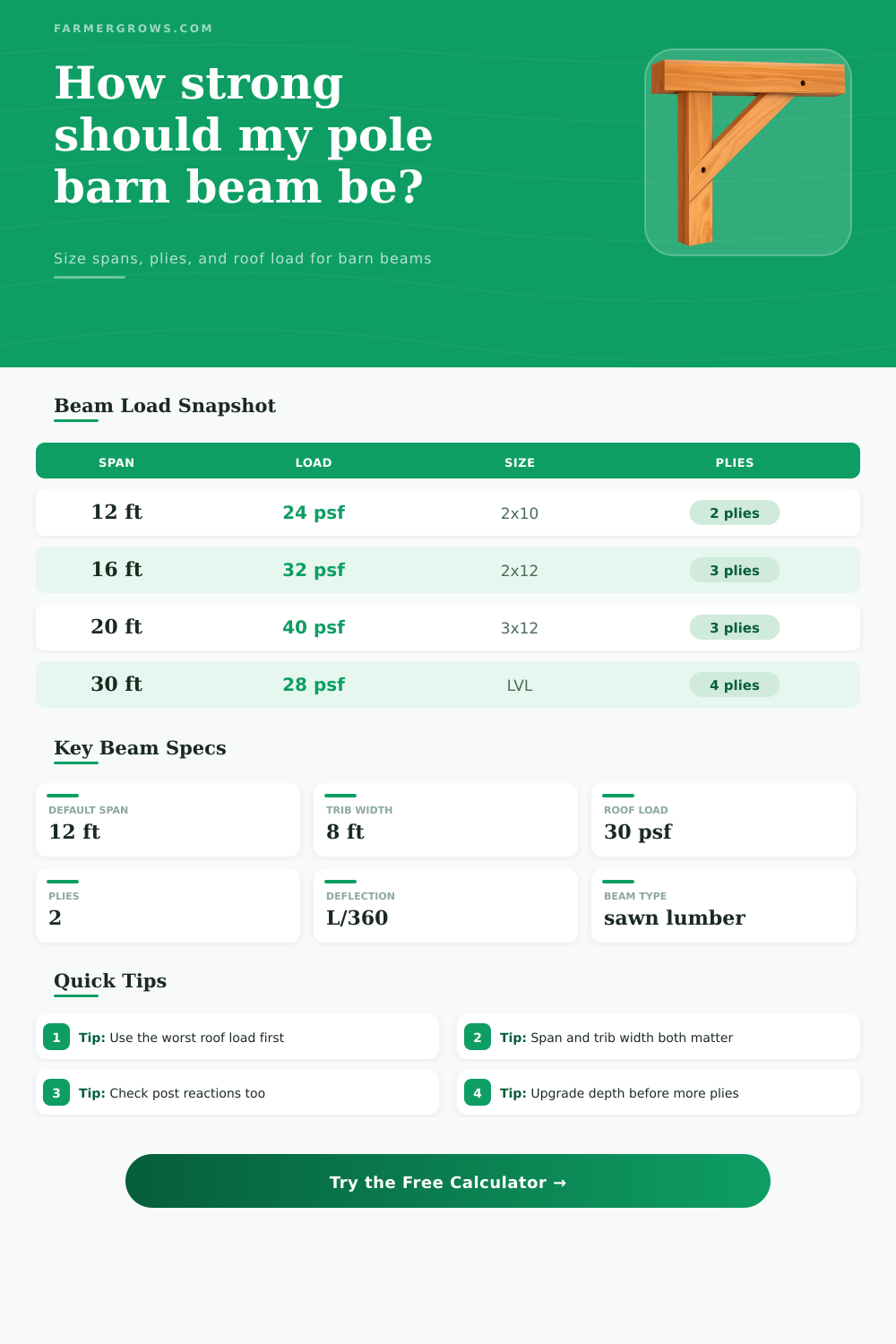
For instance, a beam that is span of 12 feet between posts might use a double 2×10 spruce pine fir beam. However, if the span is 20 feet, then triple 2×12 beams or LVL may be required to support the roof. The longer the span of a beam, the more greater the depth of the beams that are required.
This is because the bending strength of the beam increases with the depth of the beam. Furthermore, increasing the number of plies of lumber that make up the beam can increase the bending strength of a beam. However, increasing the number of plies will increase the weight of the beam.
It is also critical to select the appropriate lumber for the beams. Spruce pine fir No. 2 grade lumber has a bending strength of 875 psi and is often used in budget build. Southern pine No. 1 has a bending strength of 1400 psi, which is stiffer than spruce pine fir.
Engineered woods such as LVL and glulam are also strong and consistent in there strength because they do not have the knots in the lumber that can weaken the beams. Additionally, the actual dimension of the lumber are smaller than the nominal dimensions. For example, a 2×12 beam has actual dimension of 1.5 inches by 11.25 inches.
These actual dimensions should be used in calculating the section modulus of the beam. Another problem that often develop in beams is deflection. Deflection is the bending of the beam under load.
If the deflection is too much, then the beam may cause the ceiling to crack or allow water to accumulate on the roof. The limit for deflection in beams is the L/360 limit. This means that the beam should sag no more than the length of the span divided by 360.
To reduce deflection, you can increase the depth of the beam because increasing the depth of the beam will increase the stiffness of the beam more effective than adding more plies of lumber to the beam. Another factor to consider is the reactions at the posts. The reaction at the posts is the total load on the posts from the beams.
The beams will transfer half of their total load to each post. Therefore, if very heavy beams are used but the posts are weak, the posts will eventually fail under the total reaction load from the beams. Additionally, you need to convert the snow load that is on the ground to the snow load on the roof.
This calculation can be performed using the factors for slope and exposure of the roof that are listed in the local building code. Finally, the connections between the beams and the posts need to be secure. These connections include the bolts, the hangers, and the post caps.
The bolts and hangers need to be strong enough to transfer the shear force from the beam to the posts without splitting the wood. Additionally, the post caps need to cradle the beam without crush the edges of the lumber beams. If each of these factor is considered and you select the correct beams for the pole barn, then the beams will correctly support the structure of the barn.