Pole Barn Height Calculator
Estimate ridge height, wall height, roof rise, and practical clearance from your barn layout. Switch units, test presets, and compare roof profiles fast.
Use a preset to load a realistic pole barn height scenario. Each preset sets the roof profile, span, wall height, pitch, overhang, clearance allowances, and door target in one click.
Height Results
Your height summary appears here after the calculator runs.
| Pitch | 24 ft span | 36 ft span | 48 ft span |
|---|---|---|---|
| 3/12 | 3 ft | 4.5 ft | 6 ft |
| 4/12 | 4 ft | 6 ft | 8 ft |
| 5/12 | 5 ft | 7.5 ft | 10 ft |
| 6/12 | 6 ft | 9 ft | 12 ft |
| Use | Wall ht | Door ht | Note |
|---|---|---|---|
| Small shop | 10 ft | 7 ft | Light tools |
| Utility barn | 12 ft | 8 ft | Most common |
| Equipment bay | 14 ft | 10 ft | Tall gear |
| RV bay | 16 ft | 12 ft | Extra room |
| Door type | Clear | Headroom | Use |
|---|---|---|---|
| Walk door | 7 ft | 12 in | People |
| Service door | 8 ft | 18 in | Shop access |
| Farm door | 10 ft | 24 in | Gear access |
| RV door | 12 ft | 30 in | Tall entry |
| Allowance | Imperial | Metric | Use |
|---|---|---|---|
| Floor build | 4 in | 10 cm | Slab base |
| Roof depth | 6 in | 15 cm | Clearance |
| Grade drop | 1 ft | 30 cm | Site slope |
| Monitor lift | 3 ft | 90 cm | Center bay |
Use the highest side as your wall reference so the calculator stays conservative on sloped pads.
Compare the clear wall height before framing so the opening is not tight later.
To determine the height of a pole barn, you must consider how much equipment you will be storing in the barn. You need to establish the height of the pole barn to allow for your machinery to drive in and leave the barn. You will also have to make a decision about the height of the pole barn to allow for your stored items to have enough room within the pole barn.
Building a pole barn that is too short will result in the doors for the barn not being able to accommodate the items you own and want to store. Building a pole barn that is too high will also result in the waste of the lumber that would of been used for the height of the pole barn. The height of the barn walls, also known as the eave height, is the measurement from the finished floor to the roof.
How Tall Should Your Pole Barn Be
This measurement must take into consideration the slope of the ground. The foundation of a pole barn is built on level ground; however, the ground may not be level. One side of the pole barn could be lower than the other unless you take into account the height of the floor and the height of the roof trusses.
If you build the walls to be twelve feet high, the actual height will likely be less if the floor slab is thick or if the roof trusses are deep. In this case, the thickness of the floor and the depth of the trusses must reduce the height of the wall. The roof pitch will determine how high the roof will rise.
A shallow roof pitch, such as a four-over-twelve slope, will make the pole barn and its building materials more affordable. A steeper slope, such as a six-over-twelve slope, will allow the snow to slide off the barns roof more easy. The width of the pole barn, also known as the span, will determine the height of the barns roof.
Overhangs will extend the rafters of the barns roof and will protect the barn from water damage. The different styles of roofs will change the height of the pole barn. A single-slope roof will rise from one side to the other of the pole barn.
Single-slope roofs is useful for lean-tos and structures that need additional daylight. A monitor roof features a raised ridge in the middle of the barn. This type of roof will provide headroom for the occupants in the middle of the pole barn.
A tool available to assist in the determination of the height of these different types of roofs is a roof calculator. The floor of the pole barn will affect the height of the barn. If you build the pole barn on a concrete slab or gravel, the height of the floor will increase the height of the walls.
As such, if you build higher walls to accommodate for the height of the floor, there will be less height within the pole barn. The depth of the posts will affect the height of the pole barn. The posts will need to be buried in the ground two to four feet to prevent ground heave.
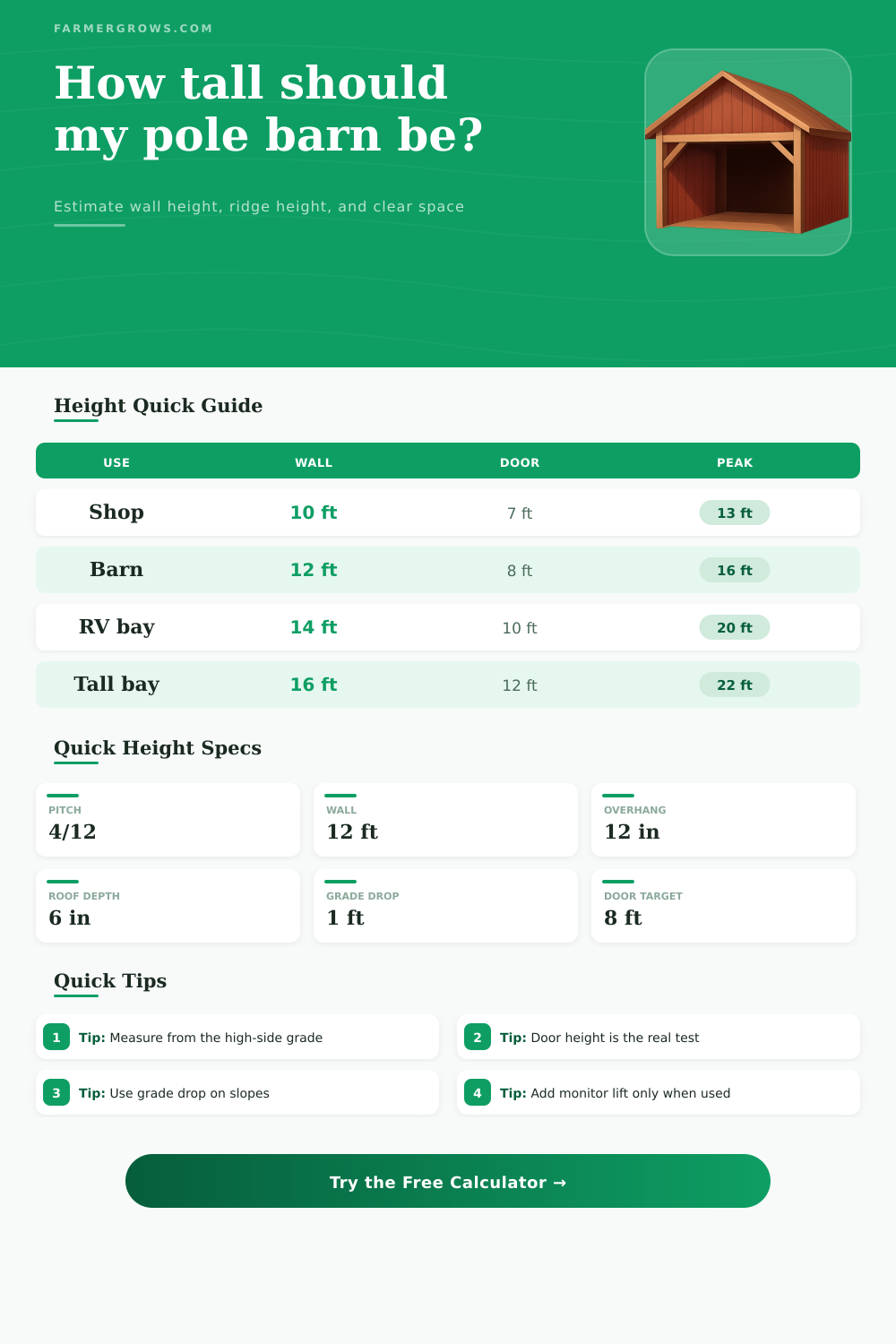
If the posts are not deep enough into the ground, the pole barn may tilt. The use of the pole barn will dictate the height of the barn walls. For a small shop, the height of the walls could be only ten feet and the peak of the roof could be thirteen feet.
A utility barn may have walls that are twelve feet high and a peak of the roof that is sixteen feet high to allow for tractors to park in the barn. If the pole barn is to contain an RV bay or if it is to be used as a shed for tall equipment, the height must be fourteen to sixteen feet for the walls and the height of the peak of the roof must be at least twenty feet. Additionally, barns that contain stables for horses will have walls that are twelve feet high and feature steep pitches for the roof to allow for the intake of warm air and the storage of hay.
Environmental elements will play a role in the determination of the height of the pole barn. If you choose a steeper roof pitch, snow will slide off the barns roof more easyly. However, steeper slopes requires more roofing materials and take up more space within the pole barn.
The wind that blows in wide areas will also affect the width of the pole barn. The height of the pole barn will have to be balanced such that the structure does not develop a momentary torque on the posts. Additionally, you will have to follow local building codes and perform soil tests in the area where the pole barn will be constructed to determine if the depth of the posts must be more or less than the standard two to four feet.
There are trade-offs in the height of the pole barn. For example, the taller the walls of the pole barn are constructed, the more siding is needed and the number of girts that is used to support the walls. Additionally, more expensive equipment will be needed to lift the roof trusses to such heights.
However, building a pole barn with a height that is too low will result in insufficient clearance for the barns doors, and it will be more expensive to fix this once the pole barn is constructed. Other elements to consider in the height of the barn include the placement of cupola vents or ridge lifts into the barn. The placement of such elements will increase the peak height of the roof.
Another element to consider is the installation of solar panel arrays or mezzanines within the pole barn. In this case, there will need to be extra height for the walls of the pole barn to accommodate these structures in the future.