Hydraulic Reservoir Calculator
Size working oil volume, nominal tank capacity, and turnover from flow, dwell time, and service severity.
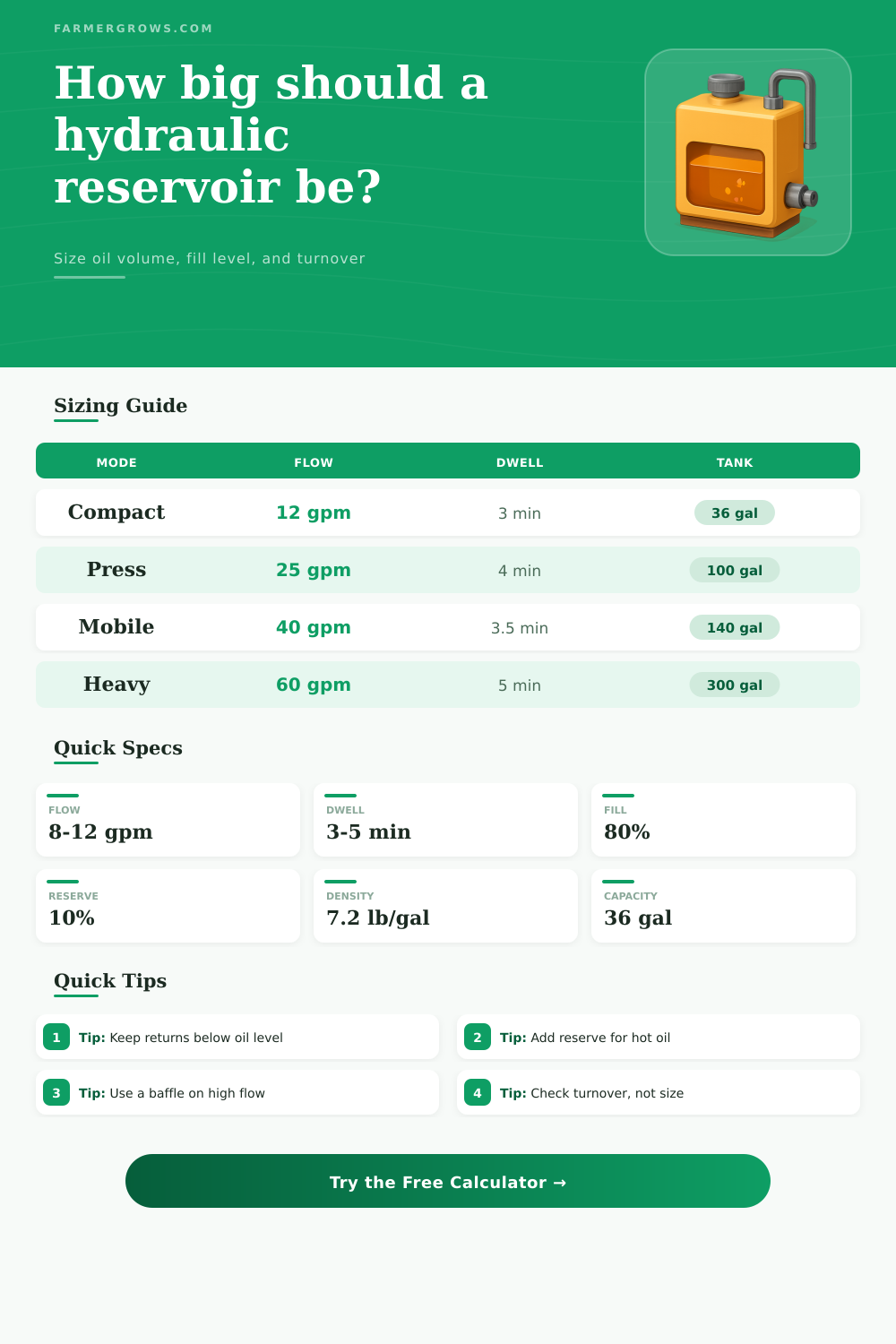
| Application | Flow band | Dwell target | Severity |
|---|---|---|---|
| Compact power unit | 8-15 gpm | 3-4 min | 1.00-1.05 |
| Industrial press | 15-30 gpm | 4-5 min | 1.05-1.15 |
| Mobile excavator | 30-60 gpm | 2.5-3.5 min | 1.15-1.30 |
| Servo / test stand | 20-80 gpm | 4-6 min | 1.10-1.25 |
| Flow | 3 min | 4 min | 5 min |
|---|---|---|---|
| 10 gpm | 30 gal | 40 gal | 50 gal |
| 20 gpm | 60 gal | 80 gal | 100 gal |
| 40 gpm | 120 gal | 160 gal | 200 gal |
| 60 gpm | 180 gal | 240 gal | 300 gal |
| Fluid type | lb/gal | kg/L | Note |
|---|---|---|---|
| Mineral oil ISO 32 | 7.1 | 0.85 | Common light-duty oil |
| Mineral oil ISO 46 | 7.2 | 0.86 | General purpose |
| Mineral oil ISO 68 | 7.3 | 0.88 | Heavier film |
| Water-glycol | 8.6 | 1.03 | High density fluid |
| Fill target | Freeboard | Use case | Note |
|---|---|---|---|
| 75% | 25% | Foamy return | More expansion room |
| 80% | 20% | General duty | Balanced default |
| 85% | 15% | Clean circuits | Compact cabinets |
| 70% | 30% | Hot oil systems | Extra breathing room |
Tip: Keep return lines submerged to reduce foam and air entrainment, then allow the baffle to slow the oil before it reaches the pump inlet.
Tip: If the circuit runs hot or the returns surge, raise the reserve and headspace together so the reservoir still breathes cleanly.
Hydraulic reservoir sizing are essential for any hydraulic system because the hydraulic reservoir must manage oil flow, heat, and contamination within a hydraulic system. If a hydraulic reservoir become too small for a hydraulic system, the hydraulic oil wont be able to settle within the reservoir. Additionally, the hydraulic oil will not be able to shed heat within the small reservoir.
For these reason, the reservoir must be large enough to permit proper oil turnover in the reservoir. Oil turnover is the process in which all of the hydraulic oil in a system cycles through the reservoir. It is important to ensure that the hydraulic oil in a system cycles through the hydraulic reservoir at least once every few minutes.
How to Size a Hydraulic Reservoir
If the hydraulic oil does not have enough time to dwell in the hydraulic reservoir, the hydraulic pump will suck in air and contaminants from the reservoir. These contaminants can damage the component of the hydraulic system. The dwell time of hydraulic oil within the hydraulic reservoir is the measurement of how long the oil sit in the reservoir before it is returned to the hydraulic system.
Most hydraulic systems require a dwell time of three to five minutes for the hydraulic oil to complete one cycle. However, if the system is experiencing heavy use and the system components are performing continuous movement, then the dwell time should be increased. Another important factor to consider in hydraulic reservoir sizing is the flow rate of the hydraulic system.
The flow rate of the hydraulic pump must be determined in units of gallons per minute or liters per minute. The flow rate will be used to calculate the working volume of the hydraulic reservoir. Because hydraulic systems may experience surges in hydraulic oil return to the reservoir, an increase in the size of the reservoir is necessary to account for this return flow.
This increase is referred to as the surge factor. The surge factor will prevent the hydraulic oil from foaming within the reservoir when it exit the hydraulic system and returns to the reservoir. Another important factor in reservoir sizing is the severity of the hydraulic systems operating environment.
The severity of the environment may include exposure to high levels of dust, heat, or both. The severity of the operating environment will impact the size of the reservoir. For instance, higher levels of dust in the hydraulic system may require larger reservoirs to allow for the hydraulic oil to settle and to avoid introducing contaminants into the system.
The severity of the environment will act as a buffer for the hydraulic oil within the reservoir. One more factor to consider when sizing the hydraulic reservoir is the inclusion of a reserve margin. A reserve margin allow for additional space within the reservoir for thermal expansion of the hydraulic oil or for the rods that make up the cylinder of the system.
The headspace for the hydraulic reservoir is the empty space within the reservoir. This headspace allow for the oil within the reservoir to foam. Additionally, the headspace allows for thermal expansion of the hydraulic oil within the reservoir.
Most reservoirs should be filled to 80% of the total capacity of the reservoir. However, if the hydraulic system’s hydraulic oil will reach high temperature during normal operation, then the reservoir should be filled to only 70% of its total capacity to allow for thermal expansion of the oil. Another important consideration of the sizing of the hydraulic reservoir is the materials from which the reservoir is made.
For most hydraulic reservoirs, mild steel will be the material of choice. Mild steel is metal that is easily welded, which makes it easy to incorporate baffles into the reservoir. Baffles are plates that are incorporated into the reservoir that redirect the flow of the hydraulic oil to avoid turbulence in the system.
Stainless steel is used for hydraulic reservoirs that are exposed to water. Stainless steel is a metal that resists rust and corrosion. Aluminum is used for mobile hydraulic systems.
Aluminum is a metal that is lightweight and dissipates heat very well. However, aluminum is more susceptible to dents than steel. Baffles must be incorporated in every hydraulic reservoir.
Baffles will prevent air from being entrained in the hydraulic system. Air that becomes entrained in the hydraulic oil will lead to the oil foaming. One of the primary functions of a hydraulic reservoir is the management of heat that is produced by the system.
Each time the hydraulic system performs a cycle, heat is generated. This heat is transferred into the hydraulic oil. If the size of the reservoir is too small, the reservoir will not be able to dissipate the heat from the hydraulic oil.
High temperatures within the hydraulic oil can lead to numerous problems for the hydraulic system. In addition to the hydraulic oil losing its viscosity at high temperatures, the seals within the system may begin to leak. If the temperature of the oil reaches 160 degrees Fahrenheit, there are problems for the hydraulic system.
Increasing the rate at which the oil performs its cycle will help to manage the heat within the oil. The rate of turnover of the hydraulic oil can be increased by increasing the dwell time for the oil within the reservoir. If the dwell time within the reservoir is too short relative to the amount of heat that must be dissipated from the oil, then a heat exchanger will have to be incorporated into the hydraulic system to allow for the hydraulic oil to reach an appropriate temperature.
Finally, the installation of the hydraulic reservoir can impact the functionality of the hydraulic system. When installing the hydraulic reservoir, the reservoir should be mounted as low as possible within the system. This placement will allow for proper priming of the hydraulic pump.
Additionally, the suction lines for the hydraulic pump should be oversized to allow for the pump to receive a steady flow of hydraulic oil from the reservoir. Breather-filter combos can be installed on the hydraulic reservoir to allow for the filtration of any dirt that may be in the air. This will prevent dirt from entering the hydraulic oil.
Additionally, a sight glass should be installed on the hydraulic reservoir to allow for the oil level to be monitored. It is important that the hydraulic reservoir is not overfilled with hydraulic oil. For hydraulic systems that have very high flow rates, the return lines from the system should be split into two lines.
One line will allow the hydraulic oil to return to the hydraulic reservoir. The other line will allow the oil to return to the reservoir through a cooler. By properly installing and sizing the hydraulic reservoir for a hydraulic system, the system will stay efficiently and the hydraulic oil will remain clean, cool, and stable.