Hydraulic Motor HP Calculator
Estimate hydraulic motor horsepower, speed, and torque from flow, displacement, pressure, and efficiency for gear, vane, orbital, and piston motors.
Quick start: Pick a real machine profile and the calculator fills the fields, switches units if needed, and runs the math automatically.
Note: The unit system toggle can switch the measurement set to imperial or metric, while the individual unit fields stay visible for precision.
| Flow | 1 ci/rev | 2 ci/rev | 4 ci/rev |
|---|---|---|---|
| 5 gpm | 1039.5 | 519.8 | 259.9 |
| 10 gpm | 2079.0 | 1039.5 | 519.8 |
| 15 gpm | 3118.5 | 1559.3 | 779.6 |
| Pressure | 1.5 ci/rev | 3.0 ci/rev | 6.0 ci/rev |
|---|---|---|---|
| 1000 psi | 203 lb-in | 406 lb-in | 812 lb-in |
| 2000 psi | 406 lb-in | 812 lb-in | 1624 lb-in |
| 3000 psi | 609 lb-in | 1218 lb-in | 2436 lb-in |
| Flow | in³/min | L/min | RPM @ 2 ci |
|---|---|---|---|
| 2 gpm | 462 | 7.6 | 207.9 |
| 5 gpm | 1155 | 18.9 | 519.8 |
| 10 gpm | 2310 | 37.9 | 1039.5 |
| 15 gpm | 3465 | 56.8 | 1559.3 |
| Type | Speed band | Torque band | Best for |
|---|---|---|---|
| Gear motor | 250-2500 rpm | Moderate | Fans, conveyors |
| Vane motor | 300-1800 rpm | Smooth | Small power units |
| Orbital motor | 20-1000 rpm | High | Augers, wheels |
| Piston motor | 100-6000 rpm | Very high | Heavy duty drives |
Use the working pressure and real displacement. Published ratings can overstate the torque you will see in service.
When torque is critical, confirm the pressure reserve too. Small changes in displacement or efficiency can shift the output more than expected.
In order to size a hydraulic motors, a person must have an understanding of the relationships between flow, pressure, and motor displacement. The hydraulic motor will take the pressurized fluids and turn it into rotational movements, but the rotational movement of the hydraulic motor will be more less than that which is theoreticaly possible due to efficiency losses. Such losses is the result of internal leaks within the hydraulic motor and friction within the motor.
Volumetric efficiency is the amount of internal slippage of the hydraulic motor, fluid that bypasses the internal component of the motor instead of contributing to the rotational movement of the motor. Mechanical efficiency is the amount of friction within the motor that turns the rotational movement of the fluid into heat. If a person ignores either of these efficiencies, the hydraulic motor will either spin too slow or will overheat while under a load.
How to Size a Hydraulic Motor
The flow of fluid to the motor will determine the speed at which the motor will turn, and the pressure of the fluid will determine the torque of the motor. Displacement is a measurement of the amount of fluid that the motor move during one revolution of the motor. Intuitively, one would think that a motor that moves more fluid per revolution will spin more slow than a motor that moves less fluid per revolution.
For instance, heavy equipment manufacturers may choose to use a large displacement motor for equipment like a winch (which requires high torque) but may choose to use a small displacement motor for equipment like a high-speed metal cutter. The mathematical equation for determining the speed of a hydraulic motor is the flow divided by the displacement of the motor. However, the flow rate can be adjusted for volumetric efficiency.
The mathematical equation for torque is the pressure of the fluid within the motor multiply by the displacement of the motor. However, the calculation of the torque can be adjusted for mechanical efficiency. The intersection of flow and pressure is horsepower.
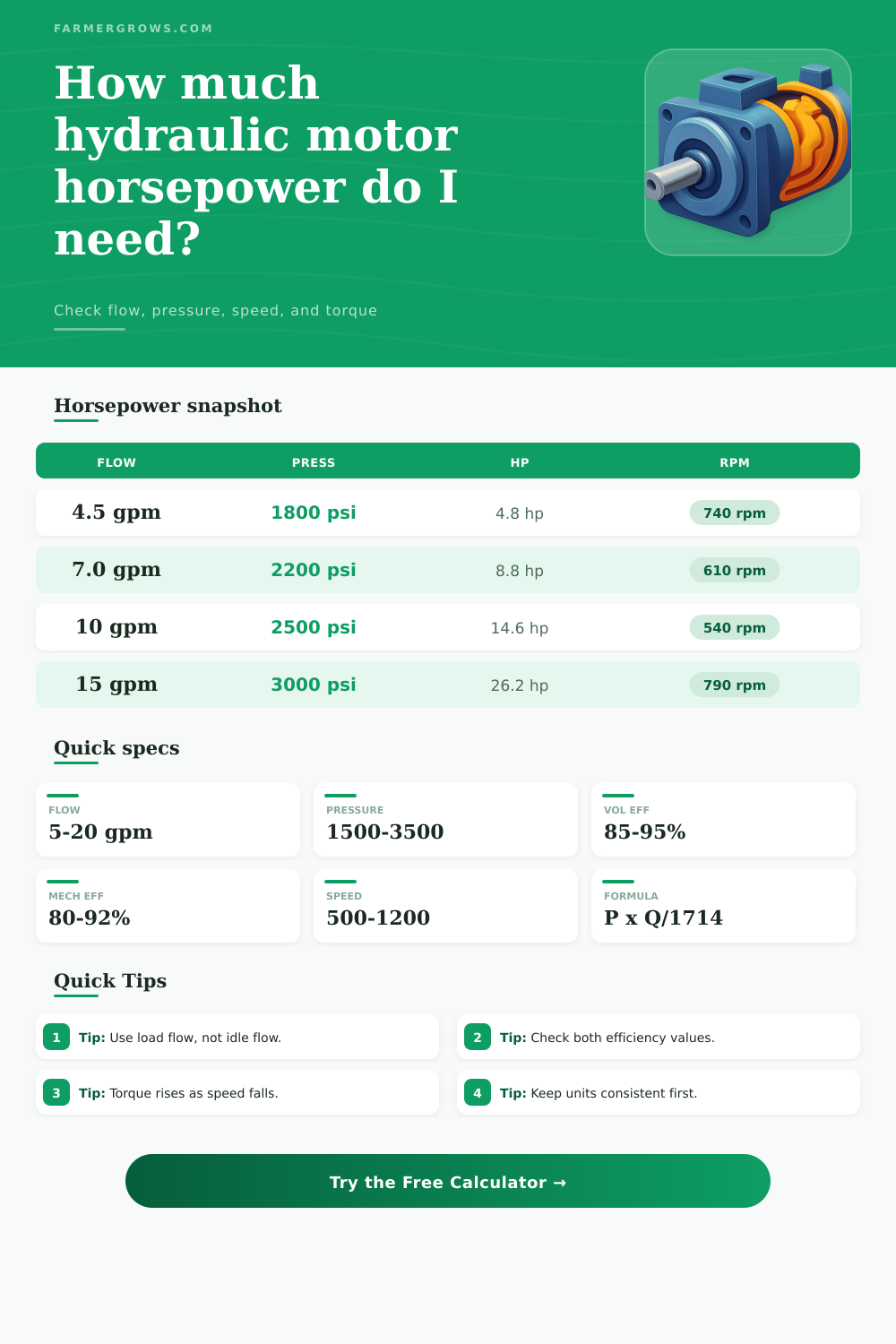
In imperial units, horsepower is equal to the pressure of the fluid multiplied by the flow divided by 1714. However, efficiency must also be used to determine the actual horsepower of the motors. Conversions must be made between different units.
For example, some manufacturers use gallons per minute and cubic inches. Other manufacturers use liters per minute and cubic centimeters. Incorrect conversions will lead to incorrect sizing of the motor.
For example, a person must know that there are 231 cubic inch in one gallon of fluid. Using the wrong number of cubic inches in one gallon will result in incorrect sizing of the motor. Many people make mistakes when measuring the flow rate of the fluid.
For instance, they may use the flow rate of the pump when the pump is idling. However, the flow rate of the fluid at idle is not the same than the flow rate of that fluid when it is under the working load of the hydraulic motor. To ensure that the sizing of a hydraulic motor is accurate, a person should always measure the line flow at the working pressure of the motor.
Additionally, a person may have to change the efficiency estimates of the hydraulic motor as the motor wear down. As the hydraulic motor wears down, the volumetric efficiency of the motor decreases due to fluid bypassing internal components of the motor. The orbital motor design is more efficient in dirty environments than vane motors because vane motors experiences more slippage with dirty fluid.
The pressure of the hydraulic motor has a significant bearing on how the motor performs. The motor has a torque ceiling determined by the maximum pressure that can be provided to the motor. If a person chooses a motor that is too small for the tasks that are to be perform, the motor will stall when it encounters resistance.
If a person chooses a motor that is too large for the tasks that are to be performed, the hydraulic pump will waste energy and create excess heat. To prevent errors, a person can use the reverse check method to determine whether a hydraulic motor will be able to provide the necessary flow for the target revolutions per minute (RPM) calculations. Not all hydraulic motors are created the same, and they are suited for different task.
Gear motors provide steady movement for conveyors but do not provide much control for low speeds. Vane motors are used for applications that require smooth movement such as power packs. Orbital motors are used in augers and wheels because of their high starting torque.
Finally, piston motors are used for heavy tasks because these motors allows for variable displacement. The effect of heat on hydraulic motors cannot be understated. If a hydraulic motor is sized properly, it will operate at peak efficiency while keeping the oil temperature below 140 degrees Fahrenheit.
Poor sizing of a hydraulic motor will result in the oil temperature rise above the ideal range. High oil temperatures create thickening of the hydraulic fluid and cause the motor to wear down quick. Since inefficiency creates heat, the sizing of the motor impacts the hydraulic fluid requirements for the reservoir and cooler.
A hydraulic motor may experience issues, and a person may have to troubleshoot the problem. The measured speed of the motor may be less than the calculated speed which indicate a decrease in volumetric efficiency. A decrease in volumetric efficiency is caused by internal wear or air being entrained in the fluid.
Additionally, if the measured torque of the motor is less than the calculated torque of the motor, the problem is caused by mechanical drag or insufficient pressure. A person should always measure the actual performance of the motor compared to the original calculation of the hydraulic motor to establish a baseline.