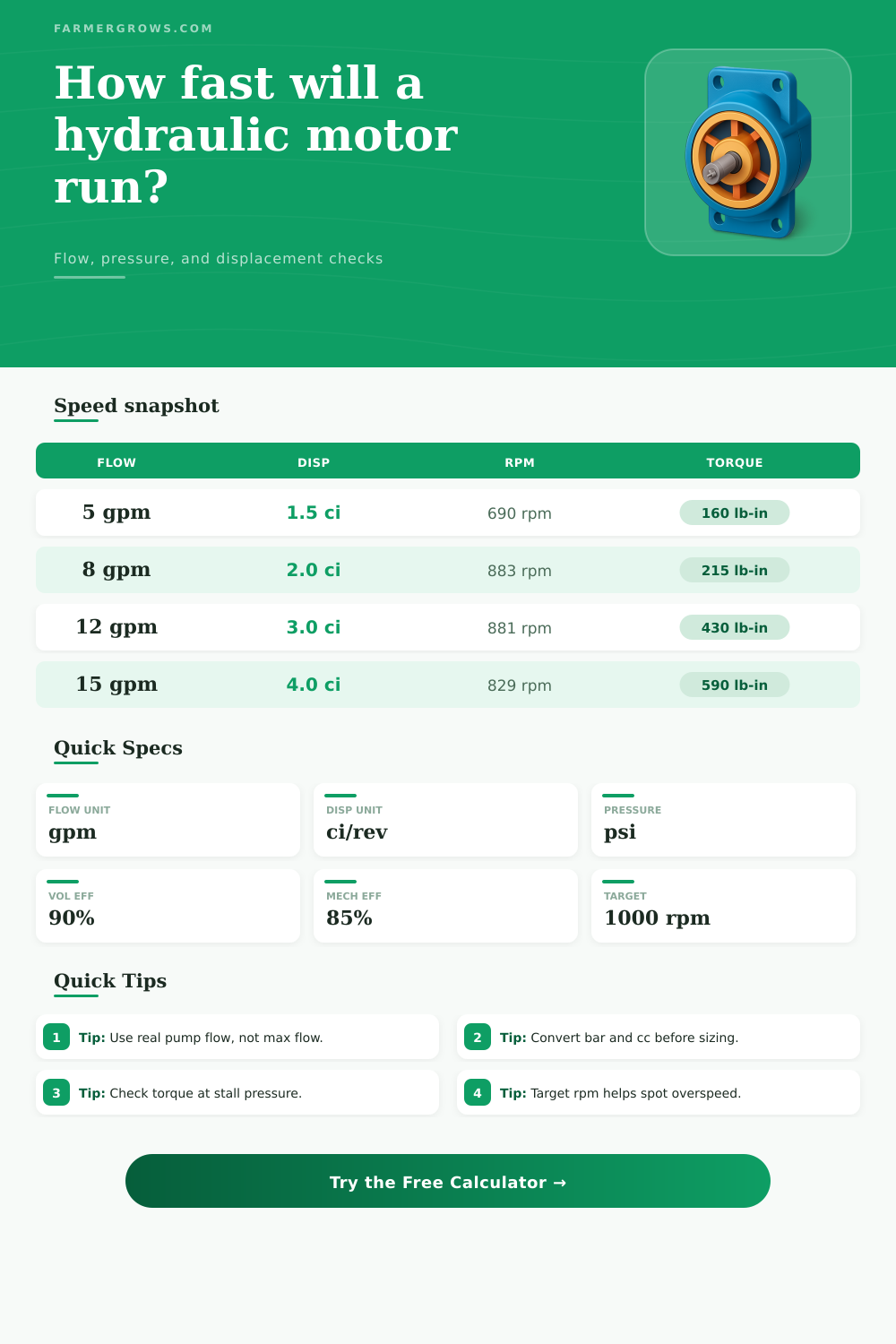
Hydraulic Motor RPM Calculator
Estimate motor speed, torque, and shaft power from flow, displacement, pressure, and efficiency for gear, vane, orbital, and piston motors.
Quick start: Pick a real machine profile and the calculator fills the fields, switches units if needed, and runs the math automatically.
Note: The unit system toggle can switch the measurement set to imperial or metric, while the individual unit fields stay visible for precision.
| Flow | 1 ci/rev | 2 ci/rev | 4 ci/rev |
|---|---|---|---|
| 5 gpm | 1039.5 | 519.8 | 259.9 |
| 10 gpm | 2079.0 | 1039.5 | 519.8 |
| 15 gpm | 3118.5 | 1559.3 | 779.6 |
| Pressure | 1.5 ci/rev | 3.0 ci/rev | 6.0 ci/rev |
|---|---|---|---|
| 1000 psi | 203 lb-in | 406 lb-in | 812 lb-in |
| 2000 psi | 406 lb-in | 812 lb-in | 1624 lb-in |
| 3000 psi | 609 lb-in | 1218 lb-in | 2436 lb-in |
| Flow | in³/min | L/min | RPM @ 2 ci |
|---|---|---|---|
| 2 gpm | 462 | 7.6 | 207.9 |
| 5 gpm | 1155 | 18.9 | 519.8 |
| 10 gpm | 2310 | 37.9 | 1039.5 |
| 15 gpm | 3465 | 56.8 | 1559.3 |
| Type | Speed band | Torque band | Best for |
|---|---|---|---|
| Gear motor | 250-2500 rpm | Moderate | Fans, conveyors |
| Vane motor | 300-1800 rpm | Smooth | Small power units |
| Orbital motor | 20-1000 rpm | High | Augers, wheels |
| Piston motor | 100-6000 rpm | Very high | Heavy duty drives |
Use the actual pump flow at working temperature. Cold oil and ideal ratings can make a motor look faster than it will run in service.
When the target RPM matters, size from the reverse flow check too. A small change in displacement or leakage can move the real speed a lot.
To be able to select a hydraulic motor for a particular task, you must understand the relationship between hydraulic flow, motor displacement, and hydraulic pressure. Hydraulic flow are the volume of oil that passes through the hydraulic motor. The hydraulic displacement is the volume of oil that the motor can move in one single revolution of the motor.
You can calculate the theoretical revolutions per minute (RPM) of a hydraulic motor by dividing the hydraulic flow by the hydraulic motor displacement. In practice, the actual RPM of the motor will typicaly be more less than the theoretical value due to volumetric efficiency. Volumetric efficiency is a ratio of how much oil stays within the motor to create movement, versus how much oil leak out of the motor.
How to Choose a Hydraulic Motor
Thus, if the motor has a volumetric efficiency of 90%, it will be spinning at 90% of the theoretical RPM. Hydraulic pressure is another different variable of a hydraulic motor. The hydraulic pressure determines the torque of the hydraulic motor, and the more pressure that the operator places into the motor, the more torque the motor will create.
Thus, a balance of hydraulic flow, motor displacement, and hydraulic pressure are need to ensure that the motor will have enough speed to perform the task with which it is to be utilized, but also that it will have enough torque to accomplish that task. For instance, motors with a small displacement will create a high RPM but low torque. Motors with a large displacement will create a low RPM but high torque.
Therefore, it is necesary to select a motor with the appropriate displacement based off whether high speed or high torque are more important to accomplish the task. The third major factor that must be considered is the effect that temperature has upon the motor. If the hydraulic oil within the motor becomes too hot, the oil will thin.
Thin oil will reduce the efficiency of the hydraulic motor. If the efficiency of the motor drop, the RPM will drop. Thus, the operator should monitor the temperature of the oil, as it can affect the RPM of the motor.
Additionally, the case drain line of the motor should not become clogged. If they do, the efficiency of the motor will drop, as. Another factor to consider is unit conversion.
For instance, it is common for many people to utilize gallons per minute as the unit of measurement for hydraulic flow. Other people, however, may use liters per minute. You must convert liters per minute into gallons per minute prior to calculating motor specification.
Additionally, displacement can be measured in cubic inch per revolution. However, it can also be measured in cubic centimeters per revolution. Each of these units must be correctly converted into the other before any calculation are performed on the motors specifications.
If the hydraulic motor is too small, it may stall under heavy load. If it is too large, it may spin too fast for the remainder of the machines gearbox. Finally, another consideration is the type of hydraulic motor that is to be utilized for the specific task.
For instance, gear motor are used for applications that require moderate amount of torque and speed, and often are used in conveyors and fans. Orbital motor have high amounts of torque but low RPMs. Orbital motors are often used in winches.
Lastly, piston motors are used in applications that require high amounts of torque at a variety of speed. These motors are often used in heavy-duty industrial application. Each task, however, has specific requirement of the type of hydraulic motor that is to be used to accomplish the task.