🌾 Acre Calculator
Convert rectangles, circles, triangles, or direct area inputs into acres, hectares, square feet, and square meters with one field calculator.
Small garden lot
Large homesite
Small paddock
Standard acre
Steel tape
Best for short straight runs and clean corner checks.
Measuring wheel
Handy for long field edges, fence lines, and tracks.
GPS map trace
Useful for rough acreage from irregular boundary maps.
Stakes and flags
Mark corners first so you can recheck every side.
| Unit | In 1 acre | Metric | Quick note |
|---|---|---|---|
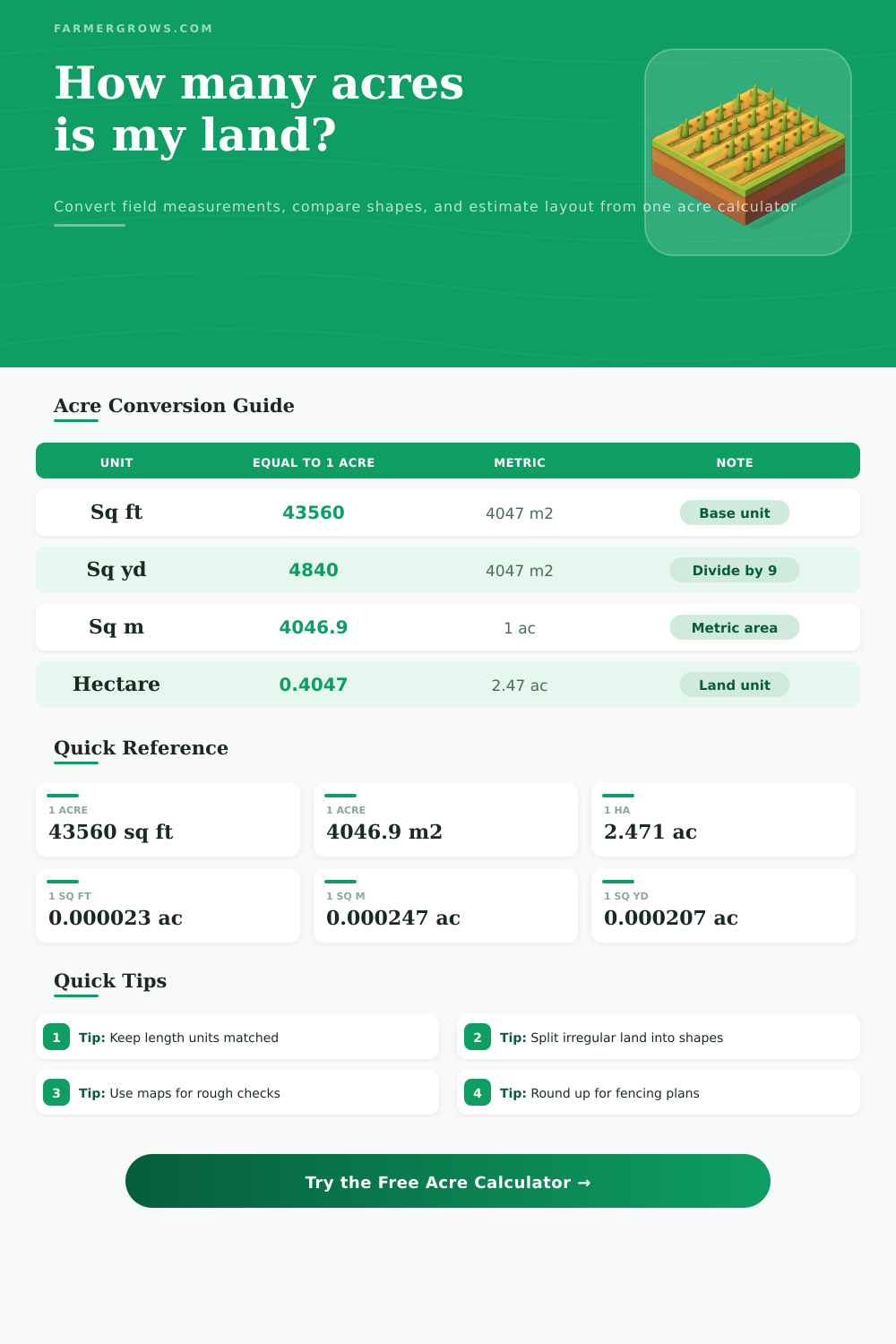
| Square feet | 43,560 | 4,046.9 m2 | Base acre unit |
| Square yards | 4,840 | 4,046.9 m2 | Divide feet by 9 |
| Square meters | 4,046.9 | 1 acre | Metric area view |
| Hectares | 0.4047 | 2.471 acres | Common land unit |
| Square miles | 0.0015625 | 640 acres | Very large blocks |
| Shape | Inputs | Area formula | Boundary note |
|---|---|---|---|
| Rectangle | Length, width | L x W | Perimeter = 2L + 2W |
| Circle | Diameter | pi x r squared | Perimeter = pi x d |
| Triangle | Base, height | 0.5 x b x h | Perimeter is estimated |
| Custom | Direct area | Entered value | Use map or survey |
| Acres | Sq ft | Square side | Typical use |
|---|---|---|---|
| 0.10 | 4,356 | 66.0 ft | Small garden |
| 0.25 | 10,890 | 104.4 ft | Large homesite |
| 0.50 | 21,780 | 147.6 ft | Small paddock |
| 1.00 | 43,560 | 208.7 ft | Standard acre |
| 2.00 | 87,120 | 294.9 ft | Small block |
| 5.00 | 217,800 | 466.7 ft | Large block |
| Acres | Square side | Approx fence | Note |
|---|---|---|---|
| 0.25 | 104.4 ft | 417.6 ft | Square estimate |
| 0.50 | 147.6 ft | 590.4 ft | Square estimate |
| 1.00 | 208.7 ft | 834.8 ft | Square estimate |
| 2.00 | 294.9 ft | 1,179.6 ft | Square estimate |
| 5.00 | 466.7 ft | 1,866.8 ft | Square estimate |
An acre are a unit of measurement for land. One acre is equal to 43,560 square feet. One acre is also the size of an American football field without the end zone.
A square acre is 209 feet in length from one side to the other. These different unit of measurement for acreage will dictate the way in which the land is to be plan for use. For example, the number of seed that will be planted into the land will dictate the number of fence post that will be purchased for that land.
What Is an Acre and How to Measure Land
The type of use of that land will dictate the total amount of money that will be spent on purchasing the materials required for that use of the land. Many piece of land are not perfect rectangles. Other pieces of land have irregular shape.
For example, if the land to be measured is in the shape of a circle, it is first necessary to measure the diameter of the circle. The radius of the circle, if measured alone, will result in an incorrect measurement of the area of the circle. For instance, if the land in the shape of a triangle is to be measured, it is first necessary to determine the base and height of that triangle.
A triangle is half of a rectangle. For example, if the land is an irregular shape, it is first necessary to divide that land into smaller rectangles and triangles. The area of each of these smaller shapes will have to be calculated individual and the numbers added to find the total area of that piece of land.
It is important to ensure that the same unit of measurement are used when measuring land areas. For instance, if the unit of measurement of distance is feet but the measurements are taken in units of yard, the area will be measured incorrect. For instance, one acre is 43,560 square feet.
One hectare is approximately 2.47 acre. These different units of measurement will help to determine the size of the land in various unit. One system of measurement should be used for the entire land area to ensure that the calculation are accurate.
In addition to the area of land, it is also important to measure the perimeter of the land. For instance, the perimeter will determine the length of the fence that will have to be install on the property. A square acre has a perimeter of 835 feet.
The perimeter of land that is much longer in one dimension than it is in another will have a larger perimeter. For instance, if the land is circular in shape, its perimeter will be more efficient than if it were in the shape of a square. A perimeter that is more efficient will require less fencing material to enclose the land.
There may be obstacle to measuring land. For instance, the land may have hills, wet areas, or tree that make it difficult to place a tape measure from one point to the next. GPS applications will provide estimate of the area of the land.
However, there may not be allowance for every detail in that GPS map of the land. A professional land survey of the land will provide the most accurate measurement of each boundary of the land. Sketches of the land can be drawn to provide an estimate of the area.
However, a small buffer of land should be included to the measurement to account for the fact that there will not be enough material to treat all of the land according to the measurements. There are common mistake made when measuring land. For instance, some people will measure the land only to the fence post but will forget that there are units of measurement for the length of the wire that extend from the fence post.
For instance, if the land feature a triangle, it is possible for individuals to make a mistake with the area calculation if they use the length of the slanted side of the triangle rather than the height of the triangle. These error can be avoided if measurements are taken in comparison to a benchmark of the size of an acre. A standard acre will have 43,560 square feet of land.
The size of the land that is to be used will dictate the way in which it is to be use. For instance, a quarter acre of land is enough for a garden of raised bed and footpaths. A half-acre of land is enough for horses.
A full acre of land can be used for hay production. As the size of the acre increase, the scale of the land increases. For instance, more land will require the use of tractor rather than hand tools.
The scale of the land will impact the tool that will be used to manage that land efficient.