🐑 Sheep Stocking Rate Calculator
Estimate flock capacity, pasture demand, area required, and forage balance from liveweight, intake, yield, and grazing window.
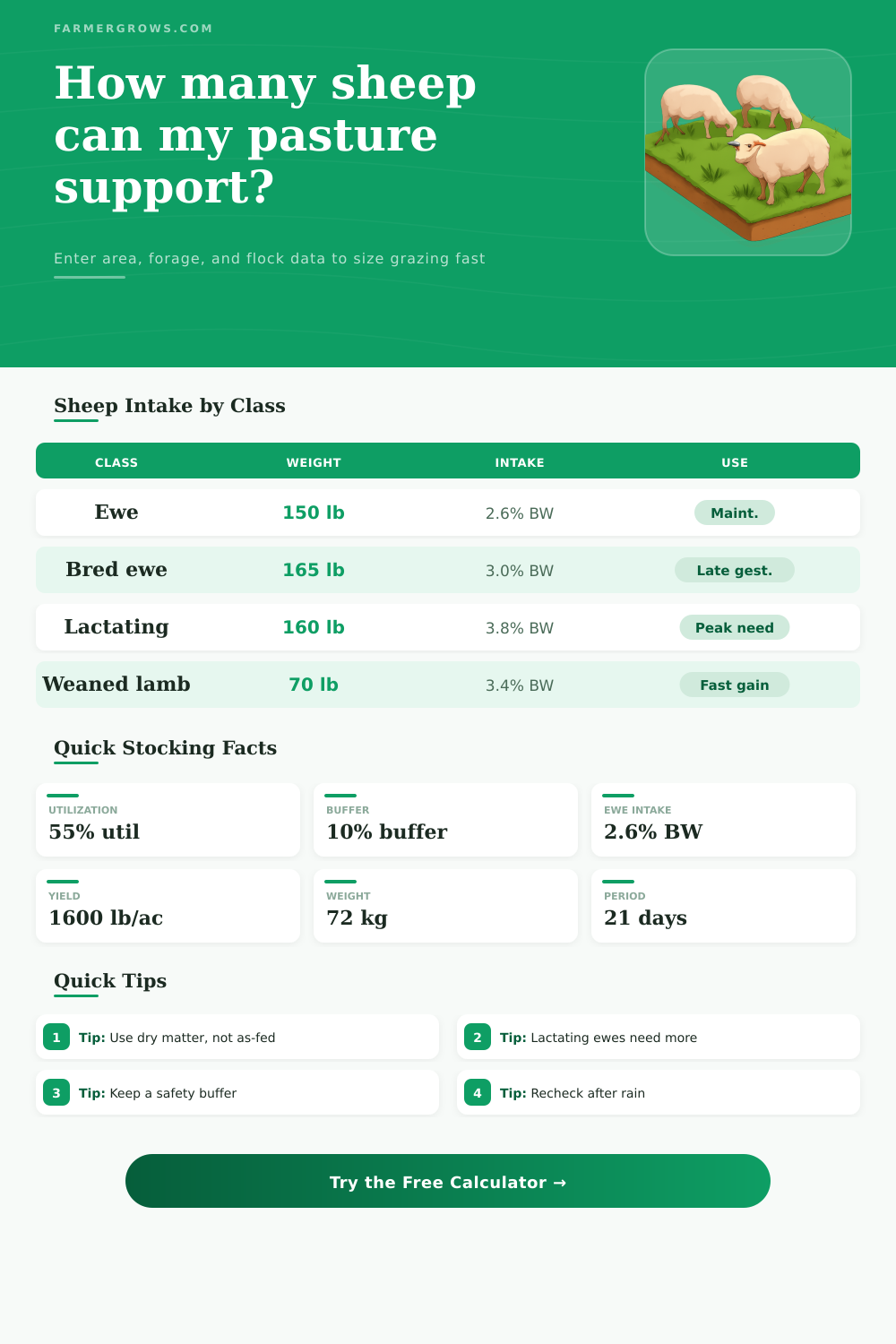
| Class | Weight | Intake | Use |
|---|---|---|---|
| Maintenance ewe | 140-160 lb | 2.4-2.8% | Baseline flock |
| Bred ewe | 150-180 lb | 2.8-3.2% | Late gestation |
| Lactating ewe | 150-190 lb | 3.5-4.5% | Peak demand |
| Weaned lamb | 50-80 lb | 3.0-4.0% | Growing lambs |
| Mature ram | 200-280 lb | 2.0-2.6% | Low intake load |
| Finishing lamb | 70-100 lb | 3.5-4.5% | Fast gain |
| Pasture | Yield | Harvest | Note |
|---|---|---|---|
| Native warm season | 900-1500 lb/ac | 35-45% | Light load |
| Improved grass | 1500-2500 lb/ac | 50-60% | Common rate |
| Clover mix | 2200-3200 lb/ac | 55-65% | High quality |
| Annual forage | 2500-4000 lb/ac | 60-70% | Short window |
| Crop aftermath | 800-1800 lb/ac | 30-40% | Use cautiously |
| Dry summer sod | 700-1200 lb/ac | 25-35% | Conservative load |
| System | Utilization | Buffer | Best Use |
|---|---|---|---|
| Continuous grazing | 25-35% | 15-25% | Low risk |
| Rotational grazing | 40-55% | 10-15% | Balanced load |
| Adaptive grazing | 55-65% | 5-10% | Close control |
| Drought plan | 20-30% | 20-30% | Safety first |
| Scenario | Area | Approx Load | Note |
|---|---|---|---|
| 5 ac improved grass | 5 ac | 8-12 ewes | Spring flush |
| 10 ac lactation | 10 ac | 15-22 ewes | High intake |
| 15 ac lambing set | 15 ac | 25-40 lambs | Short graze |
| 25 ac finishers | 25 ac | 70-110 lambs | Good forage |
| 2 ac ram pen | 2 ac | 3-6 rams | Low demand |
| Metric mixed flock | 6 ha | 30-45 head | Rotational use |
A stocking rate are the number of sheep that a person allows to graze upon a specific amount of pasture. In order to determine the stocking rate for a particular area of pasture, a person must take into consideration that the stocking rate should ensure that the sheep has enough food to eat, yet that it should also prevent the sheep from destroying the pasture. Providing too many sheep to a piece of pasture ensures that the pasture will become depleted of its forage quick.
Conversely, providing too few sheep to a pasture indicates that the pasture isnt being utilized in the most efficient manner. In order to calculate the stocking rate for a pasture, a person must consider the amount of forage that will grow in that pasture. The forage that is selected for that pasture may be improved grass species that contains 2,000 pounds of dry matter per acre, or the pasture may contain native grass species that will yield less dry matter.
How to Work Out the Right Number of Sheep on a Pasture
Dry matter is the amount of nutrients that the forage species contains after the water weight is removed from the species. Additionally, not all of the dry matter that the pasture produces will be eaten by the sheep; some of the forage the sheep will trample. Therefore, a utilization rate is used to account for the amount of forage that will actualy be eaten by the sheep.
Many people use a utilization rate of 50% in rotational grazing areas, but often incorporate a buffer rate of 10% to account for additional factors that may reduce the amount of forage that the sheep can utilize. The amount of forage that the sheep consumes relate to the biology of the sheep. For example, lambs will require more forage than rams, and young sheep will require more forage than older sheep.
Furthermore, supplements to the diet of the sheep may allow for a reduction in the amount of forage that is required to meet the needs of the sheep. Finally, the number of days that the sheep will graze upon the specific piece of pasture will also factor into the stocking rate for that pasture. Many people make error in stocking rates in that they visually assess the amount of forage that is growing in the pasture.
Such assessments may not reflect the actual amount of forage that the sheep may utilize. The type of soil in which the pasture is established will also impact the growth of the forage; clay soils holds more moisture than sandy soils. Additionally, the weather in which the pasture is established will impact the growth of that pasture; rain will increase the growth of the pasture, but heat waves will decrease its growth.
Rotational grazing allows for the pasture to regrow its forage, but continuous grazing can lead to bare ground within the pasture if the stocking rate is too high for that specific pasture. In order to determine the amount of forage that the sheep can utilize, a person can multiply the area of the pasture by the yield of forage that will grow in that pasture. The resulting number can then be multiplied by the utilization rate of that forage, as well as the buffer rate.
For instance, if the pasture contains 10 acres of land, and each acre will produce 2,000 pounds of dry matter, the total amount of dry matter that can grow in the pasture is 20,000 pounds. If the utilization rate for the sheep is 55%, and if a 10% buffer is established for the pasture, the total amount of dry matter that the sheep can utilize is approximately 9,900 pounds. If the requirements of the sheep is 3 pounds of dry matter per day, the amount of dry matter that is available for the sheep will enable that pasture to contain 3,300 sheep for a period of 3 days.
All forage measurements should be converted to dry matter measurements. If as-fed weights of the forage are used in place of dry matter measurements, the stocking rate will be established with potential error. For instance, hay that contains 85% moisture will have a high as-fed weight, but the actual amount of nutrients that the sheep will consume is much less; using the as-fed weight will make it seem like there is more forage available for the sheep than there truly is.
Furthermore, the amount of forage residue that remains on the pasture is something that should be monitored. A target amount of forage residue that should remain on the pasture is approximately 1,500 pounds of dry matter per acre; this amount of forage residue will allow the pasture to recover from grazing by the sheep. Based off the calculations of the amount of forage that will be available in the pasture, as well as the requirements of the sheep to consume that forage, the stocking rate should be established in a way that allows the person to adjust the amount of sheep that graze upon that pasture based upon the way that the sheep consume the forage that grows in that pasture.
For instance, if the stocking rate is such that the sheep each consume an amount of forage that is equal to the amount of forage that grows in the pasture during a period of time, the sheep will have a positive forage balance, indicating that there is an abundance of forage relative to the population of sheep. In this case, it may be possible to increase the number of sheep that live in the pasture, or to allow the existing sheep to graze upon the pasture for longer periods of time. Conversely, if there is a forage deficit in the pasture, the population of sheep should be reduced, or the sheep should be provided with supplements to their diets to ensure that their forage requirements are met.
You should of checked the math twice.