Corn Stalk Grazing Calculator
Estimate residue supply, grazing days, acres needed, and supplement pressure for winter cornstalk grazing.
Yield stays in bushels per acre. The toggle converts acres, weight, and supplement amounts.
🌱Quick Presets
Full Breakdown
📊Calculator Specs
🌾Residue Yield Reference
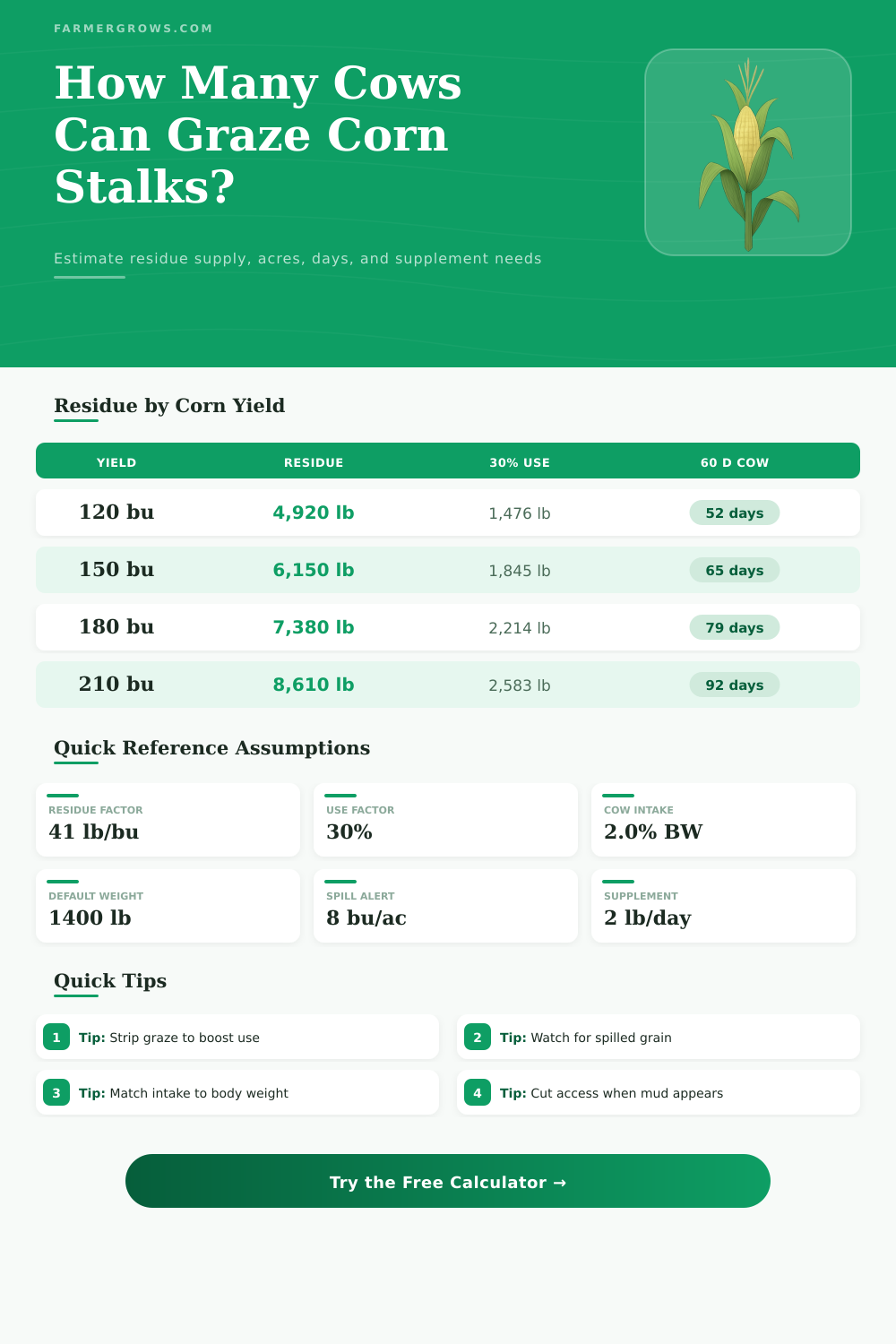
| Grain yield | Total residue DM | 30% grazable | 60-day cow use |
|---|---|---|---|
| 120 bu/ac | 4,920 lb/ac | 1,476 lb/ac | 52 days |
| 150 bu/ac | 6,150 lb/ac | 1,845 lb/ac | 65 days |
| 180 bu/ac | 7,380 lb/ac | 2,214 lb/ac | 79 days |
| 200 bu/ac | 8,200 lb/ac | 2,460 lb/ac | 88 days |
| 220 bu/ac | 9,020 lb/ac | 2,706 lb/ac | 96 days |
| 240 bu/ac | 9,840 lb/ac | 2,952 lb/ac | 105 days |
| 260 bu/ac | 10,660 lb/ac | 3,198 lb/ac | 114 days |
| 300 bu/ac | 12,300 lb/ac | 3,690 lb/ac | 132 days |
🐮Cattle Intake Reference
| Cattle class | Weight | DMI % BW | Daily DM |
|---|---|---|---|
| Mature beef cow | 1,400 lb | 2.0% | 28 lb/day |
| Bred beef cow | 1,350 lb | 2.1% | 28 lb/day |
| Cow-calf pair | 1,500 lb | 2.2% | 33 lb/day |
| Dry dairy cow | 1,500 lb | 2.5% | 38 lb/day |
| Stocker steer | 800 lb | 2.5% | 20 lb/day |
| Weaned heifer | 900 lb | 2.3% | 21 lb/day |
| Heavy winter cow | 1,600 lb | 2.3% | 37 lb/day |
| Light-use dry cow | 1,200 lb | 1.8% | 22 lb/day |
📏Area Guide by Grazing Days
| Days | 1,400 lb cow need | Acres at 180 bu | Acres at 220 bu |
|---|---|---|---|
| 30 days | 840 lb | 0.38 ac | 0.33 ac |
| 45 days | 1,260 lb | 0.57 ac | 0.50 ac |
| 60 days | 1,680 lb | 0.76 ac | 0.66 ac |
| 75 days | 2,100 lb | 0.95 ac | 0.83 ac |
| 90 days | 2,520 lb | 1.14 ac | 1.00 ac |
| 120 days | 3,360 lb | 1.52 ac | 1.33 ac |
| 150 days | 4,200 lb | 1.90 ac | 1.66 ac |
| 180 days | 5,040 lb | 2.28 ac | 1.99 ac |
🚧Field Risk and Response
| Field condition | Access factor | Risk level | Best response |
|---|---|---|---|
| Dry stubble | 35-40% | Low | Turn in and monitor |
| Frozen ground | 30-35% | Low | Good time for turnout |
| Light snow cover | 25-30% | Moderate | Watch intake closely |
| Wet corners | 20-25% | Moderate | Fence off soft spots |
| Heavy snow | 15-20% | High | Strip graze or delay |
| Thawing mud | 10-15% | High | Pull cattle before damage |
| Many downed ears | 20-25% | High | Use tighter strips |
| Spill piles | 15-20% | Very high | Fence off hot spots |
Strip grazing helps limit binge intake, especially when spilled grain is above the 8 bu/ac risk line.
If cattle start wasting residue or walking through soft corners, tighten the allocation before damage grows.
Residue math is based on a 41 lb dry matter per bushel rule of thumb and a grazing-access percentage that you can tune for field conditions.
Cornstalk grazing is a use of the leftover plant material from a cornfield after humans have harvested the corn. When farmers harvest corn from the fields, the corn plants leaves behind stalks, husks, and leaves. These leftover components contain dry matter that cattle can consume.
The dry matter from cornstalk residue isnt the same than hay. Cattle will not consume all of the residue left behind by corn plants. Instead, cattle will eat the leafy parts and husks of the corn plants but will leave the tough stems behind.
Feeding Cattle with Cornstalks
The percentage of the dry matter that cattle will eat from cornstalk residue range from 20 to 40 percent. However, if the ground has heavy amounts of snow or mud, the percentage will drop below 40 percent. Cornstalk residue can be utilized more effectively if there is spilled grains in the field.
Planted during the corn production phase, these spilled grains are an additional energy source for cattle while grazing. However, if there are heavy amounts of spilled grain in the field, this can cause health problems for the cattle. To avoid this problem, strip grazing with polywire can be used.
Strip grazing involve moving the cattle to different areas of the field every 24 hours. Using strip grazing techniques, the amount of cornstalk residue that the cattle utilize increase from 30 percent to nearly 50 percent. The size of the cattle and how much the cattle eat will dictate the amount of cornstalk residue that is required for each animal.
A 1,400-pound beef cow will consume around 28 pounds of dry matter every day. This is around 2 percent of the cows body weight. Bred cows requires more dry matter than other types of cattle.
Stocker cattle will require less dry matter than bred cows. The amount of dry matter required by the cattle increases with the temperature of the climate. Cows will require more dry matter to consume in cold weather climates to help maintain their body temperature.
In this case, supplements, such as hay or feed cubes, will have to be provided to the cattle to provide them with the nutrients they require. These supplements will fill the nutritional gap in relation to the dry matter from cornstalk residue that the cattle eat. The supplements will ensure that the body condition of the cattle remain the same.
The weather can impact the availability of cornstalk residue for the cattle to eat. Frozen ground is beneficial for the grazing of cattle as it will prevent the ground from becoming mud and compact under the weight of the animals hooves. Light snow may allow the cattle to find the cornstalk residue, but this may also reduce the amount of residue that the cattle can consume to 25 or 30 percent of the available residue.
Thawing mud is problematic as the cattle will have difficulty finding the residue. Additionally, the thawing mud may transform the field into mud which the cattle will destroy as they walk on the field. The quality of the cornstalk residue will decrease over time as the winter progresses.
The leaves will shatter on the cornstalk residue, and the plants will bleach. This will make the residue less nutritious for the cattle. Less nutritious residue will require more supplements to maintain the body condition of the cattle.
A person can calculate the number of days that the cattle can graze in the cornfield by calculating the yield of the field and the number of cattle in the field. For instance, if the field yields 180 bushels of corn per acre, this field will contain enough cornstalk residue to provide for a standard cow for a limited period of time. However, this dry matter will not contain all of the nutrients that the cow requires.
There are some common mistakes that a person can make when utilizing cornstalk grazing areas. One of the common mistake is overestimating the amount of cornstalk residue that can be provided to the cattle because the cattle are selective eaters and will trample parts of the residue. Another common mistake is ignoring the weight of the cattle because a 900-pound heifer will have different requirements than a heavy bred cow.
Other common mistakes involve the spilled grain in the field because this can cause health problems for the cattle if not manage properly. Additionally, the person must observe the cattle every day to ensure that they are getting enough dry matter from the residue. If the body condition of the cattle starts to drop, it mean that they need more food.
A supplement strategy can be used to manage the nutrition of the cattle that graze on cornstalk residue. The dry matter from cornstalk residue will contain little protein after the first 60 days of grazing. Thus, a supplement such as feed cubes or silage can be used to provide the necessary protein for the cattle.
Two pounds of supplement consumed daily will help the cattle to eat the tougher stems of the cornstalk residue. Additionally, if a person can find the correct amount of supplement to balance the amount of cornstalk residue that the cattle consume, this will reduce the cost of hauling hay to provide for the cattle. Cornstalk grazing is a way to utilize the dry matter from the leftover cornfield to provide for the cattle at a low cost.
It is a good way to manage moderntype grazing.