
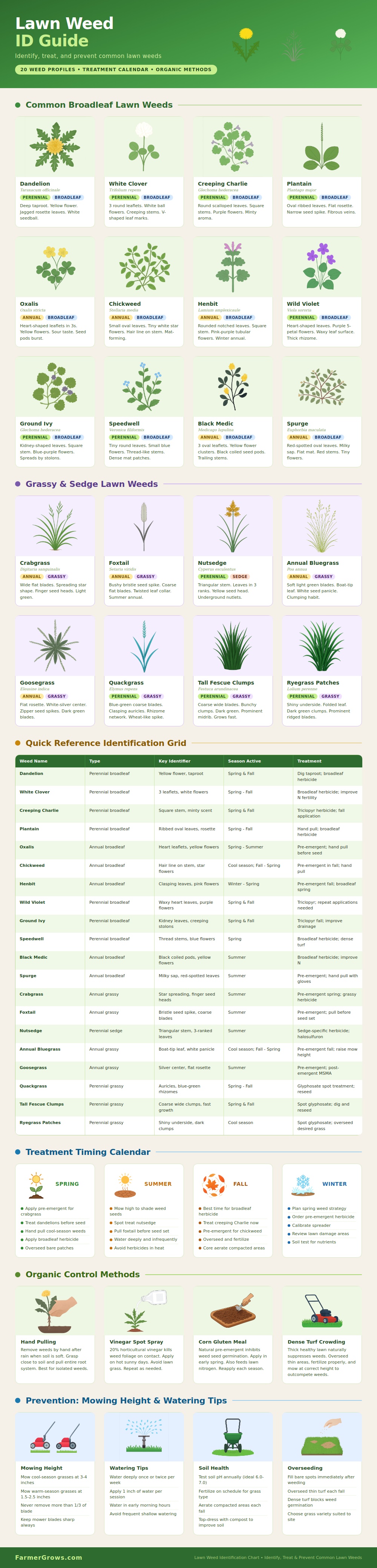
Proper weed identifications is a necessary process to treat weeds appropriate. Incorrect weed identification can waste money and effort to control the weed. Incorrect identification can also result in the weeds remaining on the lawn.
There are two main groups of weeds that can be categorized. These two groups are the broadleaf weeds and the grassy and sedge weeds. Broadleaf weeds is generally easy to identify because of the flowers that they have and the jagged edge of the leaves of these weeds.
How to Identify and Control Lawn Weeds
Some examples include dandelions that has yellow flowers and deep taproots that you must completely remove to eliminate the weed. Creeping Charlie has roots that grow above the soil surface and has square stem. Chickweed spreads as mat and has tiny star shaped flowers.
Grassy and sedge weeds are different than broadleaf weeds as they does not stand out from the turf grass that is growing on the lawn. Crabgrass grows in a star shape and have wide blades. Nutsedge weeds have triangular stems that you can feel with the fingers when picking the weeds.
The proper timing of the control of the weeds depend on the type of weed that is growing on the lawn. Cool season weeds grow in the fall and spring. Summer weeds grow only during summer month.
Weeds should be pull before they have a chance to produce the seed that will ensure that the weeds grow and multiply on the lawn. The treatments for the weeds depends on the type of weed that is growing on the lawn. Use a spray that target the broadleaf weeds such as dandelions.
Use triclopyr to treat creeping Charlie and wild violet in the fall so that the weeds will absorb the triclopyr into their root system. Do not use broadleaf herbicide for nutsedge weeds. Use sedge-specific herbicides to kill nutsedge weeds.
Use an pre-emergent treatment in the spring to prevent crabgrass weeds. Organic method are alternatives to chemical weed treatments. You can hand-pull the weeds after it rains so that the soil is soft and you can easily remove the roots of the weeds from the soil.
Use horticultural vinegar to kill the foliage of the weeds during sunny day. The vinegar will not kill the roots of the weeds. Use corn gluten meal as a naturaly pre-emergent herbicide to prevent the sprouting of weeds.
Dense turf prevents weeds from sprouting so overseeding the lawn will help prevent weeds from growing. The best way to control weeds is to prevent them from sprouting in the first place. Add weeds in areas where turf grass are weak.
Mow the grass to the proper height. Cut cool-season grasses to three to four inch and warm-season grass to one-and-a-half to two-and-a-half inch. Do not clip more than one-third of the grass blade as clipping more than one-third of the blade will stress the grass plant.
Water the grass deep once or twice a week to encourage the grass to develop deep roots. Deep roots allow turfgrass to compete with weeds for nutrient. Perform soil test annually to ensure that the soil pH is between six and seven to encourage proper grass growth without overfeeding the weeds.