🥔 Potato Seed Rate Calculator
Estimate seed piece mass, piece count, hill density, and field totals from field shape, row spacing, and tuber weight.
Results
Seed-piece totals are computed from area, spacing, and the live seed factor chain.
Row spacing and hill density
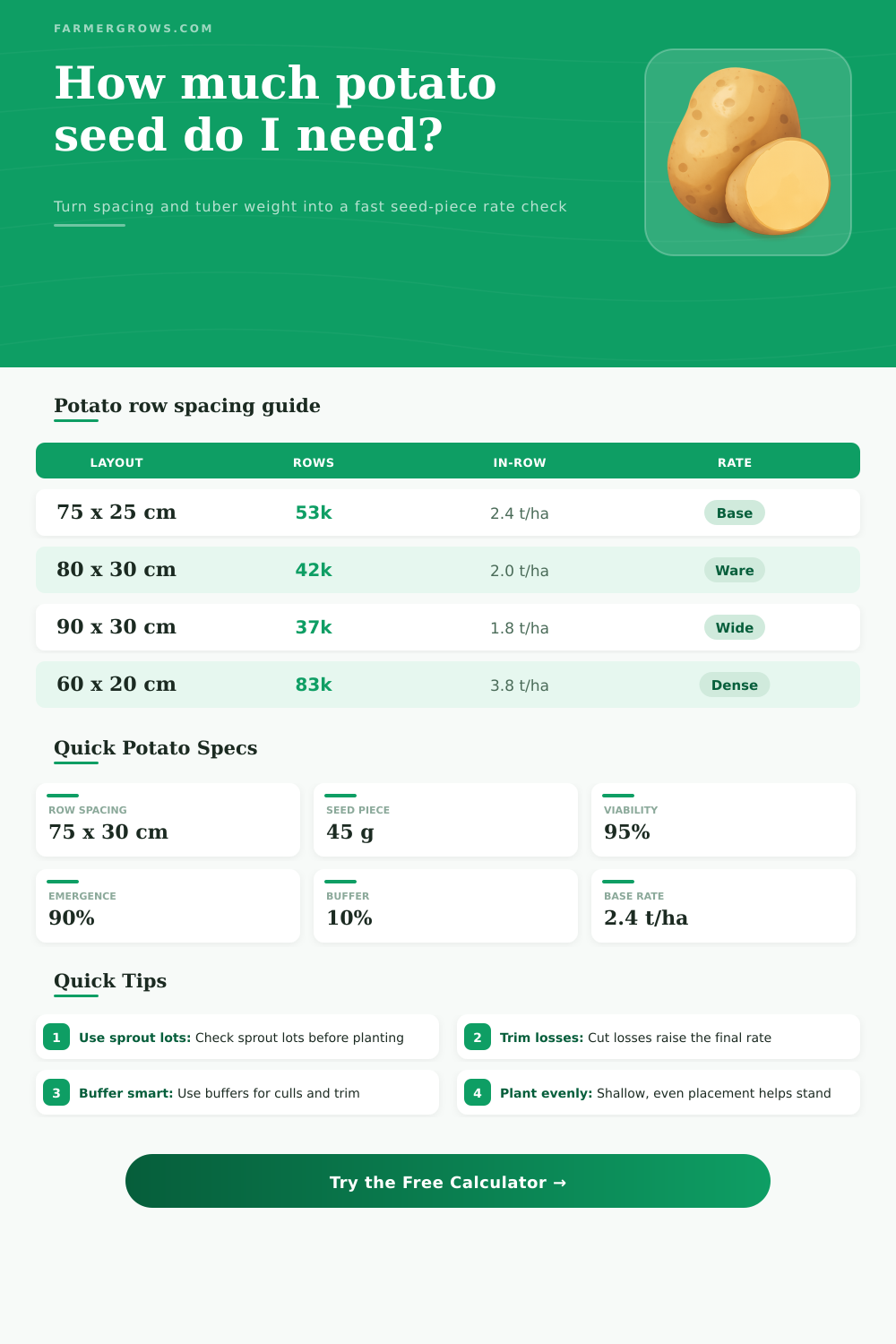
These reference rows show common potato spacings and the approximate hills per hectare and per acre.
| Layout | Row x in-row | Hills/ha | Seed note |
|---|---|---|---|
| Early table | 75 x 25 cm | 53,333 | Higher density |
| Fresh ware | 80 x 30 cm | 41,667 | Balanced rate |
| Processing | 90 x 30 cm | 37,037 | Wider rows |
| Trial ridge | 60 x 20 cm | 83,333 | Dense planting |
Seed piece size guide
Seed piece weight changes the rate fast because the calculator converts the full piece count into mass.
| Size class | g/piece | Pieces/kg | Note |
|---|---|---|---|
| Small cut | 25 g | 40.0 | Very light |
| Medium cut | 35 g | 28.6 | Common size |
| Planting lot | 45 g | 22.2 | Default lot |
| Large tuber | 60 g | 16.7 | Heavy lot |
Establishment scenarios
The final planting mass increases when viability, emergence, or cut quality falls below the target.
| Field condition | Viability | Emergence | Buffer |
|---|---|---|---|
| Firm moist bed | 97% | 93% | 5% |
| Normal field | 95% | 90% | 10% |
| Cool ridge | 94% | 88% | 10% |
| Risky patch | 90% | 84% | 15% |
Common field blocks
These sample blocks use the default 75 x 30 cm layout and a 45 g seed piece for quick comparison.
| Plot | Area | Pieces | Mass |
|---|---|---|---|
| Backyard strip | 100 m² | 604 | 27.2 kg |
| Market bed | 500 m² | 3,018 | 135.8 kg |
| One acre | 4,047 m² | 24,430 | 1,099 kg |
| One hectare | 10,000 m² | 60,366 | 2,717 kg |
When planning to grow potato, determining the correct amount of seed potatoes to purchase and plant into the ground is necesary. If there is to few seed potatoes planted into the ground, the weeds will grow in those empty spaces. If the farm plants too many seed potatoes, the farm will spend too much money on the seed potatoes that could of been sold for food.
To calculate the amount of seed potatoes that is necesary to be planted, several factor must be considered. The first of these factors is the distance that the hill of seed potatoes are to be planted. If the hills are too close together, the potato plants will compete for nutrient, which will lead to smaller potatoes.
How Many Seed Potatoes to Plant in One Hectare
If the hills are too far apart, the plants will grow larger potatoes but there will not be enough area for the rows of hills to cover the planting area. For machine planting, a distance of 75 to 90 centimeters is often used between rows. Within those rows, a farmer plants hills of seed potatoes at a distance of 25 to 30 centimeters apart.
The distance between hills will determine the total number of hills of potatoes that will need to be planted within the field in a hectare. In addition to distance, losses of seed potatoes need to be accounted for. Not all seed potatoes will sprout, and not all that sprout will emerge from the ground.
If the soil is too wet or forms a hard crust upon the ground, the emergence rate of the potatoes will decrease. Additionally, some of the seed potatoes may be bruised or rot prior to planting. To account for these losses, people often add 10 percent to the total calculation of the amount of seed potatoes that will be planted into the ground.
This will ensure that there are enough seed potatoes to fill the planting area. Additionally, the weight of the individual seed pieces will alter the total weight of the required amount of seed potatoes. For instance, if 45 gram seed pieces are used, there are 22 seed pieces in a kilogram of seed potatoes.
If 25 gram seed pieces are used, there are 40 seed pieces in a kilogram of seed potatoes. If 60 gram seed pieces are used, there are only 17 seed pieces in a kilogram of seed potatoes. Thus, the larger the individual pieces of seed potatoes, the less seeds that are required.
However, larger sized seed pieces contain more carbohydrates to fuel the initial growth of the potatoes, and cost more money. The shape of the field and the type of soil within the ground also impact the calculation. Rectangular field are the easiest to plant using machinery with GPS technology to mark the fields.
However, different shapes of fields require different calculation of the area of those fields. For instance, the total area of the field has to be measured in hectares or acres to determine the ton of seed potatoes that should be ordered. Additionally, farmers incorporate ridges into fields with clay soil to allow water to shed off the potatoes, while flat planting areas are used in sandy soil where the ground drain rapidly.
Depending on the layout of the rows and hills within the ground, the amount of seed potatoes will mathematically change. For instance, if the rows are planted at a distance of 75 centimeters from each other and hills are planted at a distance of 25 centimeters from each other, then there will be over 53,000 hills of potatoes to be planted per hectare area, which amount to 2.4 tonnes of seed potatoes. If rows are planted at a distance of 90 centimeters from each other and hills are planted at a distance of 30 centimeters from each other, then there will be 37,000 hills of potatoes to be planted per hectare, and approximately 1.8 tonnes of seed potatoes.
Finally, if the rows of hills are planted at a distance of 60 centimeters from each other and hills within rows are 20 centimeters from each other, there will be 3.8 tonnes of seed potatoes per hectare. These layouts are to be established according to the soil in which the potatoes are to be planted, as well as for what market the potatoes will be sold. In order to avoid mistakes while planting the potatoes, the viability of the seed potatoes should be tested prior to planting them into the ground.
If the farmer does not test the viability of the potatoes, numerous failure in sprouting will reduce the total number of plants that will be started. In addition, care should be taken to ensure the potatoes are not planted too deep into the soil, or the emergence of the potatoes from the ground will become difficult. Finally, the use of a calculator to determine the hill density and the requirement for the potatoes in relation to the hectare will ensure that all losses are accounted for, and that there will be enough seed potatoes to plant for that day.