Nozzle Pressure Calculator
Balance nozzle flow, hose loss, elevation, and pump head for irrigation and sprayer systems.
💧 Nozzle family guide
📈 Reference tables
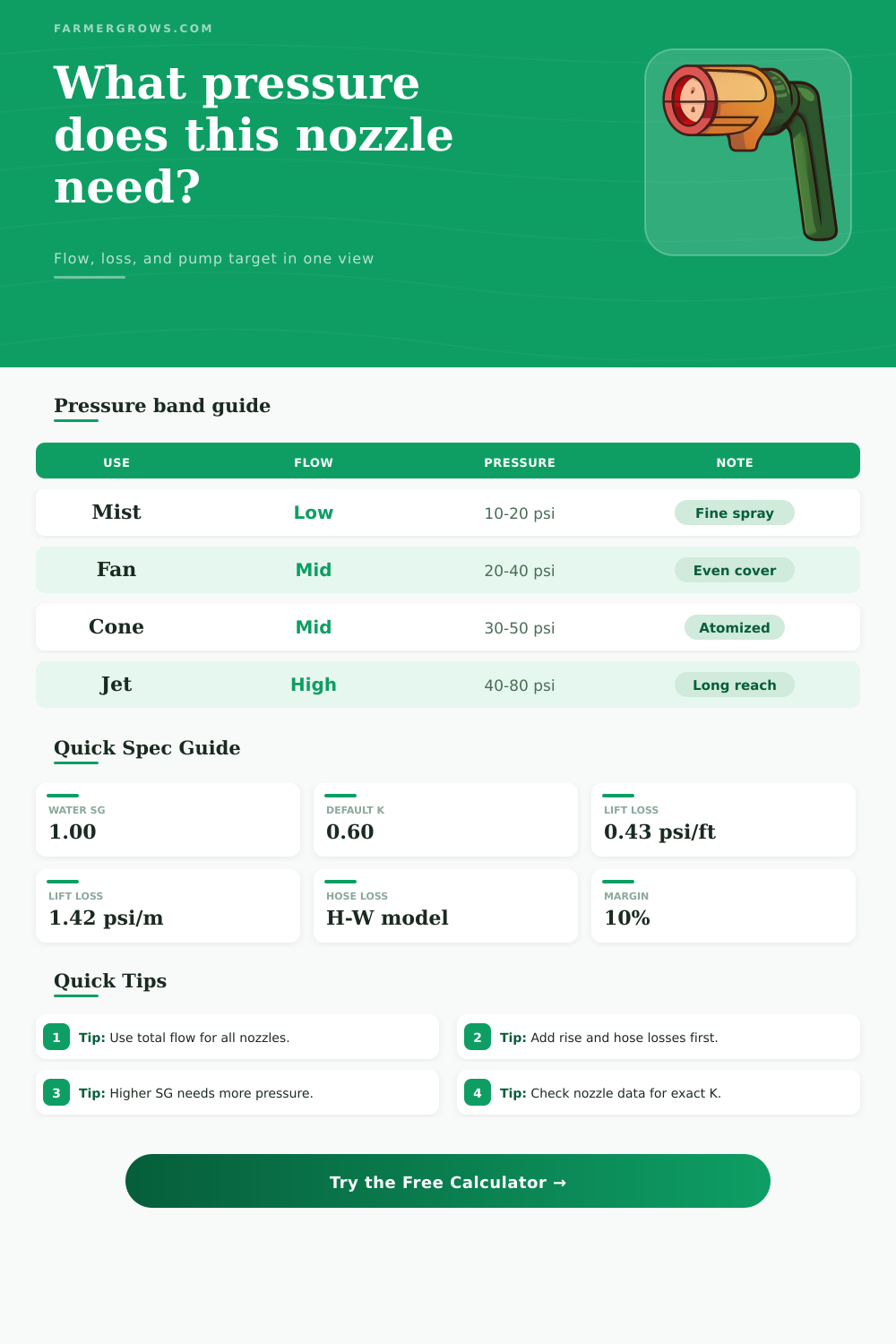
| Nozzle type | K factor | Pressure band | Best use |
|---|---|---|---|
| Mist | 0.01-0.03 | 10-20 psi | Propagation |
| Flat fan | 0.05-0.08 | 20-40 psi | Row spray |
| Hollow cone | 0.08-0.11 | 30-50 psi | Fine coverage |
| Jet | 0.22-0.35 | 40-80 psi | Washdown |
| Hose size | C-factor | Loss trend | Good for |
|---|---|---|---|
| 1/4 in | 140 | Very high | Short mist |
| 3/8 in | 140 | Moderate | Small lines |
| 1/2 in | 140 | Low | Row spray |
| 3/4 in | 150 | Very low | Main feed |
| Item | Imperial | Metric | Use |
|---|---|---|---|
| Pressure | psi | bar | Nozzle |
| Flow | gpm | L/min | Total |
| Length | ft | m | Hose |
| Diameter | in | mm | Orifice |
Use the pump pressure result, not the nozzle pressure, when selecting a supply source or checking if the line has enough headroom.
If the hose loss looks large, increase hose diameter or shorten the line before raising pump pressure.
🧰 Common setup cards
Nozzle pressure are another critical component of any irrigation or spray system. The nozzle pressure will help to determining the flow and the coverage of the spray nozzle. If a person does not manage the nozzle pressure correct, the nozzle pressure can create even spray patterns or cause the nozzle to dribbles.
Proper nozzle pressure ensure that the pump does not run dry and that the pump does not waste energy. In order to manage nozzle pressure, a person must understand the relationship between flow and resistance. Nozzles will determine the types of spray that is released from the nozzle and the specific pressure that are required to create that type of spray.
How Nozzle Pressure Affects Spray, Hoses and Pumps
For instance, flat fan nozzle are often used for row crops, and these types of nozzles require between 20 and 40 psi to provide even coverage of the crops. If a person utilizes a pressure that is lower than 20 psi, then the droplets will clump together. If a person utilizes a pressure higher than 40 psi, the droplets will create a fine mist that will evaporate before it can reach the crops.
For propagation task, however, the pressure can be lower, between 10 and 20 psi. Each nozzle will have a K factor that helps to determine the flow of the nozzle, based on the square root of the pressure. The size of the orifice for the nozzle and the discharge efficiency of that nozzle can determine the K factor for each nozzle.
The K factor is important in that changes in the pressure will result in large changes in the flow of the nozzle. Nozzles must contend with several physical factor in their systems. For instance, the nozzles must pull the water through the hoses that connects the pump to the nozzles, and the water must travel through the nozzles to the crops.
In these hoses, there will be a friction loss in the system. Friction loss in the hoses will increase if the flow rate of the water increase, if the length of the hose increase, or if the diameter of the hose decrease. A person can reduce friction loss by utilizing larger diameter hoses.
The total system demand in a system can be found by simply counting the number of nozzles within the system. This total system demand will determine the friction loss in the hoses before the water reaches the nozzles. Additionally, the elevation of the system will impact the nozzle pressure.
Gravity will create a pressure change of 0.43 psi for every foot of vertical rise in the system. The density of the fluid that the nozzles are dispensing will also impact the pressure in the system. For example, if the fluid is a nutrient mix or a slurry, it will have a higher specific gravity then water.
As a result, higher specific gravity will require higher pressure for the same flow rate. A boom sprayer system will experience friction loss within the row lines that connect the nozzles to the boom sprayer. If the row lines are undersized in relation to the amount of water that the nozzles are to dispense, the friction loss within the row line can reduce the output of the pump 10% to 15%.
Friction loss can be reduced by widening the hoses or shortening the length of the hoses. Additionally, it is helpful to include a safety margin of 10% to account for the variances in pumps. For instance, if the system requires a specific gravity of 1.02, the pump will have to work harder to pump the nutrient mix than if it were simply water.
A person can size the system by inputting the desired flow to find the appropriate pump to use. Alternatively, a person can size the system by installing a fixed pump and determining the flow that will result. For example, if a person sizes the nozzles to a fixed pump, they will have to account for the friction loss in the hoses and the elevation of the fields to which the water will be dispensed.
For instance, an orchard cone nozzle may require 30 to 50 psi to create an atomized drop of the fluid. If the hoses create a drag loss on that nozzle, the pressure at the nozzle will drop to 25 psi. If the pressure at the nozzle drops to 25 psi, the nozzle will create coarse droplets and the chemical dispensing will be wasteful.
The type of spray pattern that the nozzles create must match the requirements of the tasks. For instance, mist nozzles are used for propagation to allow for the mist to maintain the humidity within the propagation trays without causing the water to run off of the plants. Flat fan nozzles are used for foliar applications because the flat fan nozzles allow for the water to overlap the plants’ leaves without leaving any stripes in the coverage.
Jets are used for washdown the systems because the water has the reach to clean the designated areas. High pressure will create an atomized spray that will help to reach the leaves, but it will also lead to drift of that spray. Low pressure will create a soaking effect of the plants, but the coverage will be even with low pressure.
Additionally, if a person uses a slurry, they will have to use higher pressure because the slurry has a higher specific gravity than water. A slurry will also erode the nozzle tips faster than water will. In order to create a successful system, a person must first consider the total flow that the system is to dispense.
Then, a person must consider the specific requirements for each nozzle. Finally, a person has to check the specifications of the pump that is to be utilized. A person should always check the specifications of the nozzles, as each brand can have a different K factor for their nozzles.
Thus, in order to create an effective system, a person must manage the nozzle pressure, the friction loss of the hoses, the elevation of the fields, and the specific gravity of the fluid. By doing so, a person will not only be able to ensure even spray coverage by the irrigation system, but they can also ensure that the pump will last the life of the irrigation system.