Sprayer Speed Calculator
Find your required ground speed to hit a target application rate — or calculate actual GPA/L/ha at any speed
✅ Calculation Results
Standard flat fan nozzle 0.3 GPM at 20-inch spacing
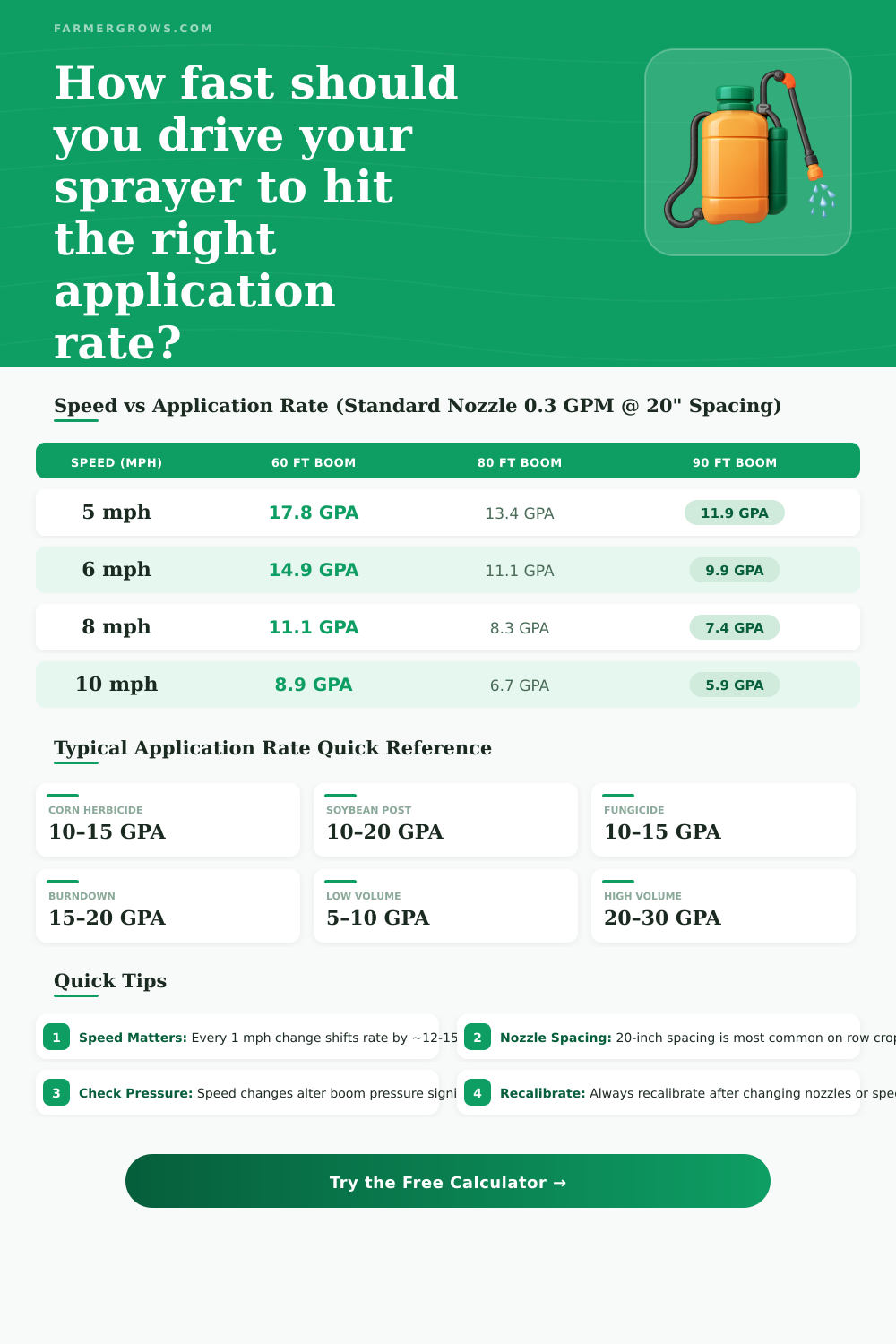
| Speed (mph) | 60 ft Boom GPA | 80 ft Boom GPA | 90 ft Boom GPA |
|---|---|---|---|
| 4 mph | 22.3 | 16.7 | 14.9 |
| 5 mph | 17.8 | 13.4 | 11.9 |
| 6 mph | 14.9 | 11.1 | 9.9 |
| 7 mph | 12.7 | 9.5 | 8.5 |
| 8 mph | 11.1 | 8.3 | 7.4 |
| 10 mph | 8.9 | 6.7 | 5.9 |
| 12 mph | 7.4 | 5.6 | 4.9 |
| Crop / Use | Typical GPA | Boom Pressure | Notes |
|---|---|---|---|
| Corn Herbicide | 10–15 GPA | 20–40 PSI | Use flat fan nozzle |
| Soybean Post | 10–20 GPA | 20–40 PSI | Adequate coverage critical |
| Wheat Fungicide | 10–15 GPA | 25–40 PSI | Penetration needed |
| Burndown / Pre | 15–25 GPA | 20–40 PSI | More water helps coverage |
| Low Volume | 5–10 GPA | 30–60 PSI | Use low-drift nozzles |
| High Volume | 20–40 GPA | 15–30 PSI | Flood or wide-angle tips |
| Boom Width | Acres/hr @ 6 mph | Acres/hr @ 8 mph | Acres/hr @ 10 mph |
|---|---|---|---|
| 30 ft | 21.8 | 29.1 | 36.4 |
| 40 ft | 29.1 | 38.8 | 48.5 |
| 60 ft | 43.6 | 58.2 | 72.7 |
| 80 ft | 58.2 | 77.6 | 97.0 |
| 90 ft | 65.5 | 87.3 | 109.1 |
| 120 ft | 87.3 | 116.4 | 145.5 |
Ground speed are one of the most important measurement for chemical applications. If a person applies too little chemical the weeds will grow and the crop will produce less yield. However, if a person use too much chemical the chemical products will be wasted and there may be issue with the chemical residue.
Ground speed will dictate how much time the nozzle will spend over a particular area. Thus, ground speed is the primary variable to control the chemical application rate. Application rate is determine by the relationship between coverage and time.
How Ground Speed Changes Spray Rate
If a person slows ground speed, the application rate will increase. If the ground speed is increased, the application rate will decrease. Thus, ground speed must be adjusted to the requirement of the chemical to be applied.
The baseline for chemical application is the flow rate of the nozzles. A flat fan nozzle typically dispense 0.3 gallon per minute at a specific pressure. To find the total gallons per minute dispensed by all the nozzles on the boom, you multiply that flow rate by the total number of nozzles on the boom.
The total number of nozzles is found by dividing the width of the boom by the distance between nozzle. The gallons per minute is divided by the ground speed and the width of the boom to find the rate at which the chemical is applied to an area. Chemical application rates vary with the type of chemical that is to be applied.
Corn herbicide may require 10 to 15 gallons of chemical per acre. Soybean post-emergence chemicals require 20 gallons of chemical per acre. Burndown chemicals typically require 15 to 20 gallon of chemical per acre.
Fungicides require 10 to 15 gallon of chemical per acre because they typically work more better with fine droplets. Using a chemical calculator allow a farmer to calculate the ground speed that the implement will need to travel to achieve the rate at which the chemical is to be applied. The farmer can enter the number of nozzles on the boom into the calculator as well as other variable of the chemical application process.
The calculator will show the required ground speed in miles per hour. The calculator will also show the total flow of the chemical dispenser on the implement and the number of acres that can be covered per hour. If the boom is wider, it will cover more acre per hour.
Boom stability and pressure will affect chemical application. If the ground is too rough the boom may bounce. If the boom is bouncing, it will change the height of the nozzles and ruin the chemical application pattern.
If the ground speed is increased, the chemical pump may drop in the amount of chemical pressure. Chemical application droplets must be fine and not too coarse or too fine with too many chemical pressure. The chemical pressure should be within the range of the nozzles.
Most nozzle work at between 20 and 40 psi. A person can avoid chemical application error by using GPS guidance for the implements. Tractor tachometers can be inaccurate in determining the ground speed of the implement.
GPS guidance will provide an accurate measurement of the ground speed of the implement. Manual calibration of the nozzles can also avoid chemical application error. The tachometer can become inaccurate due to the chemical residue that may clog or wear the nozzles.
Chemical application droplets must be even throughout the field. A person can test the flow rate of the nozzles by collecting the amount of chemical dispensed by the nozzles into a jar in a 30-second period while the sprayer is at operating pressure. The total amount collected in the jar can be divide by 30 to find the flow rate of the nozzles.
Environmental factor will affect chemical application as well. The wind may affect how the chemical is applied to the area. Dense plant canopy may absorb the chemical different than sparse plant canopies.
A test strip can be used to determine if the chemical application rate is correct. Chemical can be applied to a test area and the drop in the level of the chemical tank can be measured. The amount of chemical applied to the area can be divide by the area of the test strip to find the chemical application rate.
If the actual rate of chemical application is not the target rate, adjustments must be made to the ground speed of the implements.