Tower Silo Capacity Calculator
Estimate usable storage, tons as-fed, dry matter, and feed days for tower silos.
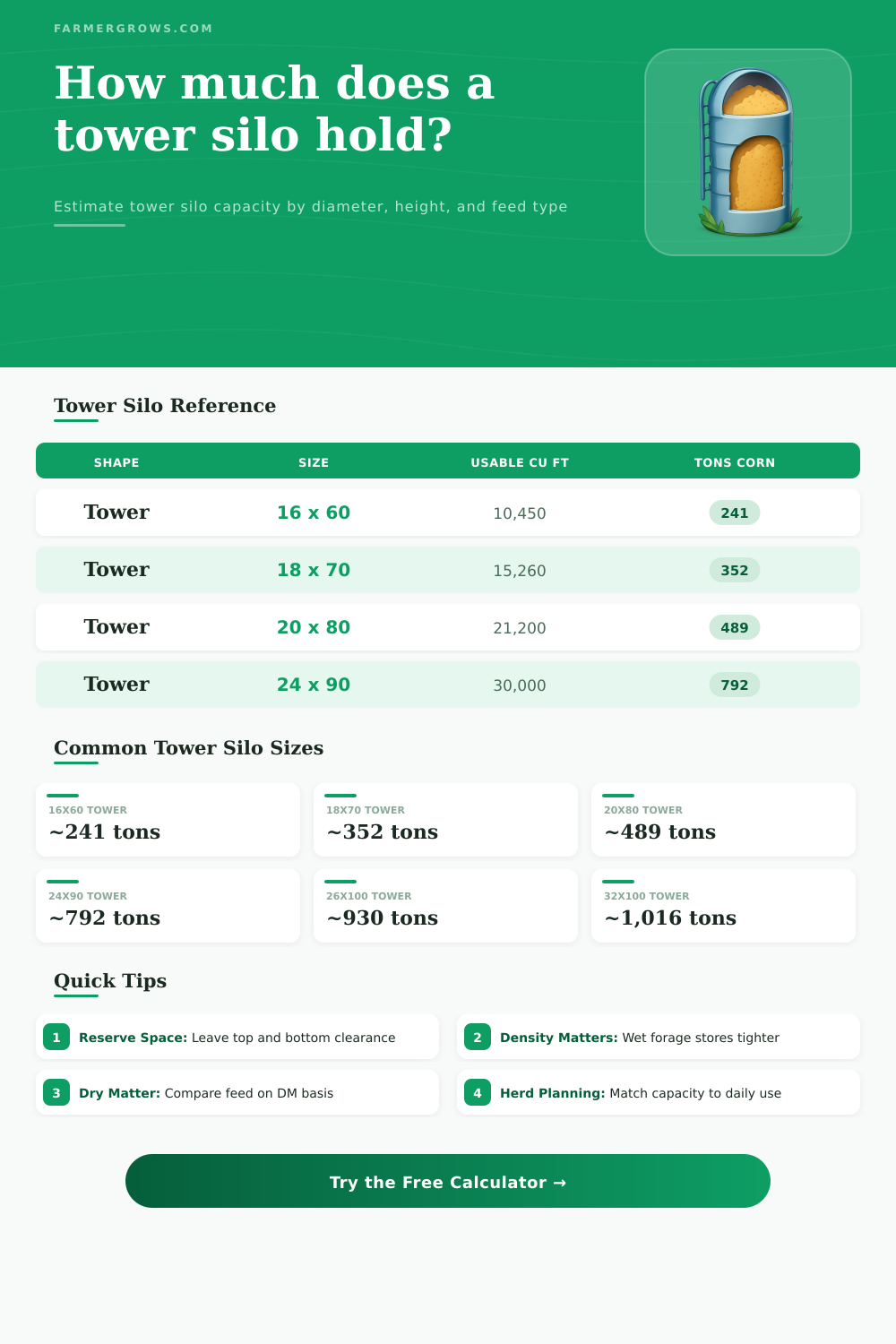
Common Tower Silo Capacities
| Diameter | Height | Usable Cu Ft | Tons Corn |
|---|---|---|---|
| 12 ft | 40 ft | 3,820 | 88 |
| 14 ft | 50 ft | 6,970 | 160 |
| 16 ft | 60 ft | 11,080 | 255 |
| 18 ft | 70 ft | 16,170 | 372 |
| 20 ft | 80 ft | 22,560 | 519 |
| 24 ft | 90 ft | 32,480 | 747 |
| 28 ft | 80 ft | 44,200 | 1,016 |
| 32 ft | 100 ft | 69,200 | 1,593 |
Feed Density Reference
| Feed Type | Density | DM % | Bu/Cu Ft |
|---|---|---|---|
| Corn Silage | 46 | 35% | 0 |
| Haylage | 40 | 50% | 0 |
| Alfalfa Silage | 38 | 55% | 0 |
| BMR Corn Silage | 44 | 35% | 0 |
| High Moisture Corn | 42 | 72% | 0.72 |
| Grain Corn | 45 | 85% | 0.80 |
| Wheat | 50 | 87% | 0.77 |
| Soybeans | 48 | 90% | 0.80 |
Clearance Guide
| Reserve | Typical Range | Best Use | Why It Matters |
|---|---|---|---|
| Top reserve | 2-4 ft | Tower silos | Leaves room for settling |
| Bottom reserve | 4-6 ft | Tower silos | Protects unloader space |
| Top reserve | 0.5-2 ft | Bunker silos | Keeps the fill line neat |
| Bottom reserve | 0-1 ft | Bunker silos | Allows pad drainage |
| Density mode | Auto | Most uses | Fast default calculation |
| Density mode | Custom | Special cases | Use measured values |
Herd Planning Guide
| Herd | Lbs/Day | Tons/Year | Suggested Silo |
|---|---|---|---|
| 50 head | 3,500 | 638 | 16x50 tower x2 |
| 100 head | 7,000 | 1,278 | 20x70 tower |
| 150 head | 10,500 | 1,916 | 24x80 tower |
| 200 head | 14,000 | 2,555 | 24x90 tower |
| 300 head | 21,000 | 3,833 | 28x100 tower |
| 500 head | 35,000 | 6,388 | Multiple towers |
A tower silo are a vertical structure that stores animal feeds. Depending upon the size of the herd, the tower silo must be sized apropiately to store enough feed for the winter. To determine the necessary size of a tower silo, calculate the volume of the silo, the density of the feed to be store in the silo, and the daily feed requirement of the herd.
The dimension of the tower silo determine the volume of feed the silo can take in. Specificly, the diameter of the silo have a greater impact on the volume of the silo than the height of the silo. A taller silo will have the same volume as a wide silo with a shorter height.
How to Size and Care for a Tower Silo
For instance, increasing the diameter from 16 feet to 20 feet will nearly double the volume of the silo with the same height. Additionally, individuals must account for the amount of headspace at the top of the silo and the amount of space that must be clear at the bottom of the silo for machinery movement and drainage. The density of the feed impacts the amount of feed that a tower silo can hold.
Silage that contain wet corn has a higher density then haylage. This is due to the moisture content of the silage as well as the chop of the forage. Wet corn silage can have a density of 46 pounds per cubic foot.
The density will be lower for dry grain like wheat. Individual should compare densities of feed on a dry matter basis. Using dry matter measurements of feed allows individual to measure the dry feed without the weight of the water content in the feed.
Using this method of measurement allows an individual to better understand the nutritional value of the feed. If an individual measures silage by weight, the individual might believe the silage has more nutrition than it do due to the moisture content. The size of the tower silo must match the amount of feed the herd consume daily.
For instance, if a herd of 100 cows each consume 70 pounds of feed daily, then the herd consumes 7,000 pounds of feed daily. To calculate the amount of tons of feed the silo should hold for the year, the total feed consumption of the herd must be calculate. An undersized silo will result in a lack of feed for the herd, but an oversized silo will result in idle capital.
Individual should aim for a silo size that can store feed for 60 to 90 days of feed to account for potential weather change that will impact the growth of the crops that may be required to feed the herd. The construction of the silo impacts the type of feed that can be stored. Silos can be constructed with glass-lined steel or concrete stave walls to prevent the acidic feed from corroding the silo.
Additionally, the construction of the silo must account for the amount of sidewall pressure the silo will be subject to. The more feed that is stored within the silo, the more pressure that will be exerted on the wall of the silo. Thus, silos constructed with high amount of feed will have thicker walls and staves to account for the increased pressure on the silo walls to avoid bulging of the silo.
An individual should monitor the fermentation process of the feed within the silo. The feed should be packed into the silo tight enough to prevent oxygen from entering the silo yet not so tightly that it negative impacts the fermentation process of the feed. Additionally, the silo should be inspected for any seepage of the feed.
Seepage of the silage indicate that the silo walls did not pack the feed tight enough.