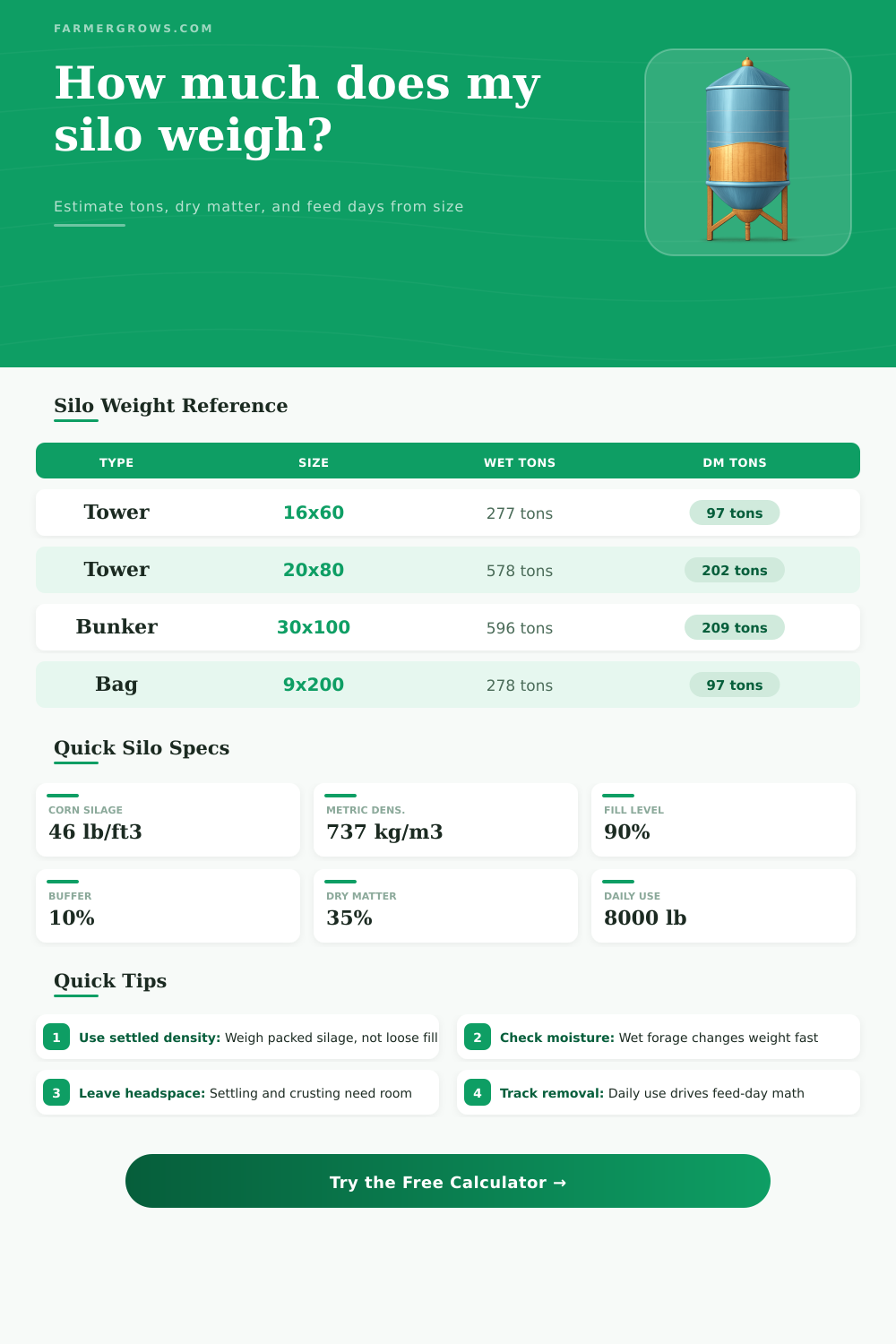
🌾 Silo Weight Calculator
Calculate total weight, dry matter tons, and days of feed for any silage storage type
| Storage Type | Typical Density | Pros | Best For |
|---|---|---|---|
| Horizontal Bunker | 14-16 lbs/cu ft | High capacity, accessible | Large dairy herds |
| Upright Silo | 14-17 lbs/cu ft | Good preservation | Medium operations |
| Silage Bag | 13-15 lbs/cu ft | Flexible, low cost | Small-medium farms |
| Drive-over Pile | 12-15 lbs/cu ft | Very low cost | Low-budget options |
| Tower Silo | 15-18 lbs/cu ft | Excellent preservation | Premium operations |
| Storage Size | Volume (cu ft) | Approx Tons (45 lbs/cu ft) | Herd Days (50 head @ 50 lbs/day) |
|---|---|---|---|
| Bunker 50'x20'x8' | 8,000 | ~180 tons | ~144 days |
| Bunker 100'x30'x10' | 30,000 | ~675 tons | ~540 days |
| Bunker 200'x50'x12' | 120,000 | ~2,700 tons | ~2,160 days |
| Upright 16'x40' | 8,042 | ~181 tons | ~145 days |
| Tower 20'x60' | 18,850 | ~424 tons | ~339 days |
| Bag 8'x200' | 10,053 | ~226 tons | ~181 days |
Calculating silage inventorees requires understanding the relationship between volume, density, and dry matter. Because many variable influence the weight of silage, inventory isnt always an easy calculation. Those who miscalculate the inventory for a silage may find themselfs either out of feed too soon or the silage may begin to rot.
Accurate calculations of silage inventory will allow a farm to apropiately plan for the feeding of the herd, the need to truck in silage, the need to balance feeding rations for the herd, and even when negotiations will need to occur with silage buyers. The type of silage and how much silage is packed into the storage site influence the weight of silage. Silage made from corn will weigh between 14 and 17 pound per cubic foot of silage if packed correctly.
How to Calculate Silage Inventory
Grass and alfalfa silage tends to be lighter than corn silage and is more difficultly to pack. The portion of silage that provides nutrition to the herd are referred to as dry matter. Dry matter will be low if the silage contains a higher amount of water.
For instance, 35% of silage dry matter means 65% of the silage is water. The weight of the water dont provide nutrition to an herd. The volume of a bunker silage storage site can be calculated by multiplying the length of the bunker by the width of the bunker and the depth of the bunker.
To determine how many day of silage a farm has, the farm can use the volume of silage if it calculates the feed that is consumed. For instance, if a farm has 50 dairy cows that consume 50 pounds of silage each, the herd consumes 2,500 pounds of silage each day. By subtracting the silage consumed by the herd each day from the total weight of silage inventory, the farmer can calculate the number of days of silage that is left for the herd.
Silage is often packed into the storage area to increase the density of the silage. Silage that is packed will weigh more than silage that is not pack. The weight of silage that a tractor packs can be between 38 and 50 pounds per cubic foot.
The tractor creates this weight when it pack the silage and removes the oxygen from the silage. Silage bag and vertical silos can produce higher densities of silage than bunkers. Bunkers allow for the storage of large amount of silage, but drive-over piles of silage are less dense than bunkers because the silage is not packed as tightly into the storage area.
The moisture levels of silage will impact the dry matter of the silage. Corn silage should have a moisture level between 30% and 35% while alfalfa silage should have a moisture level between 40% and 45%. Too dry silage will produce dust and heat.
Moisture levels may change due to precipitation or the amount of time the silage sit in storage. A probe can be used to sample the moisture level of the silage. The silage may appear dry, but the interior of the silage may have a higher moisture level.
Silage can be stored in many different ways. Bunkers are large storage areas for silage but may require covers and wall to seal the silage. Silage bags are an inexpensive option for small area but can be punctured and may sag under the weight of the silage.
Vertical silos preserve silage well because there is little contact between the silage and the air. However, special equipment is required to move silage out of the silo. The farmer should remove silage from the face of the bunker at a consistent rate or the silage may heat up and spoil.
It is important to include a buffer in the calculation of silage inventory. As silage age, it shifts and loses some of it weight due to crusting or spoiling silage. A 10% buffer may account for any measurement error or loss of silage.
With knowledge of the dimensions of the silage storage area, the type of silage produced, the density of the silage within the storage area, and the consumption rate of the animals in the herd, the farmer can successfuly calculate the length of time that the herd will have access to silage. They should of accounted for more if they wanted to be safe.