🌾 Grain Moisture Calculator
Calculate wet basis & dry basis moisture content, weight loss from drying, and safe storage levels for all major grain types
ℹ️ Safe storage values are for long-term storage (12+ months). Short-term storage may allow 1–2% higher moisture.
| Wet Basis (WB%) | Dry Basis (DB%) | Water per 100 lbs | Dry Matter per 100 lbs |
|---|---|---|---|
| 10% | 11.1% | 10.0 lbs | 90.0 lbs |
| 12% | 13.6% | 12.0 lbs | 88.0 lbs |
| 14% | 16.3% | 14.0 lbs | 86.0 lbs |
| 16% | 19.0% | 16.0 lbs | 84.0 lbs |
| 18% | 22.0% | 18.0 lbs | 82.0 lbs |
| 20% | 25.0% | 20.0 lbs | 80.0 lbs |
| 22% | 28.2% | 22.0 lbs | 78.0 lbs |
| 24% | 31.6% | 24.0 lbs | 76.0 lbs |
| 26% | 35.1% | 26.0 lbs | 74.0 lbs |
| 30% | 42.9% | 30.0 lbs | 70.0 lbs |
| Grain Type | Test Weight (lbs/bu) | Shrink Factor / 1% | lbs Lost per 1,000 lbs |
|---|---|---|---|
| Corn | 56 lbs/bu | 1.4% | 14.0 lbs |
| Soybeans | 60 lbs/bu | 1.4% | 14.0 lbs |
| Wheat | 60 lbs/bu | 1.4% | 14.0 lbs |
| Oats | 32 lbs/bu | 1.4% | 14.0 lbs |
| Barley | 48 lbs/bu | 1.4% | 14.0 lbs |
| Grain Sorghum | 56 lbs/bu | 1.4% | 14.0 lbs |
| Rough Rice | 45 lbs/bu | 1.4% | 14.0 lbs |
| Canola | 50 lbs/bu | 1.4% | 14.0 lbs |
| Grain | lbs / Bushel | kg / Bushel | Bushels / Tonne |
|---|---|---|---|
| Corn | 56 lbs | 25.4 kg | 39.4 bu |
| Soybeans | 60 lbs | 27.2 kg | 36.7 bu |
| Wheat | 60 lbs | 27.2 kg | 36.7 bu |
| Oats | 32 lbs | 14.5 kg | 68.9 bu |
| Barley | 48 lbs | 21.8 kg | 45.9 bu |
| Grain Sorghum | 56 lbs | 25.4 kg | 39.4 bu |
| Rough Rice | 45 lbs | 20.4 kg | 49.2 bu |
| Canola | 50 lbs | 22.7 kg | 44.1 bu |
The moisture of grains can decide if the harvest will succeed or flop Between grains and its moisture level exists a strong tie. During treatment of grains it helps as an important tool. Too much moisture risks and too little also.
Growers know well the Goldilocks-impact regarding moisture in grains. If it is too high, the grains sell for less. If too low, they miss weight because of shrinkge.
Why Grain Moisture Matters
The moisture seriously affects the quality, storage and sale of grains.
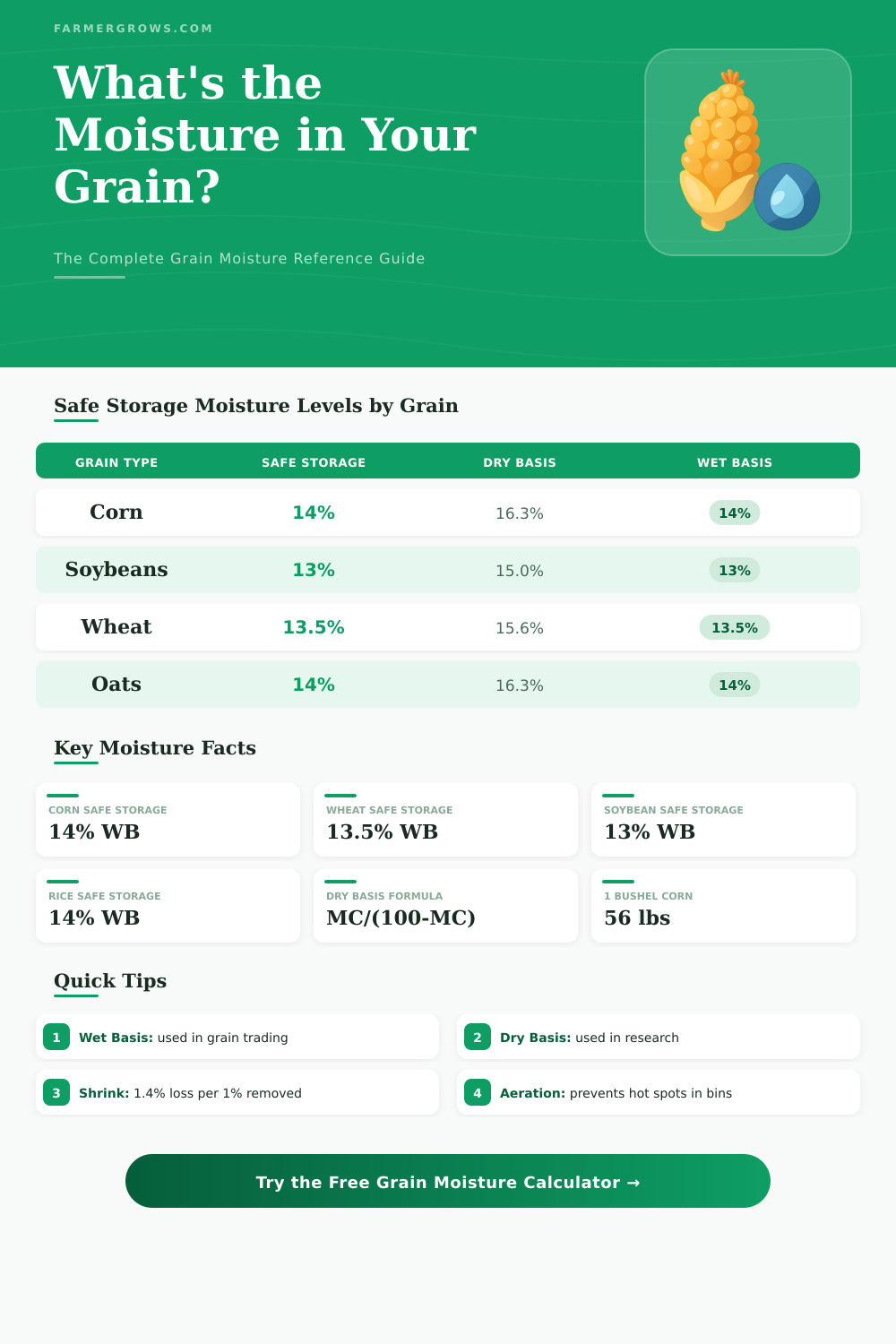
For wheats the safe moisture is under 14.5 percent. Kernels without green leave to dry grains without quality loss. Harvesting before bad weather, the quality improves.
Corn stored from 6 to 12 months dry to 14 percent moisture. For more than 12 months use 13 percent. Temperature changes and moisture motion require good floors in storage buildings.
Rye cut in 40, 45 percent moisture, later leave slowly dry in the field.
Food grains for later use dry entirely. Moisture helps germs. On time drying paddy after harvest, you escape discolor.
While storage the moisture reduces the growth of seeds.
For sale you measure moisture by means of special devices. That seriously estimates quality, value and storage. Grain moisture meters calibrate for fast precise results, so ranchers decide better about harvest or storage.
One model measures 18 types of grains.
The most reliable mode to estimate moisture are standard oven tests with scales. It dries samples according to issued instructions in laboratories. Resistance tests require a ground sample, capacitance operate with whole grains.
Grinded meters answer for field, whole grain for stores with ventilation.
Study points that grains in 18 percent moisture commonly have 1 percent error, with bigger diversity in freshly harvested. In around 15 percent the meters deviate each 0.5 percent of the oven tests. In United States the official standard is 149MHz-technology.
Corn growers care about drying costs or losses for corn above 15.5 percent moisture.