
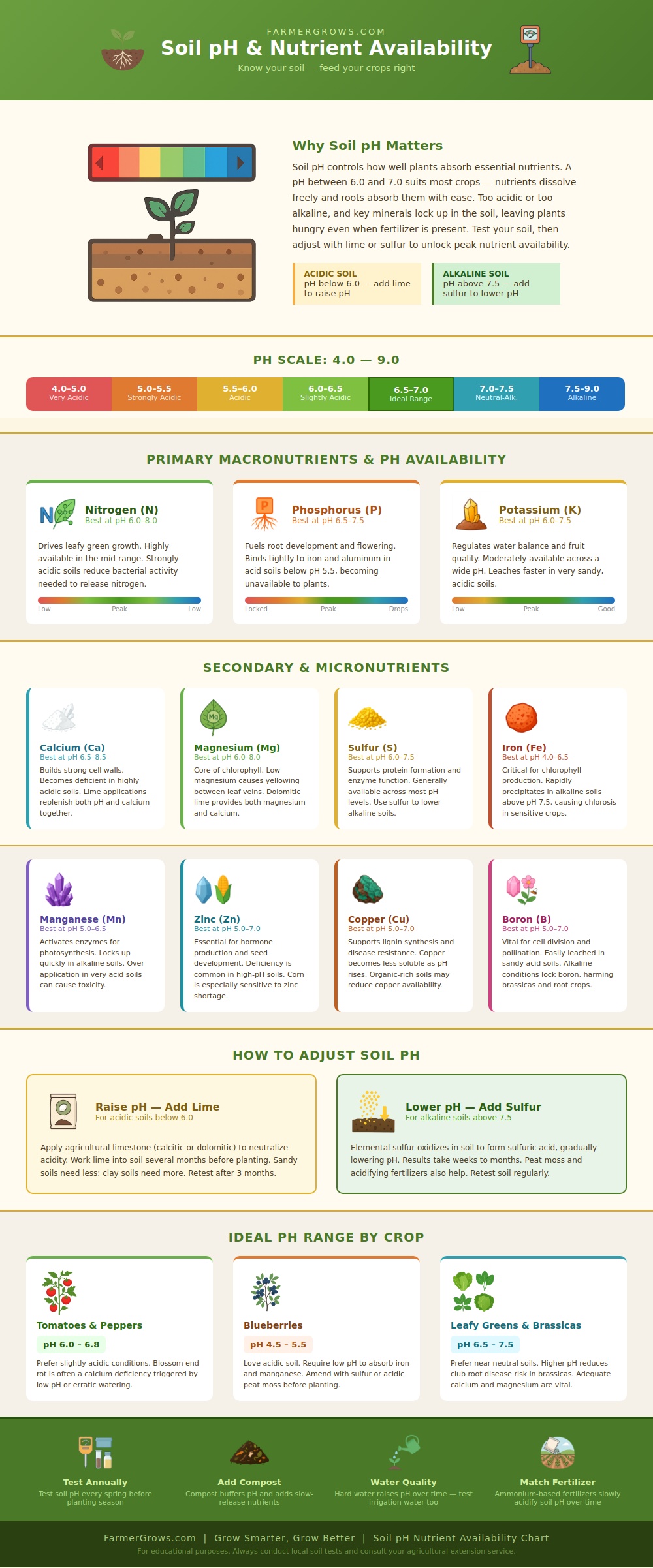
The soil pH seriously affects how plants can get the nutrients that they need from the ground. It plays a decisive role in the solubility and uptake of those nutrients. In acidic soils some elements are more easily accessible while others are soluble in basic environments.
Understanding that tie is the basic step for efficient plant nutrition.
How Soil pH Affects Plant Nutrients
Most commonly you advise pH between 6.0 and 7.5 for the most plants, because here the main nutrients are avaliable. Nitrogen, phosphorus and potassium are needed in big amounts. Around neutral pH of 6.5 to 7 you reach best access to the nutrients of plants.
Plants grow best in pH above 5.5.
The soil pH alters the nutrient availability by changing their chemical form in the ground. When nourishment is less soluble, it does not stay dissolved in the soil water and root hairs can not reach it. Like this it simply becomes unreachable.
By changing the pH to a good level you can improve the access of important elements.
Under pH 6.0 phosphorus, nitrogen and potassium become less available. Also magnesium and calcium commonly decline. Acidic soils release aluminium, manganese and iron in too high dose.
Rather, in pH close to 7 or higher micronutrients and phosphorus are bad soluble, while calcium and magnesium are more free.
Macronutrients such as nitrogen, potassium, calcium, magnesium and sulphur are available in pH 6.0 to 6.5. Micronutrients, for instance boron, copper, iron, manganese, nickel and zinc, favor a range of pH 5 to 7. Extreme acidic or basic soils lock many nutrients.
Various crops like different pH levels. For corn, beans and wheat the answer is low to mid 6. Alfalfa requires pH near 7 and tolerates a bit basic ground.
Blueberries want pH close to 5. Every plant has its own nutrient needs, that range according to life stage.
Nutrient availability depends also on the soil texture, so of the amount of sand, silt, clay and organic matter. The uptake of nutrients regarding pH and soil type adjusts according to plant species and symbiotic creatures as mycorrhizal fungi and rhizobacteria. Lowering pH in a field from 7.2 to 6.5 can help a lot for some basic micronutrients and overall plantgrowth.