🛖 Grain Bin Concrete Pad Calculator
Calculate cubic yards, bags, and weight for your grain bin foundation pad
| Depth | Sq Ft per Cu Yd | Sq M per Cu M | Cu Yds per 100 Sq Ft | Cu M per 100 Sq M |
|---|---|---|---|---|
| 3 in (7.6 cm) | 108 sq ft | 13.1 m² | 0.93 yd³ | 0.076 m³ |
| 4 in (10.2 cm) | 81 sq ft | 9.8 m² | 1.23 yd³ | 0.102 m³ |
| 5 in (12.7 cm) | 65 sq ft | 7.8 m² | 1.54 yd³ | 0.127 m³ |
| 6 in (15.2 cm) | 54 sq ft | 6.5 m² | 1.85 yd³ | 0.152 m³ |
| 8 in (20.3 cm) | 40.5 sq ft | 4.9 m² | 2.47 yd³ | 0.203 m³ |
| 10 in (25.4 cm) | 32.4 sq ft | 3.9 m² | 3.09 yd³ | 0.254 m³ |
| Bag Size | Cu Ft per Bag | Bags per Cu Yd | Covers at 4 in (sq ft) |
|---|---|---|---|
| 40 lb bag | 0.30 cu ft | 90 bags | ~0.24 sq ft |
| 50 lb bag | 0.375 cu ft | 72 bags | ~0.30 sq ft |
| 60 lb bag | 0.45 cu ft | 60 bags | ~0.36 sq ft |
| 80 lb bag | 0.60 cu ft | 45 bags | ~0.49 sq ft |
| 90 lb bag | 0.675 cu ft | 40 bags | ~0.55 sq ft |
| Ready-mix truck | ~729 cu ft | 1 truck (27 yd³) | varies |
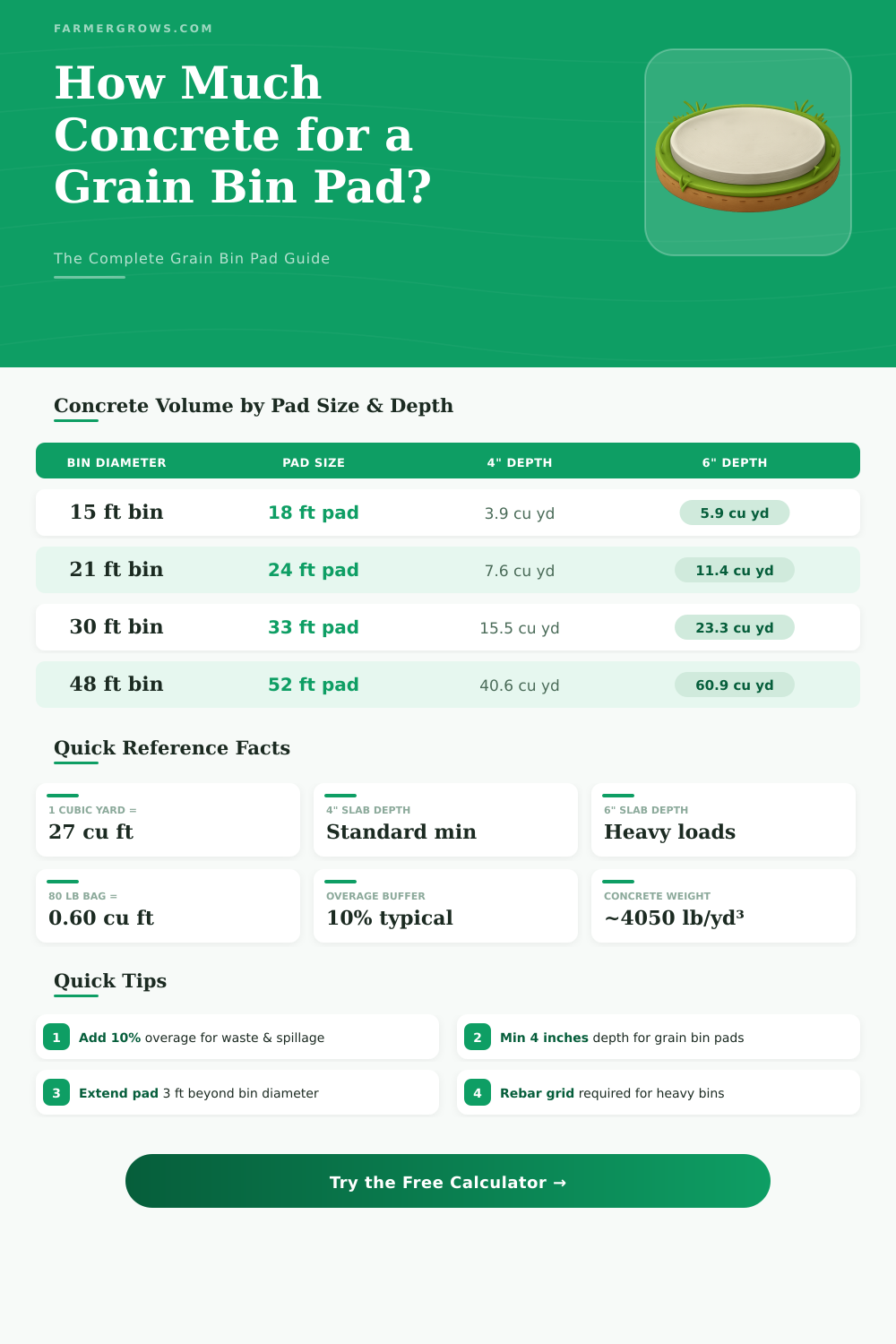
| Bin Diameter | Pad Diameter | Pad Area (sq ft) | Cu Yds at 4 in | Cu Yds at 6 in | 80 lb Bags (4 in) |
|---|---|---|---|---|---|
| 12 ft | 15 ft | 177 | 2.2 | 3.3 | 99 |
| 15 ft | 18 ft | 254 | 3.1 | 4.7 | 140 |
| 18 ft | 21 ft | 346 | 4.3 | 6.4 | 194 |
| 21 ft | 24 ft | 452 | 5.6 | 8.4 | 252 |
| 27 ft | 30 ft | 707 | 8.7 | 13.1 | 392 |
| 30 ft | 33 ft | 855 | 10.6 | 15.8 | 477 |
| 36 ft | 40 ft | 1,257 | 15.5 | 23.3 | 698 |
| 48 ft | 52 ft | 2,124 | 26.2 | 39.3 | 1,179 |
Key part of installation of grain bin on farm is the concrete pad under it. Do it right according to basic rules to avoid many troubles later In the center you commonly use 6-inch thick, but for big bins thicker is better. Add rebar in the concrete according to advice of the maker of the grain bin, usually in intervals of 18 inches or even less.
For round concrete you most commonly use pivot kit. It is made up of metal pole set to heavy base. Set the pole in the center of the work space, so that it leads the framing for the round of the base.
How to build a concrete pad for a grain bin
Little tube driven in the soil marks the center of the foundation. With that tube as pivot, board or sharp pole in the end of chain points the diameter. The fill edge must be two feet smaller than the bin diameter.
For instance, 42-foot bin requires 40 feet for the filll.
Forming is the most difficult work. Garden tiller helps to cut the outside trench. Dig hole about 10 inches of depth inside of the forms.
Plastic under the concrete is not needed, if the bin has air floor. A bit of grit in the bottom, well compacted, helps the base.
For bins with legs you can build rebar grid, wired together in right corners, with cross poles no more than 8 inches also. You lay this frame in hole 4 feet of depth and 2 feet of width, one hole for every leg. Later you fill them with concrete, and pour the rest of the base thicker than usually, minimum 8 inches, with specially strong mix as fiber mesh.
Some farmers used two layers of 20mm rebar on one-foot grid with 18-inch concrete.
Building the base up has many advantages. Any cause is more unpleasant than you dig under the bin always. Pour the concrete two feet higher than the soil, so that the bin unloads directly.
Little extra cost of concrete means less need of drill and machines.
Battery-powered roller screed, paired with pivot kit, helps any skill level pour round versions. AltaMix Concrete prepares precast pads for almost every size of grain bin, what gives to farmers fast and practical solution. Concrete cost around 10 dollars each square foot for base.
If the base cracks or sinks over time, not always require to remove it. Mudjacking or lifting by means of polyurethane foam is well known modes for fix the grain bin without big digging. Concrete lifting is cost-effective replacement for whole new.
You also can pour new bases beside the old, leave them cure for some weeks, later use crane to seize the bin and move it over. Especially in clay soil concrete is the best choice. One neighbor used only grit, and the bin fell with no insurance to coverit.