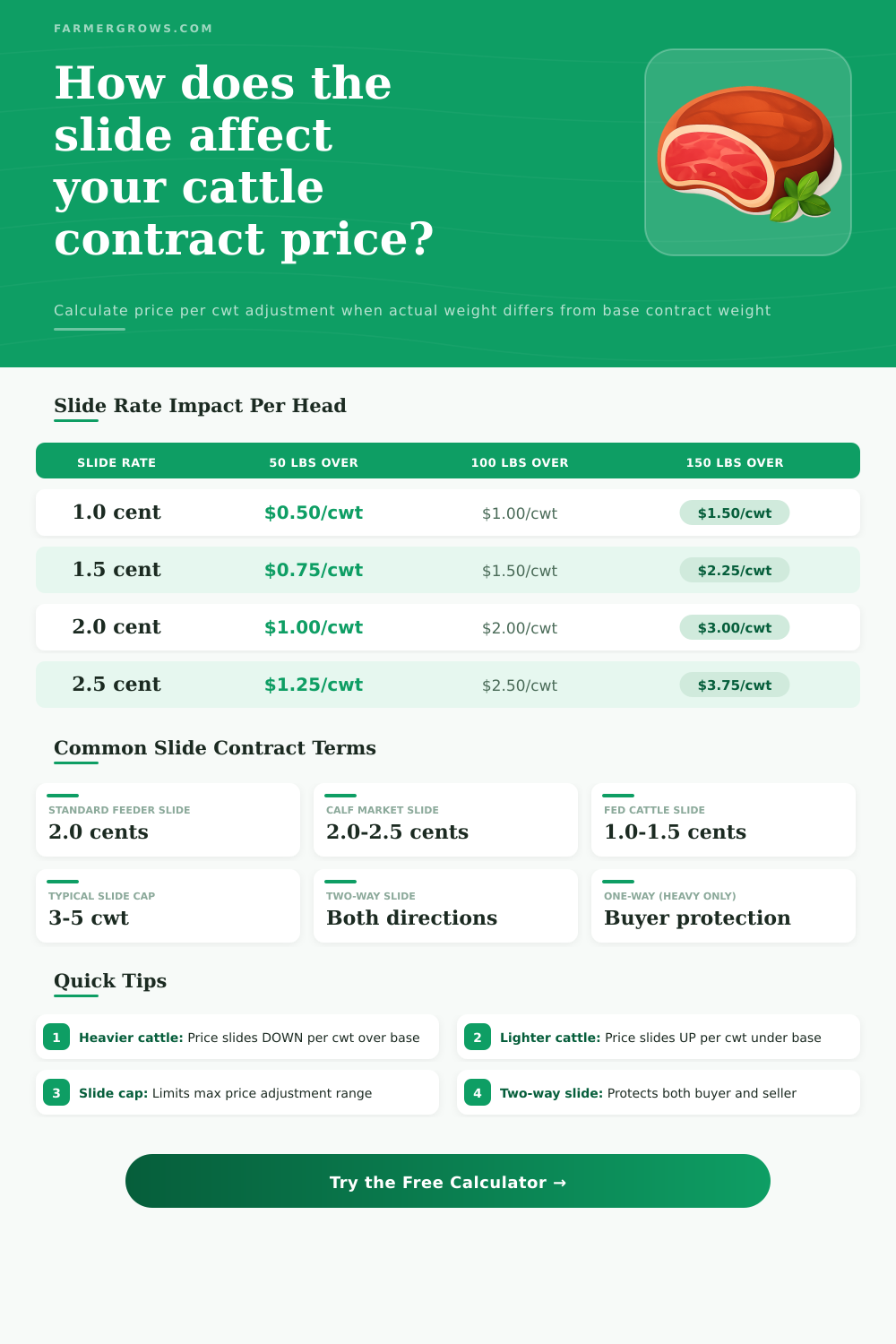
A cattle slide is an important idea that affects the marketing of feeder cattle. Usually the price per pound of feeder cattle drops as the weight grows and you call that price slide Naturally it happens that prices of cattle, commonly in dollars per hundredweight, drop when the weight of the animal climbs.
Sellers of cattle before delivery must estimate the future weight of the cattle. Because of that the sale price usually adjusts because real delivery weights differ from estimates. “Up slide” and “down slide” help set fair market value.
Cattle Slide: How Weight Affects Price
Slide is a price correction that you apply usually when the average weight per head passes a limit in the contract. It is very hard to predict the precise weight during delivery, especially if you market cattle beofre.
Not only do prices range according to weight of cattle, but also the size of the price change depends on that weight. Price slides measure the amount of price change because of weight differences from base. They indeed lower the price when cattle pass the base weight of the contract.
Here is a sample of how it works. Assume that the pay weight is 800 pounds with a price of $240.00 per hundredweight, so $1,920 per head. If cattle weighed 850 pounds, the price drops because of 50 pounds above the base.
With an $8.00 per hundredweight slide, it would drop by $4.00 per hundredweight.
A producer needs to understand price differences between weights and classes of cattle, together with knowledge about expected weight gain. For instance, assume that some yearling steers are contracted in June for August delivery at $0.80 per pound. They weighed 730 pounds on sale day, and you expect 850 pounds after a 3 percent shrink August 1st with 2 pounds gain per day.
The contract requires average shrunk weight of 850 pounds with a $4 per hundredweight slide and a 10-pound limit up of base weights before discounts enter.
There is even a Cattle Slide Calculator as a separate tool for estimating the final price of cattle according to weight and slide data. It counts price and weight stops. Cattle producers that well understand the price slide will be able to market their livestock more effectively, especially as the custom for lighter cattle seemstobefading.