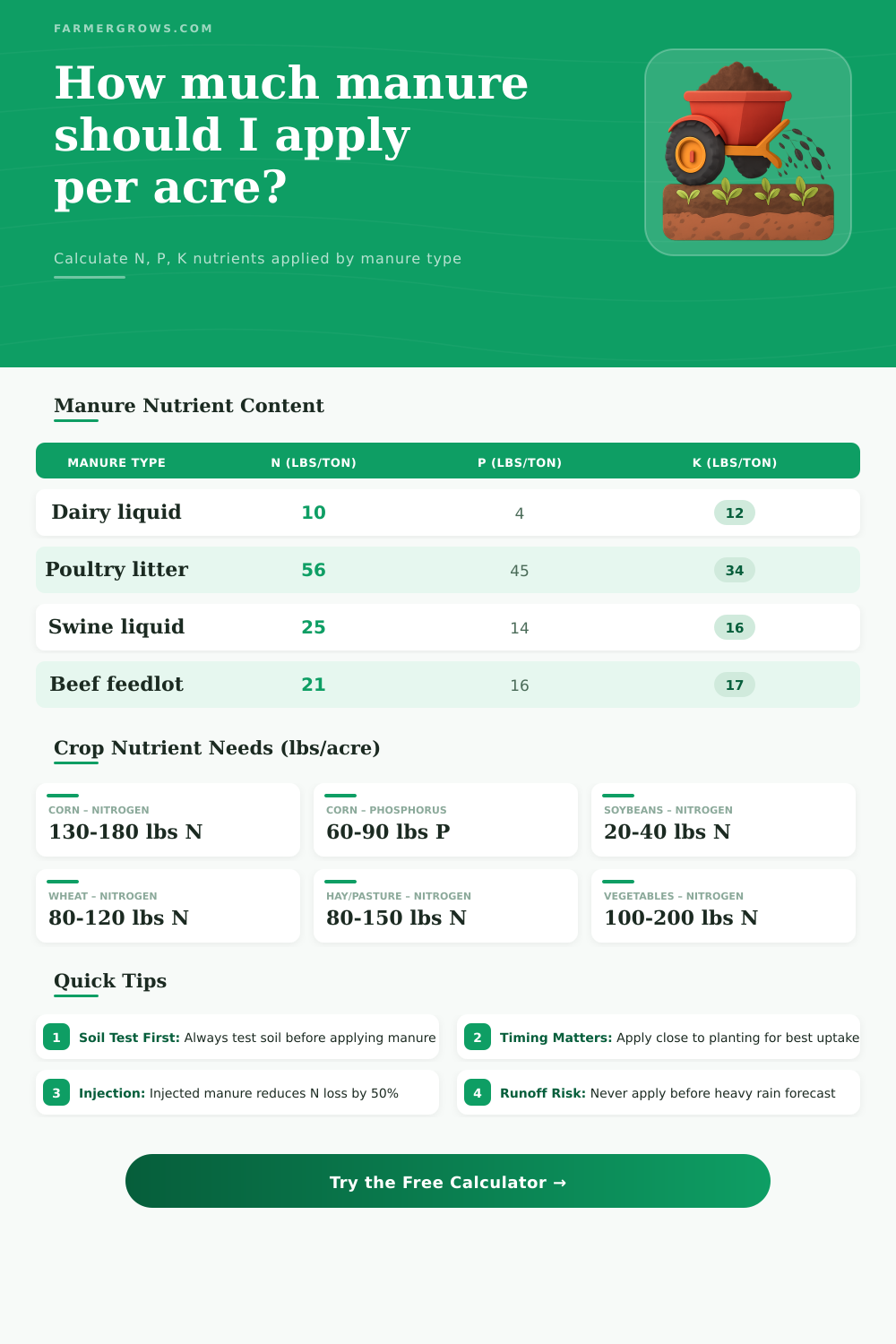
💩 Manure Application Rate Calculator
Calculate nutrients applied and compare to crop needs for any manure type and field size
| Crop | Nitrogen (N) | Phosphorus (P) | Potassium (K) |
|---|---|---|---|
| Corn | 130-180 lbs | 60-90 lbs | 100-150 lbs |
| Soybeans | 20-40 lbs | 40-60 lbs | 80-120 lbs |
| Wheat | 80-120 lbs | 40-60 lbs | 60-100 lbs |
| Hay/Pasture | 80-150 lbs | 30-50 lbs | 100-160 lbs |
| Vegetables | 100-200 lbs | 60-100 lbs | 80-150 lbs |
| Manure Type | Typical Rate | Method | Notes |
|---|---|---|---|
| Dairy liquid | 5,000-8,000 gal/acre | Injected or broadcast | High water content, quick uptake |
| Dairy solid | 5-8 tons/acre | Broadcast + incorporate | Good for fall application |
| Beef feedlot | 4-6 tons/acre | Broadcast spreader | High P, rotate fields regularly |
| Swine liquid | 3,000-6,000 gal/acre | Injected preferred | High N, inject to reduce odor |
| Poultry litter | 1-3 tons/acre | Broadcast spreader | Very high N & P, use sparingly |
| Horse manure | 4-8 tons/acre | Broadcast + till | Often contains weed seeds |
| Sheep manure | 3-5 tons/acre | Broadcast spreader | Good balanced nutrient profile |
Get the right manure application rate as one of the most important things that farmer or gardener can do. For plants over-fertilising is as bad as too little and using more fertiliser than needed costs a lot and wastes resources. Every label of commercial fertiliser points the application rate for a certain area and the frequency of use, when and how often you should use it in the garden
To set the manure application rate, you first estimate the amount of nutrients, especially nitrogen and phosphorus, that the crop will use during the year. Searching online “crop nutrient uptake” or “crop nutrient removal” with the name of the crop and region, you find right values. When the nutrient needs are clear, you choose a manure application rate that meets them while you think about extra soil nutrients or improvement of soil.
How to Apply the Right Amount of Manure
Usually agronomic rates base on nitrogen need and phosphorus removal.
Manure application rates depend on soil analyses, manure analyses, time and way of application and weather conditions. Traditionally you based them on nitrogen, and commonly you suggest 30 tons each acre yearly. It is better to analyze the manure itself than estimate, because of differences between farms.
Send manure samples to good laboratories to check the total nitrogen, phosphorus and potassium. Application rates are calculated more simply if the analysis is given as “as received”.
For instance, if a crop absorbs 210 pounds of nitrogen each acre, you can apply manure in 210 pounds of available nitrogen each acre. When manure rich in phosphorus is available, use a phosphorus-based manure application rate, it makes more sense. Continuous applications can build up phosphorus in soil, so soil tests measure those levels.
Corn requires the most nitrogen from manure, 92 pounds each acre, followed by cotton, wheat, barley, oats, bean and peanut. Cotton leads for phosphorus at 37 pounds each acre, corn leads for potassium at 59 pounds each acre.
Application rates for manure spreaders usually are in tons each acre or gallons each acre. Because liquid manure is described for 1,000 gallons, you multiply the rate by 1,000. Slurry manure is applied in 7,000 to 30,000 gallons each acre.
With hose application many factors affect the rate in the field, as tractor speed, pressure and loss from hoses. Calibrating the machine, you can well match the dose to nutrient needs of the field according to a nutrient management plan.
Chicken manure has a lot of available nitrogen and can burn roots. Treat it as fertiliser, not a soil improver. One guide is 250 grams each square metre before planting.
Knowing the manure amount for every field helps to track nutrients and estimate impact on crop yield.