🐄 Dairy Cattle Nutrition Calculator
Calculate daily dry matter intake, nutrient requirements & feed amounts for your dairy herd
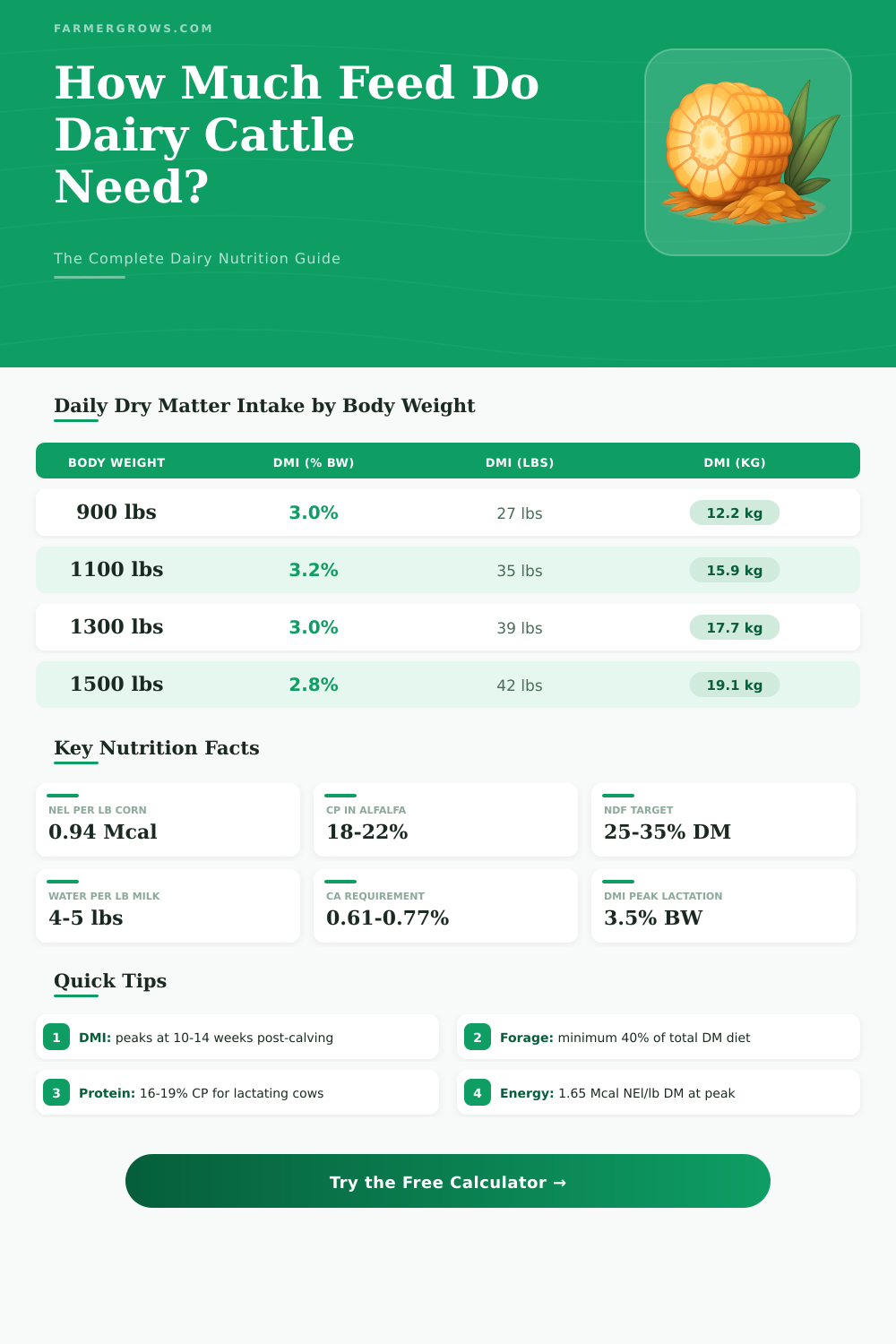
| Lactation Stage | DMI (% BW) | NEl (Mcal/day) | CP (% DM) | Ca (% DM) | P (% DM) |
|---|---|---|---|---|---|
| Fresh (0-3 wks) | 2.5-3.0% | 28-35 | 19% | 0.77% | 0.40% |
| Peak (4-14 wks) | 3.0-3.5% | 38-45 | 18% | 0.73% | 0.38% |
| Mid (15-30 wks) | 2.8-3.2% | 30-38 | 16% | 0.63% | 0.34% |
| Late (31-44 wks) | 2.5-2.8% | 24-30 | 15% | 0.61% | 0.32% |
| Dry Cow (far-off) | 1.8-2.0% | 14-16 | 12% | 0.44% | 0.24% |
| Dry Cow (close-up) | 1.5-1.8% | 16-18 | 14% | 0.44% | 0.24% |
| Bred Heifer | 2.0-2.5% | 16-22 | 13% | 0.50% | 0.30% |
| Milk (lbs/day) | Milk (kg/day) | NEl for Maint. (Mcal) | NEl for Milk (Mcal) | Total NEl (Mcal) | Approx. DMI (lbs) |
|---|---|---|---|---|---|
| 40 lbs | 18.1 kg | 12.0 | 12.9 | 24.9 | 28-32 |
| 60 lbs | 27.2 kg | 12.0 | 19.4 | 31.4 | 33-38 |
| 80 lbs | 36.3 kg | 14.0 | 25.9 | 39.9 | 40-46 |
| 100 lbs | 45.4 kg | 14.0 | 32.4 | 46.4 | 46-54 |
| 120 lbs | 54.4 kg | 16.0 | 38.9 | 54.9 | 54-64 |
| Forage Type | DM (%) | CP (% DM) | NEl (Mcal/lb DM) | NDF (% DM) | As-Fed lbs per lb DM |
|---|---|---|---|---|---|
| Alfalfa Hay (HQ) | 90% | 20% | 0.62 | 35% | 1.11 |
| Corn Silage | 35% | 9% | 0.72 | 45% | 2.86 |
| Mixed Grass/Legume Hay | 88% | 16% | 0.58 | 42% | 1.14 |
| Grass Hay | 87% | 10% | 0.52 | 60% | 1.15 |
| Wheat Straw | 91% | 4% | 0.38 | 75% | 1.10 |
| Cottonseed Hulls | 91% | 4% | 0.42 | 80% | 1.10 |
| Sorghum Silage | 30% | 8% | 0.55 | 55% | 3.33 |
| Ryegrass Silage | 25% | 17% | 0.60 | 48% | 4.00 |
| Milk Production | Water Need (gallons/day) | Water Need (liters/day) | Key Factor |
|---|---|---|---|
| 40 lbs/day | 25-30 gal | 95-114 L | 4-5 lbs water per lb milk |
| 60 lbs/day | 30-40 gal | 114-151 L | 4-5 lbs water per lb milk |
| 80 lbs/day | 40-52 gal | 151-197 L | 4-5 lbs water per lb milk |
| 100 lbs/day | 50-65 gal | 189-246 L | 4-5 lbs water per lb milk |
| Dry Cow | 18-25 gal | 68-95 L | Maintenance only |
Cattle feed is important for anyone that keeps beef or dairy animals. Cattle require water, energy, proteins, minerals and vitamins to live and produce. They require protein, carbohydrates, fats, vitamins, minerals and water.
Of all nutrients they require the most water daily
Cattle Feeding Basics
As ruminants, cattle have various microbial communities in the rumen. They must receive energy, proteins, water, vitamins and minerals in right amounts for good nutrition. Cows belong to the group of plant-eaters called foregut fermenters, which means that germs break down the raw plant material at the start of the digestive system.
Nutritional needs depend on climate, age of the animal, weight and production stage. Calves, young cattle or lactating cows all require differnet things. Disease and weather can alter the nutritional needs.
To estimate energy in a day, you use megacalories, because a calorie is too small unit for cattle nutrition.
Cattle production cycle is split into four phases according to nutritional needs: postpartum and pre-pregnancy, pregnant and lactating, gestation and pre-calving. Maximum needs come during the critical postpartum and pre-pregnancy time. If calving happens when grass does not suffice, a nutritional hole can happen, that you must fill to preserve physical state between calving and breeding.
Nutrition forms a big part of the total costs thus can seriously affect the phenotype of the animal. Cattle that commonly eat polluted feed eat less, grow less and give lower incomes to producers.
Good feeding programs must base on basic principles. You estimate nutritional needs, feed intake and wanted weight gain for every kind of livestock. Testing of feeds on the farm helps a lot.
Later you choose supplements like proteins, minerals, additives and vitamins. Finally you mix the supplies for a total answer.
Grain fed cattle pass two to six months in a feedlot, where they eat a mix of grains and grass. The target is that they grow big and get the right fat. Too thick bodies receive a low grade.
Corn silage works, because it uses the whole plant and is easy to add other ingredients for nutritional balance. Supplements improve the overall value of grass, correct gaps and help digestion. Records about heifer growth and supplements for young cattle are essential in a cow-calfherd.